

Archive position — measured, not model output
0 likes on Devpost
2,263 of the 7,850 archived projects have more likes, and 5,587 share exactly 0 — so this project's #3,830 place in the like-ranked listing is a tie-break inside that group, not a ranking.
Projects (log scale)
Likes on Devpost. ▲ marks this project's group.
Show the figures
| Likes | Projects | Share of archive |
|---|---|---|
| 0 | 5,587 | 71.2% |
| 1 | 1,758 | 22.4% |
| 2 | 284 | 3.6% |
| 3–4 | 132 | 1.7% |
| 5–9 | 75 | 1.0% |
| 10+ | 14 | 0.2% |
 User Stories BotA demo video on every pull request
Get a demo video on every new feature
GitHub App that watches your pull requests and records a narrated, captioned demo.
Save time on demo prep and make informed decisions faster with a video walkthrough of every new feature.
Executive Summary
What the company appears to be
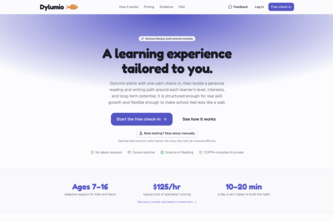
Dylumio is a self-reported personalized reading and writing platform for students in grades 2–10, built by a 15-year-old founder (Eli Albukerk). It claims to provide adaptive learning support using AI and structured literacy lessons, with an emphasis on dyslexia and broader reading/writing challenges. The product is described as a full-stack web app that includes adaptive placement, lesson progression, AI feedback, parent dashboards, and integration capabilities.
What changed
The project evolved from a hackathon demo to a functional website with mobile support, subscription infrastructure, and an extension approved for the Chrome Web Store — all within four days of development. The author states this was achieved through intensive effort over 14-hour workdays.
Single most important open question
Is there evidence that Dylumio has traction or early adoption from real users (students, parents, schools), or any validated learning outcomes? The description contains no data on user numbers, retention, usage frequency, or effectiveness metrics beyond the founder’s personal account and claims.
What The Product Actually Is
The description states that Dylumio is a personalized reading and writing platform for students in grades 2–10. It includes:
- An adaptive check-in to assess learner skills (reading, writing, spelling, comprehension, attention).
- A custom learning path based on the assessment.
- Structured literacy lessons, daily word games, AI feedback, parent progress reports, and interest-based course pathways.
- Integration with tools like Canvas, Google Classroom, IXL, and Khan Academy.
- A learning engine that combines placement results, lesson performance, interests, skill confidence, and imported education data.
It is built as a full-stack web app using technologies such as Next.js, Supabase, Stripe, Resend, and AI models for analysis and personalization. The AI layer is described as being used to interpret learner signals, generate feedback, summarize progress, and personalize recommendations — not to replace instruction.
Not evidenced
- Specific features or functionality beyond what the author describes.
- Any actual product usage data or user behavior insights.
- Whether the platform supports multiple languages or has been localized.
- The exact nature of “Subpaths” (e.g., how they are structured, whether they are fully implemented).
Positioning & Claim Evolution
The description states that Dylumio aims to "make learning feel less like a punishment and more like a system that understands the student." It positions itself as:
- A personalized learning engine, not just a remedial tool.
- Not only for dyslexia but for all students with reading/writing difficulties.
- A platform that supports both foundational skills and deeper, interest-based learning (e.g., climate systems, health biology).
- An alternative to traditional grade-level tracks, which the founder believes fail struggling learners.
The author frames Dylumio as a digital learning ecosystem that connects independent apps into a seamless experience — though it is unclear if this is fully realized or still conceptual.
Inference The positioning implies a shift from generic tools toward adaptive, student-centric support. However, the claim of being a "digital learning ecosystem" lacks evidence of integration with other platforms beyond early connector infrastructure.
Target Customer & ICP
The description states that Dylumio targets:
- Students in grades 2–10, particularly those with dyslexia or below-grade-level reading proficiency.
- Parents seeking support for their children’s learning.
- Schools or literacy programs looking to improve outcomes for struggling learners.
It also mentions a focus on students who fall through the cracks — those who are not served well by current educational systems and lack access to tutors or specialists.
Not evidenced
- Specific customer segments beyond general age ranges.
- Any data on how many students currently use the platform or have been reached.
- Whether the product is designed for teachers, administrators, or just parents/students.
- The exact demographics of target users (e.g., geographic, socioeconomic).
Business Model & Pricing Evidence
The description states that Dylumio includes:
- Subscription infrastructure.
- A parent dashboard, suggesting a model where parents pay for access.
- Integration with tools like Canvas, Google Classroom, IXL, and Khan Academy — implying possible B2B or institutional sales models.
There is no mention of pricing tiers, free trials, or monetization strategy beyond the existence of subscription infrastructure.
Not evidenced
- Any actual pricing information.
- Revenue streams (e.g., direct-to-consumer vs. school licensing).
- Customer acquisition cost or lifetime value.
- Whether the platform offers freemium or tiered access.
Technical & Delivery Signals
The project is built using:
- Next.js (frontend and backend)
- Supabase (authentication, learner profiles, progress data, privacy controls)
- Stripe (payment processing)
- Resend, Sentry, PostHog, OpenAI, Anthropic, Tailwind, TypeScript, Vercel
- AI models for feedback and personalization
The author notes challenges in:
- Making personalization deeply embedded rather than surface-level.
- Ensuring privacy compliance (e.g., COPPA).
- Balancing usability with depth of content.
They also mention that the app supports mobile, has a working extension approved by Chrome Web Store, and was developed rapidly over four days.
Inference The technical stack suggests a modern SaaS architecture. However, there is no evidence of scalability, performance metrics, or production deployment details beyond the rapid build process.
Traction & Maturity Signals
The description states:
- The platform went from demo to real website in four days, with mobile version and extension approval.
- It includes real learning engine, adaptive placement, structured curriculum, dashboards, progress tracking, subscription infrastructure, email flows, privacy exports, account deletion, and early connector infrastructure.
- A recent highlight was the approval of a Chrome extension.
There is no mention of:
- Actual users or customer base.
- Retention rates or usage frequency.
- Feedback from schools or educators.
- Any validation studies or efficacy data.
- Revenue or monetization activity.
Not evidenced
- Any real-world adoption or impact.
- Product-market fit or user engagement metrics.
- Evidence of a functioning business model beyond infrastructure.
Competitive Context
The description does not provide any information about competitors. It does not name similar platforms, nor does it describe how Dylumio differentiates itself in the edtech space.
Not evidenced
- Competitor landscape.
- Market positioning relative to existing tools (e.g., Khan Academy, IXL, Read&Write, etc.).
- Any differentiation strategy or unique value proposition beyond what is described.
Open Questions & Risks
Key concerns based on the self-reported description:
- Founder age and experience: The founder is 15 years old, which raises questions about operational maturity and long-term viability.
- Lack of traction or validation: No evidence of real users, revenue, or impact.
- Privacy compliance risks: Mention of COPPA and child data handling suggests high regulatory risk without clear evidence of compliance.
- AI implementation quality: The author notes early struggles with AI content generation, raising doubts about the maturity of AI integration.
- Unverified claims: Many statements are self-reported without corroboration (e.g., “15 million kids struggle with dyslexia”).
- Rapid development timeline: While impressive, a 4-day build suggests limited testing and potential scalability issues.
Inference The lack of independent verification, user data, or product validation makes it difficult to assess whether Dylumio is ready for commercial launch or institutional adoption.
Questions the description leaves open
- What specific learning outcomes have you observed from early users?
- How do you plan to ensure compliance with COPPA and other privacy regulations at scale?
- Can you provide evidence of how the AI personalization engine works in practice?
- Are there any schools or literacy programs currently testing Dylumio?
- What is your go-to-market strategy for reaching parents, educators, and institutions?
- How do you intend to differentiate from existing edtech tools like IXL, Khan Academy, or Read&Write?
- What are the key metrics you track to measure success or improvement in student learning?
- How do you plan to scale beyond a single developer?
Overall Assessment
Not evidenced
- No financials, revenue, or customer data.
- No indication of product-market fit or validated demand.
- No evidence of traction, user engagement, or impact.
Assessment This is a highly speculative project, built by a young founder with limited operational history. While the idea and execution show promise in concept, there is no evidence of commercial viability, traction, or measurable outcomes. The product appears to be in an early development stage, possibly pre-launch, with no verified users or monetization.
Confidence level Low This analysis is based entirely on self-reported information, which lacks corroboration or independent validation. Any assumptions about market readiness, user adoption, or business sustainability must be treated as speculative.
User Stories BotA demo video on every pull request
Get a demo video on every new feature
GitHub App that watches your pull requests and records a narrated, captioned demo.
Save time on demo prep and make informed decisions faster with a video walkthrough of every new feature.
Source
Submitted to the OpenAI 2026 hackathon on Devpost. Project home on Devpost. Back to the full gallery on Devpost.
This competitive analysis was produced by top-founders.com (opens in a new tab)
Generated by a language model from this project's public Devpost page — its tagline, the author's own write-up and any built-with tags listed there — as captured in August 2026. Short quotations are the author's words. It is an opinion on the idea as a business, not on the people behind it, and it reflects the description as published then. If the project has moved on, request a correction below. The analysis is not independent research and contains no verified traction, revenue or customer data.
An independent guide by KFG International LLC — not affiliated with, endorsed by, or connected to Devpost or OpenAI.