

Archive position — measured, not model output
0 likes on Devpost
2,263 of the 7,850 archived projects have more likes, and 5,587 share exactly 0 — so this project's #7,756 place in the like-ranked listing is a tie-break inside that group, not a ranking.
Projects (log scale)
Likes on Devpost. ▲ marks this project's group.
Show the figures
| Likes | Projects | Share of archive |
|---|---|---|
| 0 | 5,587 | 71.2% |
| 1 | 1,758 | 22.4% |
| 2 | 284 | 3.6% |
| 3–4 | 132 | 1.7% |
| 5–9 | 75 | 1.0% |
| 10+ | 14 | 0.2% |
 User Stories BotA demo video on every pull request
Get a demo video on every new feature
GitHub App that watches your pull requests and records a narrated, captioned demo.
Save time on demo prep and make informed decisions faster with a video walkthrough of every new feature.
Executive Summary
What the company appears to be
YaMecenes is a self-reported project-discovery and contribution platform designed to connect project owners with potential patrons, particularly in regions with limited access to technology, trusted networks, and flexible payment infrastructure. It positions itself as a bridge between creators and supporters, emphasizing transparency, governance, and community trust.
What changed
The project evolved from an initial focus on Congolese and Christian communities into a secular, international platform while retaining its African inspiration and commitment to community trust. The platform supports three contribution models: direct, partner-managed, or mixed. It uses AI tools (GPT and Codex) in product design and implementation.
The single most important open question
Is there evidence of real-world usage, traction, or active fundraising appeals beyond the demonstration data? The description states that all demonstration projects are fictional test data and not active calls for contributions.
What The Product Actually Is
The description states that YaMecenes is a project-discovery and contribution platform with French and English interface content. It allows project owners to submit initiatives through an access-code-controlled process, including details such as:
- Objective
- Description
- Location
- Category
- Responsible organisation
- Funding target
- Currency
- Milestones
- Expected impact
- Autonomy plan
The platform supports three contribution approaches:
- Direct contributions supplied by the project owner.
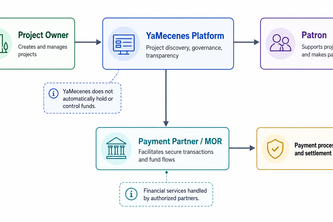
- Contributions processed through an independent payment partner or aggregator.
- A mixed model combining both.
It does not present itself as receiving, holding, safeguarding, or controlling contributed funds.
Key technical elements
- Built with Next.js, React, TypeScript, Prisma, PostgreSQL, Tailwind CSS
- Uses GPT models and Codex for product development and implementation
- Supports bilingual (French/English) interface content
- Includes administrative authentication, access-code generation, and moderation tools
Not evidenced No revenue, customer base, or actual funding data. No evidence of live users or active fundraising appeals.
Positioning & Claim Evolution
The description states that YaMecenes is inspired by the African concept of a "patron" — a respected person who recognizes potential and helps an initiative grow. It aims to help initiatives explain their purpose clearly while giving patrons better visibility into project ownership, objectives, milestones, and contribution pathways.
It explicitly states it is not building a bank, fintech company, payment institution, or digital wallet. Instead, it positions itself as a bridge between project owners, patrons, communities, and qualified independent payment partners, separating discovery and governance from payment execution.
The platform was initially centered on Congolese and Christian communities but evolved into an international and secular platform while maintaining its African inspiration and focus on community trust.
Inference The positioning appears to be driven by a desire to avoid financial regulation, aligning with the stated goal of not acting as a custodian or payment institution. This suggests a deliberate architectural choice to remain outside regulated financial services.
Target Customer & ICP
The description states that YaMecenes is designed for:
- Creators
- Researchers
- Artists
- Entrepreneurs
- Organisations
- Families
- Communities
It supports projects such as:
- Creative and cultural initiatives
- Research and innovation
- Entrepreneurship and local production
- Education and professional training
- Community infrastructure
- Health and carefully documented emergency initiatives
- Projects promoting employment and sustainable autonomy
Not evidenced No specific customer segmentation, personas, or user behavior data. No evidence of actual users or target market size.
Business Model & Pricing Evidence
The description states that YaMecenes does not present itself as receiving, holding, safeguarding, or controlling contributed funds. It is designed to provide technology, project discovery, and governance support — not financial services.
It supports three contribution models:
- Direct contributions
- Partner-managed contributions
- Mixed model
Payment methods are intended to connect to specialised independent partners, with contributions counted only after provider confirmation.
Not evidenced No pricing structure, monetization strategy, or revenue model described. No evidence of fees, subscriptions, or transaction charges.
Technical & Delivery Signals
The platform is built using:
- Next.js
- React
- TypeScript
- Prisma
- PostgreSQL
- Tailwind CSS
- Vercel-compatible deployment architecture
- Neon-compatible database infrastructure
It uses GPT models and Codex for:
- Product vision clarification
- Positioning and terminology
- Governance principles
- Implementation (data model, workflows, interfaces)
- Debugging, validation, and testing
The current version includes:
- Public project discovery
- Project-detail views
- Public project statistics
- Access-code-controlled submissions
- Project targets and milestones
- Administrative authentication
- Project moderation tools
- Contribution records
- Payment-state handling
- Backend payout workflows
- Multisignature approval structures
Not evidenced No evidence of production deployment, scalability metrics, or performance data. No mention of security reviews or compliance measures.
Traction & Maturity Signals
The description states that the core prototype is implemented, and its production build passes successfully.
Demonstration notice: All projects, organisations, amounts, and payment details shown in the demonstration are fictional test data. They do not constitute active fundraising appeals.
The current version includes:
- Public project discovery
- Project-detail views
- Access-code-controlled submissions
- Administrative authentication
- Contribution records
- Payment-state handling
Some operational screens remain French-first, so bilingual experience is incomplete.
Payment-provider integrations are currently demonstration adapters. No payment provider is presented as active until official agreements, credentials, security review, and sandbox testing are complete.
Not evidenced No real-world usage, user engagement, or active fundraising data. No evidence of customer acquisition, retention, or monetization.
Competitive Context
The description does not mention specific competitors. It positions itself as a platform that bridges project owners and patrons, with a focus on transparency, governance, and community trust, particularly in regions with limited access to financial infrastructure.
It explicitly avoids being a financial service provider, which may differentiate it from platforms like Kickstarter or GoFundMe, which are more directly involved in handling funds.
Not evidenced No competitive analysis, market sizing, or positioning relative to existing platforms. No evidence of market demand or competitive differentiation beyond self-stated claims.
Open Questions & Risks
- No real-world traction or revenue: All projects and data shown are fictional test data.
- Unverified payment integrations: Payment-provider integrations are demonstration-only, with no active payments.
- Self-reported positioning without external validation: The platform’s claims about governance, transparency, and trust are unverified.
- Limited evidence of user adoption or engagement: No data on users, usage patterns, or feedback.
- AI dependency without clear human oversight: While AI was used in development, the description does not clarify how this impacts product direction or ethical boundaries.
- No monetization strategy: No indication of how the platform intends to generate revenue.
Questions the description leaves open
- What is the actual user base beyond the demonstration data?
- Are there any real-world partnerships with payment providers, and what are the timelines for activation?
- How does the platform ensure transparency and governance without financial control or custodial responsibilities?
- What is the plan to expand beyond the current demonstration projects and into active fundraising?
- How do you intend to scale beyond a single developer (team size: 1)?
- What are the legal and regulatory considerations around not being a payment institution, especially in international markets?
- How do you define and measure success for this platform?
Overall Assessment
Not evidenced:
No financial data, revenue, or customer traction to support an investment or partnership decision.
The description is self-reported, unverified, and lacks any evidence of real-world usage, active fundraising, or monetization. It describes a functional prototype but does not demonstrate product-market fit, user engagement, or commercial viability.
Confidence level: Low
This analysis is based entirely on the author’s own account, which is not independently verified. The platform appears to be in an early-stage prototype phase, with no evidence of traction or commercial activity beyond demonstration data.
User Stories BotA demo video on every pull request
Get a demo video on every new feature
GitHub App that watches your pull requests and records a narrated, captioned demo.
Save time on demo prep and make informed decisions faster with a video walkthrough of every new feature.
Source
Submitted to the OpenAI 2026 hackathon on Devpost. Project home on Devpost. Back to the full gallery on Devpost.
This competitive analysis was produced by top-founders.com (opens in a new tab)
Generated by a language model from this project's public Devpost page — its tagline, the author's own write-up and any built-with tags listed there — as captured in August 2026. Short quotations are the author's words. It is an opinion on the idea as a business, not on the people behind it, and it reflects the description as published then. If the project has moved on, request a correction below. The analysis is not independent research and contains no verified traction, revenue or customer data.
An independent guide by KFG International LLC — not affiliated with, endorsed by, or connected to Devpost or OpenAI.