

Archive position — measured, not model output
1 like on Devpost
505 of the 7,850 archived projects have more likes, and 1,758 share exactly 1 — so this project's #1,866 place in the like-ranked listing is a tie-break inside that group, not a ranking.
Projects (log scale)
Likes on Devpost. ▲ marks this project's group.
Show the figures
| Likes | Projects | Share of archive |
|---|---|---|
| 0 | 5,587 | 71.2% |
| 1 | 1,758 | 22.4% |
| 2 | 284 | 3.6% |
| 3–4 | 132 | 1.7% |
| 5–9 | 75 | 1.0% |
| 10+ | 14 | 0.2% |
 User Stories BotA demo video on every pull request
Get a demo video on every new feature
GitHub App that watches your pull requests and records a narrated, captioned demo.
Save time on demo prep and make informed decisions faster with a video walkthrough of every new feature.
Executive Summary
What the company appears to be
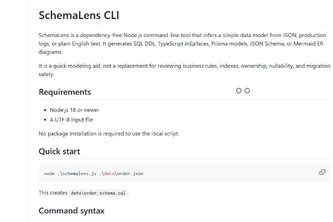
SchemaLens is a self-reported Node.js CLI tool that infers data models from JSON, log files, or plain English text, outputting structured schema formats like SQL, TypeScript, Prisma, JSON Schema, and Mermaid diagrams. It was built as a dependency-free command-line application by one developer (Nestor Campos) for use in local development environments.
What changed
The project is presented as a hackathon submission with no evidence of prior existence or commercial traction. It describes an early-stage tool that supports schema inference from multiple input types and formats, with extensible vocabulary support for domain-specific terms.
Single most important open question
Is there any evidence of actual usage, adoption, or feedback from developers beyond the author's own claims?
Note: This analysis is based entirely on self-reported information provided by the author. No third-party verification, revenue data, customer base, or traction metrics are available. All findings reflect only what was stated in the project description.
What The Product Actually Is
- The description states that SchemaLens is a "dependency-free Node.js CLI" tool.
- It reads JSON files, log files, or plain English text and infers entities, fields, basic types, and simple relationships.
- It generates outputs in PostgreSQL-style SQL, TypeScript interfaces, Prisma models, JSON Schema, and Mermaid ER diagrams.
- The tool automatically detects input format and writes results next to the input file unless an output path is specified.
- For plain English input, it uses a built-in vocabulary of common product, commerce, support, and operations concepts.
- Users can extend this vocabulary with local JSON plugin files for domain-specific terms (e.g., healthcare, finance, logistics).
- The tool was built using Codex with GPT-5.6 and Node.js.
Inference: The tool appears to be a developer utility designed to accelerate schema creation from unstructured or semi-structured data sources.
Positioning & Claim Evolution
- The description states that SchemaLens was inspired by the idea of giving developers a fast, local starting point when working with unfamiliar systems.
- It aims to reduce friction in schema development by allowing users to paste available data and receive an editable schema instead of a blank migration file.
- The author emphasizes that it is intended as a "first draft" — not a final or authoritative model.
- It supports multiple output formats, each tailored for specific use cases (e.g., SQL for constraints, TypeScript for developer ergonomics).
- The tool is positioned to help developers move from messy evidence to a trustworthy schema faster.
Claim vs Fact: These are self-reported claims about intent and positioning. There is no evidence of actual user feedback or market validation.
Target Customer & ICP
- The target audience appears to be developers working with unfamiliar systems, particularly those who need to quickly generate data models from JSON samples, logs, or textual descriptions.
- It targets developers in environments where schema design is a time-consuming step and where local tools are preferred over cloud-based services.
- The tool supports domain-specific vocabularies, suggesting it may appeal to teams working in specialized industries such as healthcare or finance.
Not evidenced: No explicit identification of customer personas, user segments, or specific industry verticals beyond mention of healthcare and logistics examples.
Business Model & Pricing Evidence
- The description states that SchemaLens runs locally with Node.js and does not require an API key, cloud service, or dependency installation.
- It is described as a command-line tool without any mention of monetization, subscriptions, or pricing tiers.
- There is no indication of whether it will be offered as open-source, freemium, or paid software.
Not evidenced: No information on business model, pricing strategy, monetization plans, or revenue streams.
Technical & Delivery Signals
- Built with Node.js and Codex with GPT-5.6.
- Uses a shared internal data model to represent entities and fields before rendering into various output formats.
- Supports automatic detection of input format (JSON, logs, plain text).
- Vocabulary plugin system allows users to extend functionality without modifying source code.
- Includes example healthcare vocabulary and text fixtures for demonstration purposes.
Inference: The tool is lightweight, modular, and extensible, suggesting a developer-focused approach with minimal runtime dependencies.
Traction & Maturity Signals
- Submitted to the OpenAI 2026 hackathon on Devpost.
- Developed by one person (Nestor Campos).
- No evidence of revenue, customers, or adoption beyond the author’s own account.
- No mention of downloads, usage statistics, or community engagement.
Not evidenced: No signs of traction, user base, or product maturity beyond its initial development stage.
Competitive Context
- The description does not reference existing tools in the schema inference space.
- It is positioned as a local CLI tool that avoids cloud dependencies and API keys.
- It supports multiple output formats (SQL, TypeScript, Prisma, JSON Schema, Mermaid), which may differentiate it from simpler schema generators.
Not evidenced: No competitive landscape analysis or comparison to existing tools in the market.
Open Questions & Risks
- The tool is presented as a hackathon submission with no prior history or commercial traction.
- It relies heavily on AI-assisted development (Codex + GPT-5.6), which may raise concerns about scalability, consistency, and long-term maintainability.
- There is no evidence of real-world usage or feedback from developers beyond the author’s own claims.
- The tool is dependency-free but lacks any indication of testing, documentation quality, or robustness in production environments.
Inference: Risk of limited adoption due to lack of proven utility and absence of a clear go-to-market strategy.
Questions the description leaves open
- What specific problems are developers facing that SchemaLens solves?
- How many developers have tried the tool, and what feedback have they given?
- Are there any plans for monetization or commercialization beyond its current form?
- Has the tool been tested in real-world development workflows?
- What is the long-term roadmap for improving accuracy and inference capabilities?
- Is there a plan to support more input formats (e.g., CSV, API specs)?
- How does SchemaLens handle ambiguity in plain English inputs?
Overall Assessment
- The project is described as a hackathon submission with no evidence of traction or commercial viability.
- It is presented as a developer utility that may have potential but lacks any demonstration of real-world impact or adoption.
- There are no signs of revenue, customers, or product-market fit beyond the author’s own claims.
Assessment: Not ready for investment or partnership at this stage. Requires further validation through user feedback, market testing, and evidence of traction before considering deeper due diligence.
User Stories BotA demo video on every pull request
Get a demo video on every new feature
GitHub App that watches your pull requests and records a narrated, captioned demo.
Save time on demo prep and make informed decisions faster with a video walkthrough of every new feature.
Source
Submitted to the OpenAI 2026 hackathon on Devpost. Project home on Devpost. Back to the full gallery on Devpost.
This competitive analysis was produced by top-founders.com (opens in a new tab)
Generated by a language model from this project's public Devpost page — its tagline, the author's own write-up and any built-with tags listed there — as captured in August 2026. Short quotations are the author's words. It is an opinion on the idea as a business, not on the people behind it, and it reflects the description as published then. If the project has moved on, request a correction below. The analysis is not independent research and contains no verified traction, revenue or customer data.
An independent guide by KFG International LLC — not affiliated with, endorsed by, or connected to Devpost or OpenAI.