

Archive position — measured, not model output
0 likes on Devpost
2,263 of the 7,850 archived projects have more likes, and 5,587 share exactly 0 — so this project's #5,792 place in the like-ranked listing is a tie-break inside that group, not a ranking.
Projects (log scale)
Likes on Devpost. ▲ marks this project's group.
Show the figures
| Likes | Projects | Share of archive |
|---|---|---|
| 0 | 5,587 | 71.2% |
| 1 | 1,758 | 22.4% |
| 2 | 284 | 3.6% |
| 3–4 | 132 | 1.7% |
| 5–9 | 75 | 1.0% |
| 10+ | 14 | 0.2% |
 User Stories BotA demo video on every pull request
Get a demo video on every new feature
GitHub App that watches your pull requests and records a narrated, captioned demo.
Save time on demo prep and make informed decisions faster with a video walkthrough of every new feature.
Executive Summary
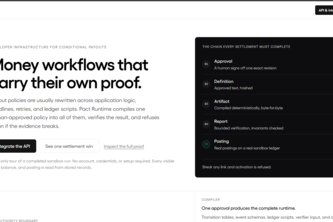
What the company appears to be: Pact Runtime is a self-reported system that converts payout policies into structured workflows, bounded verification artifacts, and ledger transactions. The author describes it as a tool for making payout policy chains inspectable, verifiable, and replay-safe.
What changed: The project was built as part of an OpenAI 2026 hackathon submission. It is described as a monorepo with TypeScript/Node.js components, PostgreSQL and Formance Ledger integration, and GPT-5.6 assistance in policy interpretation.
Single most important open question: Is there any evidence that Pact Runtime has been used beyond the author's own development and demonstration?
Analysis basis: This is a self-reported project description from the author, submitted to the OpenAI 2026 hackathon on Devpost. No external verification or traction data is provided.
What The Product Actually Is
The description states that Pact Runtime:
- Turns payout policy into workflows that can be reviewed, verified, executed, and traced.
- Supports one explicit workflow family: marketplace milestone with funding, delivery, acceptance, seller/platform split, exact refund deadline, disputes, replay protection, and competing settlement commands.
- Follows a Define → Break → Prove process:
- Define: GPT-5.6 converts policy prose into structured, source-linked candidates; human approves one immutable candidate hash.
- Break: A bounded verifier explores compiled states and transitions, checks invariants, records counterexamples.
- Prove: Approved clauses can be traced through transition, money effect, Numscript, artifact manifest, verification report, and Formance Ledger postings.
The system is described as a TypeScript/Node.js monorepo using PostgreSQL and Formance Ledger. It includes:
- A canonicalizer for exact bytes used in structured-data hashes
- A compiler generating transition tables, event schemas, static Numscript programs, verifier input, traceability records, and manifests
- A Fastify API coordinating commands through PostgreSQL
- A separate scheduler capturing deadline work from a trusted clock
- A separate worker with write-capable Formance Ledger client
Claim: The system is described as deterministic, bounded, and replay-safe.
Evidence: Self-reported by author; no external validation or demonstration of actual use.
Positioning & Claim Evolution
The author states that Pact Runtime addresses two core questions engineers cannot easily answer:
- Did this payout follow the exact policy a human approved?
- Could a retry or race condition settle the same agreement twice?
It is positioned as a system that makes payout policy chains inspectable, verifiable, and replay-safe.
The project's positioning evolved from a hackathon submission to a demonstration of a structured approach to handling payout policies in marketplace systems, with emphasis on:
- Deterministic compilation
- Bounded verification
- Replay protection
- Ledger integration
Claim: The system is positioned as a tool for governance of ledger effects.
Evidence: Self-reported by author; no external validation or market positioning data.
Target Customer & ICP
The description states that Pact Runtime supports one explicit workflow family: marketplace milestone with funding, delivery, acceptance, seller/platform split, exact refund deadline, disputes, replay protection, and competing settlement commands.
It is described as a system for handling payout policies in marketplace systems, where the policy describes what should happen, while API handlers, scheduled jobs, retry logic, database code, and ledger scripts each implement part of it.
Claim: The target customer is marketplace platforms or systems managing payout policies.
Evidence: Self-reported by author; no external validation or customer data.
Business Model & Pricing Evidence
Not evidenced. The description does not state anything about pricing, monetization, or business model.
Claim: No information provided.
Evidence: Not evidenced.
Technical & Delivery Signals
The system is described as:
- A TypeScript/Node.js monorepo
- Using PostgreSQL and Formance Ledger
- Built with Codex for implementation, testing, integration, and adversarial review
- Using GPT-5.6 for policy interpretation (but not for approval or execution)
- Supporting deterministic compilation across clean processes
- Using canonical bytes for data representation
- Implementing durable outbox delivery to handle distributed transactions
- Including 439 fast tests and 124 integration tests
- Having a build record with 86 Codex implementation sessions
Claim: The system is technically robust, deterministic, and tested.
Evidence: Self-reported by author; no external validation or production deployment data.
Traction & Maturity Signals
Not evidenced. The description does not state anything about revenue, customers, adoption, or traction beyond the author's own development work.
Claim: No information provided.
Evidence: Not evidenced.
Competitive Context
Not evidenced. The description does not mention any competitors or competitive landscape.
Claim: No information provided.
Evidence: Not evidenced.
Open Questions & Risks
- No external validation: The system is described as a hackathon submission with no independent verification.
- Single-person team: Only one member listed (Muzahidul Islam Hadi).
- Unproven use beyond demo: No evidence of real-world application or adoption.
- GPT-5.6 dependency for interpretation only: The model is used for policy interpretation but not for execution, approval, or authorization.
- No production deployment: The system is described as a demonstration and testing framework, with no indication of being in production.
Inference: The lack of external validation, traction, and real-world use raises questions about the product's readiness for commercial application.
Evidence: Self-reported by author; no external validation or traction data.
Questions the description leaves open
- What is the actual business problem you are solving, and how does this solution address it?
- Have you tested Pact Runtime in any real-world environment beyond the demo?
- How do you plan to scale this system for production use?
- What are the key assumptions about GPT-5.6's behavior that could affect the system's reliability?
- Are there any specific regulatory or compliance considerations for handling financial transactions?
- How do you plan to integrate with existing payment providers and ledger systems?
- What is your roadmap for expanding beyond the current marketplace milestone workflow?
Inference: These questions aim to probe the practical application, scalability, and integration aspects of the system.
Evidence: Self-reported by author; no external validation or traction data.
Overall Assessment
Not evidenced. The description does not provide any information about funding rounds, valuations, or investment status.
Claim: No information provided.
Evidence: Not evidenced.
User Stories BotA demo video on every pull request
Get a demo video on every new feature
GitHub App that watches your pull requests and records a narrated, captioned demo.
Save time on demo prep and make informed decisions faster with a video walkthrough of every new feature.
Source
Submitted to the OpenAI 2026 hackathon on Devpost. Project home on Devpost. Back to the full gallery on Devpost.
This competitive analysis was produced by top-founders.com (opens in a new tab)
Generated by a language model from this project's public Devpost page — its tagline, the author's own write-up and any built-with tags listed there — as captured in August 2026. Short quotations are the author's words. It is an opinion on the idea as a business, not on the people behind it, and it reflects the description as published then. If the project has moved on, request a correction below. The analysis is not independent research and contains no verified traction, revenue or customer data.
An independent guide by KFG International LLC — not affiliated with, endorsed by, or connected to Devpost or OpenAI.