

Archive position — measured, not model output
0 likes on Devpost
2,263 of the 7,850 archived projects have more likes, and 5,587 share exactly 0 — so this project's #6,536 place in the like-ranked listing is a tie-break inside that group, not a ranking.
Projects (log scale)
Likes on Devpost. ▲ marks this project's group.
Show the figures
| Likes | Projects | Share of archive |
|---|---|---|
| 0 | 5,587 | 71.2% |
| 1 | 1,758 | 22.4% |
| 2 | 284 | 3.6% |
| 3–4 | 132 | 1.7% |
| 5–9 | 75 | 1.0% |
| 10+ | 14 | 0.2% |
 User Stories BotA demo video on every pull request
Get a demo video on every new feature
GitHub App that watches your pull requests and records a narrated, captioned demo.
Save time on demo prep and make informed decisions faster with a video walkthrough of every new feature.
Executive Summary
What the company appears to be
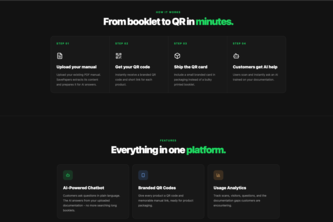
Save Papers is a self-reported platform that replaces printed product manuals with digital QR-linked documentation. It allows organizations to upload PDFs, generate public links and QR codes, and offers features such as AI-powered Q&A, multilingual support, analytics, and saved manual libraries.
What changed
The project was an idea at the start of a hackathon and became a working MVP within that timeframe. No prior traction or revenue is evidenced.
Single most important open question
Is there evidence of real-world demand for this product beyond the author’s own use case?
Analysis basis: This report is based solely on the self-reported project description provided by the author. It contains no external verification, archived data, or independent sources. All claims are treated as stated by the author and not proven.
What The Product Actually Is
The description states that Save Papers:
- Replaces printed product manuals with QR-linked digital documentation.
- Allows organizations to upload PDF manuals and generate public links and QR codes.
- Enables customers to scan the code to read, download, translate, or ask AI questions about the manual.
- Provides analytics on scans, unique visitors, product questions, and AI-generated findings.
- Supports saved manuals, multilingual translation, and AI-powered insights for improving documentation.
The platform uses NestJS (backend), Next.js (frontend), PostgreSQL, OpenAI integrations, and other technologies as declared by the author. It includes features like PDF processing, OCR fallback, embeddings, retrieval-augmented Q&A, and translation.
Inference: The product appears to be a digital manual hosting tool with AI-enhanced support and analytics capabilities. However, no evidence of actual deployment or user adoption exists.
Positioning & Claim Evolution
The author positions Save Papers as:
- A solution to reduce printing waste and save trees.
- A way to cut printing costs for organizations.
- A method to improve customer access to product information.
- An alternative to outdated or discarded printed manuals.
It is described as addressing both environmental and practical concerns — reducing paper use while improving accessibility and support workflows.
Claim vs. Fact: These are claims made by the author about intent and value proposition, not verified outcomes or traction.
Target Customer & ICP
The description states that Save Papers targets:
- Organizations that produce printed product manuals.
- Businesses looking to reduce printing costs and environmental impact.
- Companies seeking better customer support through digital documentation.
No specific industry, company size, or buyer persona is named. The author does not describe any segmentation strategy or customer acquisition approach.
Not evidenced: No evidence of defined target customer segments, personas, or go-to-market plans.
Business Model & Pricing Evidence
The description does not mention:
- Any pricing model.
- Revenue streams.
- Subscription tiers or usage-based billing.
- Monetization strategy beyond implied adoption by organizations.
Not evidenced: There is no evidence of a business model or pricing structure in the provided information.
Technical & Delivery Signals
The author states:
- The backend was built using NestJS, TypeORM, PostgreSQL, pgvector, and OpenAI integrations.
- The frontend uses Next.js, React, TypeScript, Tailwind CSS, and various UI libraries.
- Features include PDF processing, OCR fallback, embeddings, retrieval-augmented Q&A, translation, QR generation, analytics dashboards, saved manuals, and AI chat.
The author also mentions:
- Use of Codex (GPT-based) for development assistance.
- Development process involved modular code implementation, debugging, migration writing, and user experience validation.
Inference: The technical stack suggests a modern SaaS architecture with AI integration. However, no evidence of production deployment or scalability is presented.
Traction & Maturity Signals
The description states:
- Save Papers was an idea before the hackathon.
- It became a working MVP during the event.
- No mention of real users, customers, or revenue.
- No evidence of product usage metrics, retention, or growth.
Not evidenced: There is no evidence of traction, user adoption, or product maturity beyond the MVP stage.
Competitive Context
The description does not reference:
- Competitors in the digital manual or documentation space.
- Market analysis or differentiation strategy.
- Any existing solutions that Save Papers might compete with.
Not evidenced: No competitive landscape or positioning relative to other tools is described.
Open Questions & Risks
Key risks and open questions based on the description:
- The product exists only as an MVP built in a hackathon setting — no evidence of real-world testing or deployment.
- No revenue, customers, or monetization strategy are evident.
- The author is a single individual (1-person team) — raises questions about scalability and long-term execution.
- Heavy reliance on AI tools for development may indicate lack of deep technical ownership or control over product direction.
- Lack of clarity around how the platform would be adopted by organizations or whether it solves a widespread problem.
Inference: The lack of real-world usage, traction, or business model makes this a high-risk early-stage idea rather than a validated product.
Questions the description leaves open
- What specific industries or types of products are you targeting for adoption?
- How do you plan to monetize the platform? Are there any pricing models in mind?
- Have you tested the MVP with actual users or organizations?
- What is your strategy for scaling beyond a single developer?
- How do you intend to handle multilingual content while preserving document structure and visual hierarchy?
- What are the key challenges in deploying this platform at scale?
- Do you have any partnerships or early adopters lined up?
Note: These questions aim to probe beyond self-reported claims into actual execution, traction, and scalability.
Overall Assessment
Based on the self-reported description:
- Save Papers is a conceptually sound idea with potential for solving real-world problems around printed documentation.
- However, there is no evidence of revenue, customers, or product-market fit beyond the MVP stage.
- The platform appears to be in very early development and lacks any demonstrated traction or commercial viability.
- The single-person team raises concerns about execution capacity and scalability.
Assessment: Not ready for investment or partnership at this time. This is an idea with promise but no evidence of real-world demand, adoption, or business model. Further validation through user testing, early customers, or product development would be required before considering deeper due diligence.
User Stories BotA demo video on every pull request
Get a demo video on every new feature
GitHub App that watches your pull requests and records a narrated, captioned demo.
Save time on demo prep and make informed decisions faster with a video walkthrough of every new feature.
Source
Submitted to the OpenAI 2026 hackathon on Devpost. Project home on Devpost. Back to the full gallery on Devpost.
This competitive analysis was produced by top-founders.com (opens in a new tab)
Generated by a language model from this project's public Devpost page — its tagline, the author's own write-up and any built-with tags listed there — as captured in August 2026. Short quotations are the author's words. It is an opinion on the idea as a business, not on the people behind it, and it reflects the description as published then. If the project has moved on, request a correction below. The analysis is not independent research and contains no verified traction, revenue or customer data.
An independent guide by KFG International LLC — not affiliated with, endorsed by, or connected to Devpost or OpenAI.