

Archive position — measured, not model output
1 like on Devpost
505 of the 7,850 archived projects have more likes, and 1,758 share exactly 1 — so this project's #649 place in the like-ranked listing is a tie-break inside that group, not a ranking.
Projects (log scale)
Likes on Devpost. ▲ marks this project's group.
Show the figures
| Likes | Projects | Share of archive |
|---|---|---|
| 0 | 5,587 | 71.2% |
| 1 | 1,758 | 22.4% |
| 2 | 284 | 3.6% |
| 3–4 | 132 | 1.7% |
| 5–9 | 75 | 1.0% |
| 10+ | 14 | 0.2% |
 User Stories BotA demo video on every pull request
Get a demo video on every new feature
GitHub App that watches your pull requests and records a narrated, captioned demo.
Save time on demo prep and make informed decisions faster with a video walkthrough of every new feature.
Executive Summary
What the company appears to be
AuthCompanion is a self-reported macOS tool suite designed to streamline authentication for GPG signing and sudo commands using Touch ID or Apple Watch. It consists of three independently installable Homebrew products: pinentry-companion, pam-companion, and AuthCompanion, which coordinates setup, health checks, recovery, and rollback.
What changed
The author reports building a complete suite from an initial idea during a hackathon, focusing on native macOS integration and security. The project was productized with CLI-first design, modular components, and careful attention to rollback behavior and privilege boundaries.
Single most important open question
Is there any evidence of adoption or usage beyond the single developer’s own testing? The description states no revenue, customers, or traction data are available — only self-reported claims about functionality and implementation.
What The Product Actually Is
The description states that AuthCompanion is a suite of three Homebrew-installable tools:
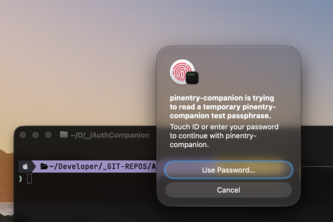
- pinentry-companion: Authenticates GPG signing via Touch ID, Apple Watch, or macOS account password fallback.
- pam-companion: Enables and manages Apple’s native
pam_tid.sointegration for sudo while preserving the administrator-password path. - AuthCompanion: Coordinates setup, health checks, recovery, and exact restoration across both components.
All three are described as real released products, not parts of a demo. They operate without daemons, cloud services, telemetry, or AI models. The tools are built using Swift, GnuPG, PAM, and macOS security frameworks.
Evidence
- Author states: “AuthCompanion is three small, independently installable Homebrew products.”
- Author states: “All three are real released products, not three parts that only work inside one demo.”
Inference The tools appear to be command-line utilities for macOS users who sign Git commits and use sudo regularly.
Positioning & Claim Evolution
The author positions AuthCompanion as a solution to the friction of managing separate authentication flows for GPG and sudo on macOS. It aims to make these processes feel “native” and seamless, avoiding shell scripts or complex edits that could break security settings.
Claims made
- The tool makes GPG signing and sudo authentication feel native.
- It avoids installation scripts that edit sensitive files without clear undo mechanisms.
- Setup is previewable and safe — no writes or prompts before review.
- Rollback is exact, with each component owning its own rollback record.
- No cloud service, telemetry, or AI model is included.
Evidence
- Author states: “I wanted both to feel native on a modern Mac.”
- Author states: “Each component owns its own rollback record.”
- Author states: “There is no daemon, cloud service, telemetry, privileged helper, or AI model in the shipped product.”
Inference The positioning reflects a niche but specific need among developers who use GPG and sudo frequently and value security and simplicity.
Target Customer & ICP
The description does not name specific customers or personas. However, it implies an audience of:
- Developers who sign Git commits with GPG.
- macOS users who regularly use
sudo. - Users seeking secure, native authentication experiences without complex setup.
Evidence
- Author states: “I sign my Git commits and use sudo constantly.”
- Author states: “A developer can install only GPG authentication, only PAM authentication, or the complete suite.”
Inference The target is likely a subset of macOS developers who prioritize security and automation in their workflows.
Business Model & Pricing Evidence
There is no evidence of pricing, monetization, or business model in the description. The project is self-reported as a personal hackathon effort with no indication of commercial intent or revenue streams.
Evidence
- Author states: “This project was submitted to the OpenAI 2026 hackathon.”
- Author states: “No revenue, customer or traction data is available beyond what they state.”
Inference The tool appears to be open-source or freeware, with no commercial structure evident.
Technical & Delivery Signals
The author describes a modular architecture built using Swift, Homebrew, GnuPG, PAM, and macOS security APIs. The tools are designed for CLI-first interaction, avoid privilege escalation unless necessary, and include detailed rollback logic.
Evidence
- Author states: “All three are real released products, not three parts that only work inside one demo.”
- Author states: “I made the consequential product and security decisions: keep the tools independent, stay CLI-first for the first release...”
- Author states: “The tools are built using Swift, GnuPG, PAM, and macOS security frameworks.”
Inference The delivery approach is technical and focused on reliability, with attention to privilege boundaries and recovery behavior.
Traction & Maturity Signals
There is no evidence of traction or adoption beyond the author’s own testing. No customers, usage metrics, or user feedback are reported.
Evidence
- Author states: “No revenue, customer or traction data is available beyond what they state.”
- Author states: “The first release is intentionally CLI-only.”
Inference The product has not yet reached a stage of widespread adoption or market validation.
Competitive Context
There are no mentions of competitors in the description. The author does not reference similar tools or platforms, nor does the project description provide any competitive positioning.
Evidence
- No mention of existing tools for GPG authentication or sudo management.
- No comparison to other macOS security utilities.
Inference The competitive landscape is unknown; this may be a unique niche solution or one that overlaps with existing but unmentioned tools.
Open Questions & Risks
Several risks and open questions are present based on the self-reported description:
- No third-party verification: The project is entirely self-reported, with no independent validation.
- Single developer team: Only one person is listed as part of the team.
- No commercial traction or revenue: No evidence of monetization or user base.
- Limited distribution method: Releases are ad hoc signed due to lack of Apple Developer Program membership.
- Unproven adoption: The author does not report any real-world usage beyond personal testing.
Evidence
- Author states: “No revenue, customer or traction data is available beyond what they state.”
- Author states: “I do not currently have a paid Apple Developer Program membership.”
Inference The lack of independent validation and commercial activity raises concerns about scalability and long-term viability.
Questions the description leaves open
- What is the actual adoption rate or usage beyond personal testing?
- How does the tool handle edge cases in PAM and GPG configurations that differ from your own setup?
- Are there plans to expand beyond CLI, such as GUI or integration with IDEs?
- Has the tool been tested across different macOS versions or hardware models?
- What is the long-term roadmap for security updates and compatibility?
Overall Assessment
Not evidenced.
There is no evidence of revenue, customer base, traction, or commercial viability to support an investment or partnership decision. The project appears to be a personal hackathon effort with no demonstrated market demand or business model.
The author states that the tool is not yet commercially viable and has no monetization strategy. It remains unclear whether this will evolve into a productized offering or remain a developer-side utility.
Confidence level Low — based entirely on self-reported claims, with no external data to validate or support any commercial potential.
User Stories BotA demo video on every pull request
Get a demo video on every new feature
GitHub App that watches your pull requests and records a narrated, captioned demo.
Save time on demo prep and make informed decisions faster with a video walkthrough of every new feature.
Source
Submitted to the OpenAI 2026 hackathon on Devpost. Project home on Devpost. Back to the full gallery on Devpost.
This competitive analysis was produced by top-founders.com (opens in a new tab)
Generated by a language model from this project's public Devpost page — its tagline, the author's own write-up and any built-with tags listed there — as captured in August 2026. Short quotations are the author's words. It is an opinion on the idea as a business, not on the people behind it, and it reflects the description as published then. If the project has moved on, request a correction below. The analysis is not independent research and contains no verified traction, revenue or customer data.
An independent guide by KFG International LLC — not affiliated with, endorsed by, or connected to Devpost or OpenAI.