

Archive position — measured, not model output
0 likes on Devpost
2,263 of the 7,850 archived projects have more likes, and 5,587 share exactly 0 — so this project's #2,612 place in the like-ranked listing is a tie-break inside that group, not a ranking.
Projects (log scale)
Likes on Devpost. ▲ marks this project's group.
Show the figures
| Likes | Projects | Share of archive |
|---|---|---|
| 0 | 5,587 | 71.2% |
| 1 | 1,758 | 22.4% |
| 2 | 284 | 3.6% |
| 3–4 | 132 | 1.7% |
| 5–9 | 75 | 1.0% |
| 10+ | 14 | 0.2% |
 User Stories BotA demo video on every pull request
Get a demo video on every new feature
GitHub App that watches your pull requests and records a narrated, captioned demo.
Save time on demo prep and make informed decisions faster with a video walkthrough of every new feature.
Executive Summary
Company: Algebrium
Tagline: Agent for Mathematics. Problem In. Insight Out.
Self-reported basis: The description is entirely from the author’s own submission to the OpenAI 2026 hackathon on Devpost. No external verification or historical data is available.
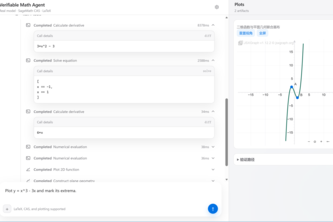
Algebrium appears to be a modular, open-source mathematics agent built as a proof-of-concept for solving and explaining mathematical problems using natural language. It integrates symbolic computation, visualization, and structured reasoning. The author describes it as an experimental system with no commercial traction, revenue, or customer base evidenced.
Key change: This is a self-reported project submitted to a hackathon; there is no indication of prior development, funding, or product-market fit beyond the author’s own description.
Single most important open question: Is this a prototype with potential for further development, or an experimental idea that has not yet demonstrated utility or scalability?
What The Product Actually Is
The description states that Algebrium is a modular mathematics-agent system designed to allow users to describe mathematical problems in natural language. It combines:
- Language-based reasoning
- Specialized mathematical tools and computer algebra capabilities
It can:
- Solve and explain mathematical problems
- Show intermediate derivation steps
- Integrate mathematical expressions
- Verify results symbolically
- Plot functions and surfaces
- Draw formal geometric objects such as circles
- Identify mistakes and explain their mathematical consequences
The system is structured around several layers:
- Natural-language interaction
- Subject-specific mathematical modules
- Tool contracts for computation and visualization
- Computer algebra verification
- Structured mathematical artifacts
- Interactive 2D and 3D rendering
Inference: The product is described as a modular architecture, not a finished product or commercial offering.
Positioning & Claim Evolution
The author positions Algebrium as an open-source mathematics agent that improves upon traditional chatbots by providing:
- Clear reasoning
- Reliable verification
- Accurate visualization
It aims to help users understand not only the final answer but also the process used to reach it.
Claim: The system is built to be more trustworthy and educational than typical AI tools for math.
Inference: This is a self-described educational or research tool, not a commercial product. There is no evidence of market positioning, branding, or user adoption beyond the author's own account.
Target Customer & ICP
The description does not state who the target customer is or what the ideal customer profile (ICP) might be.
Inference: Based on the stated capabilities, it may appeal to:
- Students learning math
- Educators seeking tools for explanation
- Researchers needing symbolic verification
But no explicit targeting or segmentation is described.
Business Model & Pricing Evidence
There is no evidence of a business model or pricing strategy in the description. The project is described as an open-source foundation, not a commercial product.
Inference: If this evolves into a product, it may be monetized through:
- Licensing
- SaaS subscriptions
- Educational partnerships
But no such plans are mentioned.
Technical & Delivery Signals
The system is built with the following technologies:
- c++
- css
- html
- javascript
- mdx
- typescript
It uses a modular architecture where:
- The core agent interprets user requests
- Specialized subject modules and mathematical tools are coordinated
- Computer algebra workloads are delegated to sandboxed CAS environments
- Mathematical objects are represented with structured data for accurate rendering and reuse
Inference: The system is designed with modularity, safety, and scalability in mind. It shows technical sophistication but no evidence of production deployment or delivery.
Traction & Maturity Signals
The description states that Algebrium was built as a hackathon project submitted to the OpenAI 2026 hackathon. There is no evidence of:
- Revenue
- Customers
- Users
- Product-market fit
- Prior funding or development stages
Inference: This is an early-stage prototype, not a mature product.
Competitive Context
The description does not mention any competitors or direct market context. It does not state how Algebrium compares to existing tools for solving math problems, such as Wolfram Alpha, Symbolab, or other AI math agents.
Inference: No competitive positioning or differentiation is evident from the description.
Open Questions & Risks
- No commercial traction: The project is a hackathon submission with no evidence of adoption or revenue.
- Open-source foundation: While this may attract developers, it does not indicate a clear path to monetization.
- Limited team size: Only one member (MEMZ-鱼子酱 Jiang) is listed, which may limit development velocity.
- Unproven utility: The system is described as experimental and not yet demonstrated in real-world use.
Questions the description leaves open
- What specific mathematical domains or problem types does Algebrium currently support?
- How does it handle errors or ambiguous inputs from users?
- Are there any plans to monetize the open-source tool or build a commercial product around it?
- Has the system been tested with real users (students, educators)?
- What are the technical limitations of the current sandboxed CAS environment?
- How is the modular architecture maintained and extended over time?
Overall Assessment
Not evidenced: There is no evidence of a commercial product, revenue, or market traction to support an investment or partnership decision.
Inference: This is an experimental prototype with potential for future development. It may be of interest as a pre-product idea, but it lacks the maturity or commercial viability to warrant investment or strategic partnership at this time.
The project shows technical capability and a clear vision, but no evidence of execution, adoption, or monetization. It remains in the early-stage idea or proof-of-concept phase.
User Stories BotA demo video on every pull request
Get a demo video on every new feature
GitHub App that watches your pull requests and records a narrated, captioned demo.
Save time on demo prep and make informed decisions faster with a video walkthrough of every new feature.
Source
Submitted to the OpenAI 2026 hackathon on Devpost. Project home on Devpost. Back to the full gallery on Devpost.
This competitive analysis was produced by top-founders.com (opens in a new tab)
Generated by a language model from this project's public Devpost page — its tagline, the author's own write-up and any built-with tags listed there — as captured in August 2026. Short quotations are the author's words. It is an opinion on the idea as a business, not on the people behind it, and it reflects the description as published then. If the project has moved on, request a correction below. The analysis is not independent research and contains no verified traction, revenue or customer data.
An independent guide by KFG International LLC — not affiliated with, endorsed by, or connected to Devpost or OpenAI.