

Archive position — measured, not model output
0 likes on Devpost
2,263 of the 7,850 archived projects have more likes, and 5,587 share exactly 0 — so this project's #6,537 place in the like-ranked listing is a tie-break inside that group, not a ranking.
Projects (log scale)
Likes on Devpost. ▲ marks this project's group.
Show the figures
| Likes | Projects | Share of archive |
|---|---|---|
| 0 | 5,587 | 71.2% |
| 1 | 1,758 | 22.4% |
| 2 | 284 | 3.6% |
| 3–4 | 132 | 1.7% |
| 5–9 | 75 | 1.0% |
| 10+ | 14 | 0.2% |
 User Stories BotA demo video on every pull request
Get a demo video on every new feature
GitHub App that watches your pull requests and records a narrated, captioned demo.
Save time on demo prep and make informed decisions faster with a video walkthrough of every new feature.
Executive Summary
What the company appears to be
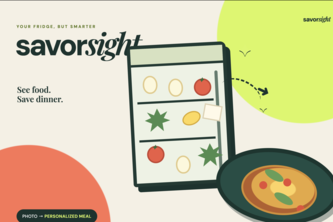
SavorSight is a self-reported prototype web application that allows users to upload a photo of their fridge contents and receive a personalized recipe based on visible ingredients, dietary needs, and cooking preferences. It uses AI (specifically GPT-5.6 vision) to identify ingredients and generate recipes.
What changed
The project was submitted as part of the OpenAI 2026 hackathon. No evidence suggests any prior commercial activity or product development beyond this prototype.
Single most important open question
Is there a viable path from this prototype to a scalable, monetizable product that users will pay for?
What The Product Actually Is
The description states:
- SavorSight is a responsive web app built with HTML, CSS, JavaScript, and Node.js.
- It uses GPT-5.6 vision via the OpenAI API to process fridge images and generate structured recipe data.
- Users upload a fridge photo, select dietary needs, cooking time, and kitchen confidence, then receive a personalized recipe.
- The app identifies visible ingredients, suggests swaps, and includes a food-safety reminder.
- It has a demo mode for testing without an API key.
Inference The product is a proof-of-concept prototype with limited functionality, designed to demonstrate AI-based recipe generation from fridge images.
Positioning & Claim Evolution
The description states:
- The tagline claims SavorSight helps users "cook faster, match dietary needs, and waste less food."
- The inspiration was to solve the problem of not knowing what to cook with ingredients at home.
- It aims to reduce decision fatigue and food waste.
Inference The positioning is centered on solving a common household problem using AI. However, there is no evidence of market research or customer validation beyond the authors’ own claims.
Target Customer & ICP
The description states:
- The app targets users who have ingredients at home but are unsure what to cook with them.
- It allows users to specify dietary needs, cooking time, and kitchen confidence — suggesting a broad audience.
Inference There is no clear indication of a specific persona or ideal customer profile beyond general household users. No evidence of segmentation or user research.
Business Model & Pricing Evidence
The description states:
- The project was built as a hackathon submission.
- There is no mention of pricing, monetization strategy, or revenue model.
- The demo mode allows testing without an API key, implying no immediate commercial barrier.
Inference No evidence exists to suggest any business model or pricing structure beyond the prototype’s current form.
Technical & Delivery Signals
The description states:
- Built with HTML, CSS, JavaScript, Node.js.
- Uses GPT-5.6 vision via OpenAI API.
- The team requested strict JSON output from the AI to ensure consistency.
- Includes a demo mode for testing without an API key.
Inference The technical stack is basic and typical for a web prototype. The use of structured AI prompts suggests some attention to reliability, but no evidence of scalability or production-grade infrastructure.
Traction & Maturity Signals
The description states:
- This is a hackathon submission (OpenAI 2026).
- No mention of users, customers, or adoption.
- The team size is two.
- No revenue, ARR, or headcount data are provided.
Inference There is no evidence of traction, user engagement, or product maturity beyond a prototype.
Competitive Context
The description states:
- No mention of competitors.
- The idea of generating recipes from fridge photos is not unique — similar concepts exist in the market (e.g., apps like "Mealime", "Yummly", or AI-powered recipe generators).
Inference No evidence of competitive analysis or awareness of existing solutions in this space.
Open Questions & Risks
- The project is a hackathon prototype with no commercial traction.
- No evidence of revenue, customers, or product-market fit.
- The use of GPT-5.6 vision implies reliance on an external API, which may not be scalable or cost-effective.
- No indication of how the team plans to monetize or grow beyond this initial version.
- The demo mode suggests no commercial readiness.
Inference The risk of failure is high due to lack of product-market fit, scalability concerns, and absence of a clear path to monetization.
Questions the description leaves open
- What specific user problems are you solving, and how did you validate those?
- How do you plan to move from this prototype to a scalable, monetizable product?
- Have you identified any competitors or similar solutions in the market?
- What is your strategy for acquiring users or building traction?
- How do you intend to handle data privacy and user trust with image uploads?
- Are there any technical limitations or bottlenecks in using GPT-5.6 vision at scale?
Overall Assessment
Not evidenced.
The description provides no information on financials, traction, customer base, or commercial viability. The project is a hackathon prototype with no evidence of product-market fit or monetization strategy.
Confidence level Low — based entirely on self-reported claims and no independent verification.
User Stories BotA demo video on every pull request
Get a demo video on every new feature
GitHub App that watches your pull requests and records a narrated, captioned demo.
Save time on demo prep and make informed decisions faster with a video walkthrough of every new feature.
Source
Submitted to the OpenAI 2026 hackathon on Devpost. Project home on Devpost. Back to the full gallery on Devpost.
This competitive analysis was produced by top-founders.com (opens in a new tab)
Generated by a language model from this project's public Devpost page — its tagline, the author's own write-up and any built-with tags listed there — as captured in August 2026. Short quotations are the author's words. It is an opinion on the idea as a business, not on the people behind it, and it reflects the description as published then. If the project has moved on, request a correction below. The analysis is not independent research and contains no verified traction, revenue or customer data.
An independent guide by KFG International LLC — not affiliated with, endorsed by, or connected to Devpost or OpenAI.