

Archive position — measured, not model output
0 likes on Devpost
2,263 of the 7,850 archived projects have more likes, and 5,587 share exactly 0 — so this project's #6,539 place in the like-ranked listing is a tie-break inside that group, not a ranking.
Projects (log scale)
Likes on Devpost. ▲ marks this project's group.
Show the figures
| Likes | Projects | Share of archive |
|---|---|---|
| 0 | 5,587 | 71.2% |
| 1 | 1,758 | 22.4% |
| 2 | 284 | 3.6% |
| 3–4 | 132 | 1.7% |
| 5–9 | 75 | 1.0% |
| 10+ | 14 | 0.2% |
 User Stories BotA demo video on every pull request
Get a demo video on every new feature
GitHub App that watches your pull requests and records a narrated, captioned demo.
Save time on demo prep and make informed decisions faster with a video walkthrough of every new feature.
Executive Summary
Company: SayAhead
Self-reported purpose: A supervised calling assistant for Deaf and hard-of-hearing people, enabling phone calls that are readable, guideable, and controllable.
Key claim: The product is a solution to improve communication accessibility during phone calls for users with hearing impairments.
What changed: This project was submitted to the OpenAI 2026 hackathon, suggesting it is in an early development or prototype stage.
Single most important open question: What is the actual user experience and adoption of this product? The description provides no evidence of traction, revenue, customers, or even a working prototype beyond its submission to a hackathon.
What The Product Actually Is
The description states that SayAhead is “a supervised calling assistant for Deaf and hard-of-hearing people.” It enables phone calls that are “readable, guideable, and controllable.”
Evidence:
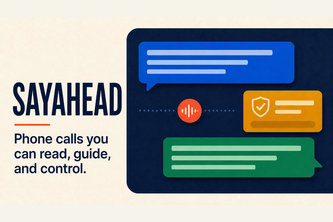
- Tagline: “Phone calls you can read, guide, and control—a supervised calling assistant for Deaf and hard-of-hearing people.”
- Built with technologies including OpenAI APIs (GPT, Realtime API), Twilio, React, Next.js, Cloudflare Workers, and TypeScript.
Inference:
- The product likely uses AI to transcribe or interpret phone call content in real time.
- It may integrate with existing telephony infrastructure via Twilio.
- It is described as a “supervised calling assistant,” implying human oversight or guidance during use.
Not evidenced:
- Whether the product is functional, tested, or deployed.
- The exact mechanism of how phone calls are made readable, guideable, and controllable.
- Any user interface or experience details beyond the tagline.
Positioning & Claim Evolution
The author states that SayAhead is a “supervised calling assistant for Deaf and hard-of-hearing people.”
Evidence:
- Tagline: “Phone calls you can read, guide, and control—a supervised calling assistant for Deaf and hard-of-hearing people.”
Inference:
- The positioning is centered on accessibility and communication support.
- It may be positioned as a tool to bridge the gap between deaf/hoh users and traditional phone systems.
Not evidenced:
- Whether this is a new category or an evolution of existing tools.
- How it differentiates from current assistive technologies for hearing-impaired users.
- Any marketing claims, branding, or positioning beyond the tagline.
Target Customer & ICP
The description states that SayAhead is intended for “Deaf and hard-of-hearing people.”
Evidence:
- Tagline: “a supervised calling assistant for Deaf and hard-of-hearing people.”
Inference:
- The primary user base is individuals with hearing impairments.
- It may be aimed at those who rely on phone communication but struggle with traditional voice-based systems.
Not evidenced:
- Specific demographics or user segments within the Deaf/hoh community.
- Whether the product targets individuals, organizations, or institutions (e.g., employers, healthcare providers).
- Any customer personas or use cases beyond the general category.
Business Model & Pricing Evidence
No evidence of business model or pricing is provided in the description.
Evidence:
- No mention of revenue streams, monetization strategy, or pricing.
Inference:
- If this is a consumer-facing product, it may be free or subscription-based.
- If used by organizations, it could be B2B with enterprise pricing.
Not evidenced:
- Any indication of how the product will generate revenue.
- Whether it is a freemium, paid, or open-source model.
- Pricing tiers or customer acquisition costs.
Technical & Delivery Signals
The project was built using several technologies including OpenAI APIs, Twilio, React, Next.js, Cloudflare Workers, and TypeScript.
Evidence:
- Built with: accessibility, cloudflare-workers, codex, fastify, gpt-5.6, next.js, openai, openai-agents-sdk, openai-realtime-api, openai-responses-api, react, twilio, twilio-media-streams, typescript, websockets, zod
Inference:
- The product likely uses AI for real-time transcription or interpretation of phone calls.
- It integrates with Twilio for telephony capabilities and may use Cloudflare Workers for serverless functions.
- It is built using modern frontend (React, Next.js) and backend (TypeScript, Fastify) stacks.
Not evidenced:
- Whether the product is functional or deployed.
- The architecture of the system or how components interact.
- Any performance metrics or scalability claims.
Traction & Maturity Signals
The project was submitted to the OpenAI 2026 hackathon and has no other evidence of traction.
Evidence:
- Source: https://devpost.com/software/call-assist-n3945a
- Submitted to OpenAI 2026 hackathon
Inference:
- The product is likely in an early prototype or proof-of-concept stage.
- It may be a hackathon submission with no commercial deployment.
Not evidenced:
- Any user feedback, pilot programs, or adoption metrics.
- Whether the team has built a working version or just conceptualized it.
- Any funding, partnerships, or growth indicators.
Competitive Context
No evidence of competitive analysis is provided in the description.
Evidence:
- None
Inference:
- The product may compete with existing assistive communication tools for Deaf/hoh users.
- It could be positioned against AI transcription services or telephony platforms that support accessibility.
Not evidenced:
- Any direct competitors or market positioning relative to them.
- Market size, share, or competitive advantages.
- Whether the product addresses a gap in the current market.
Open Questions & Risks
The project is described as a hackathon submission with no evidence of traction or commercial viability.
Evidence:
- Submitted to OpenAI 2026 hackathon
- No mention of revenue, customers, or deployment
Inference:
- Risk of being a non-functional prototype.
- Lack of clarity on how the product will scale or monetize.
- Potential for misalignment with actual user needs if not tested in real-world use.
Not evidenced:
- Any risk mitigation strategies or plans for commercialization.
- Whether the team has experience in accessibility or telecommunications.
- Any legal or compliance considerations around telephony and AI use.
Questions the description leaves open
- What is the current state of development? Is this a working prototype, or just an idea?
- How does the product actually function in real-time phone calls?
- Have you tested it with actual Deaf or hard-of-hearing users?
- What are your plans for monetization and scaling?
- How do you plan to integrate with existing telephony systems?
- Are there any legal or compliance issues related to AI use in telecommunications?
Overall Assessment
Assessment: Not ready for investment or partnership.
Reasoning:
- The project is described as a hackathon submission, indicating it is likely in an early stage with no verified traction or product-market fit.
- There is no evidence of revenue, customers, or even a functional prototype.
- The description lacks clarity on how the product will be monetized or scaled.
Confidence: Low — based entirely on self-reported information and no external validation.
User Stories BotA demo video on every pull request
Get a demo video on every new feature
GitHub App that watches your pull requests and records a narrated, captioned demo.
Save time on demo prep and make informed decisions faster with a video walkthrough of every new feature.
Source
Submitted to the OpenAI 2026 hackathon on Devpost. Project home on Devpost. Back to the full gallery on Devpost.
This competitive analysis was produced by top-founders.com (opens in a new tab)
Generated by a language model from this project's public Devpost page — its tagline and any built-with tags listed there, since the author published no write-up — as captured in August 2026. Short quotations are the author's words. It is an opinion on the idea as a business, not on the people behind it, and it reflects the description as published then. If the project has moved on, request a correction below. The analysis is not independent research and contains no verified traction, revenue or customer data.
An independent guide by KFG International LLC — not affiliated with, endorsed by, or connected to Devpost or OpenAI.