

Archive position — measured, not model output
14 likes on Devpost
5 of the 7,850 archived projects have more likes, and 2 share exactly 14 — so this project's #7 place in the like-ranked listing is a tie-break inside that group, not a ranking.
Projects (log scale)
Likes on Devpost. ▲ marks this project's group.
Show the figures
| Likes | Projects | Share of archive |
|---|---|---|
| 0 | 5,587 | 71.2% |
| 1 | 1,758 | 22.4% |
| 2 | 284 | 3.6% |
| 3–4 | 132 | 1.7% |
| 5–9 | 75 | 1.0% |
| 10+ | 14 | 0.2% |
 User Stories BotA demo video on every pull request
Get a demo video on every new feature
GitHub App that watches your pull requests and records a narrated, captioned demo.
Save time on demo prep and make informed decisions faster with a video walkthrough of every new feature.
Executive Summary
What the company appears to be
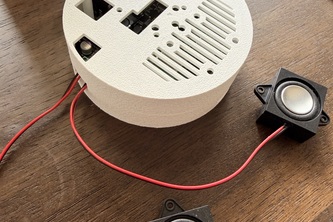
Sara Smartest Speaker is a self-reported personal voice assistant project built on open-source AI agents (Hermes-agent), GPT models, and local hardware (Raspberry Pi 5, CM4). It claims to enable full-duplex voice interaction, task delegation via tools and skills, and integration with telephony, IoT devices, and messaging platforms.
What changed
The author reports evolving from a Generative AI Art Frame project into a smart speaker system capable of executing complex tasks using local hardware and AI orchestration. The evolution involved integrating Hermes-agent, voice wake-word detection, multi-agent conversation handling (Sara and Daemon), and various tool integrations.
Single most important open question
Is there any evidence of commercial traction, revenue, or customer adoption beyond the author’s personal use case and hackathon win?
Note: This analysis is based solely on the self-reported project description provided by the caller. No external verification or historical data is available.
What The Product Actually Is
The description states that Sara Smartest Speaker is a voice-controlled AI assistant built using:
- A custom hardware setup (Raspberry Pi 5, CM4, sara-kit board with microphones and speakers)
- Open-source AI agent framework: Hermes-agent
- Generative AI models including GPT-5.5, GPT-5.6, GPT-realtime-2, whisper-1, ElevenLabs
- Tools for telephony (Twilio), messaging (Telegram, email), IoT control (Shelly, Meross, Switchbot)
- Voice wake-word detection using Porcupine or VOSK
It supports full-duplex conversation and can delegate tasks to Hermes-agent or GPT models when needed.
Claim: The system enables complex actions like calling a person, generating content, controlling smart home devices, and publishing reports.
Evidence: Self-reported by the author; no independent validation.
Positioning & Claim Evolution
The author positions Sara as:
- A "smart speaker AI Agent"
- Capable of listening, talking, and performing tasks impossible with current smart speakers
- Superior to Google Assistant, Alexa, and Apple Siri in UX, features, flexibility, and cost
Evolution described:
- Started with Generative AI Art Frames (LCD/e-ink screens)
- Moved to orchestrate multiple AI Smart Frames for exhibitions
- Integrated Hermes-agent on Raspberry Pi 5
- Developed Zoetrope-Admin skills and gateways
- Added sara-kit board for better hardware interface
- Evolved into a full-duplex voice assistant with dual personalities (Sara and Daemon)
Claim: The project is positioned as a next-generation personal AI assistant.
Evidence: Author’s own description; no third-party positioning or branding.
Target Customer & ICP
Not evidenced.
The author describes personal use cases but does not identify any defined customer segment, target market, or ideal customer profile (ICP). There is no mention of end-users beyond the creator's own needs.
Claim: No explicit target customer or ICP identified.
Evidence: Not stated in description.
Business Model & Pricing Evidence
Not evidenced.
There is no indication of pricing strategy, monetization model, or commercial structure. The project appears to be a personal hobby or hackathon effort with no evidence of sales, subscriptions, or revenue streams.
Claim: No business model or pricing information provided.
Evidence: Author’s own account; no external data.
Technical & Delivery Signals
The author reports:
- Use of Hermes-agent on Raspberry Pi 5
- Integration of multiple tools and APIs (Twilio, Telegram, Shelly, Meross, etc.)
- Full-duplex voice interaction using GPT-realtime-2
- Local memory management for continuous conversations
- Parallel task execution with queuing system
- Custom hardware board (sara-kit) with 3 microphones and speaker amp
Claim: The system uses advanced AI and local hardware to perform complex tasks.
Evidence: Self-reported by the author; no independent technical validation.
Traction & Maturity Signals
The project:
- Won third place at an OpenAI Local Hackathon (July 19, 2026)
- Is described as a personal project with no commercial deployment
- Has no evidence of user base, customers, or adoption metrics
Claim: The project has achieved some recognition via hackathon win.
Evidence: Self-reported; no further traction data.
Competitive Context
The author claims superiority over:
- Google Assistant
- Alexa
- Apple Siri
No competitive analysis or market positioning beyond these comparisons is provided. No mention of competitors, market size, or competitive advantages in a commercial context.
Claim: The product outperforms existing smart speakers.
Evidence: Author’s own claim; no independent benchmarking or market data.
Open Questions & Risks
- No commercial traction: No evidence of customers, revenue, or adoption beyond the author's personal use.
- Unverified claims: All technical and performance claims are self-reported without external validation.
- Limited scalability: The project is built on a single-person effort with no team or infrastructure.
- Hardware dependency: Relies heavily on specific hardware (Raspberry Pi, custom boards) that may not be scalable or reproducible.
- No monetization path: No indication of how the product would generate revenue.
Inference: The project lacks commercial viability or scalability without further development and market validation.
Questions the description leaves open
- What is your plan for scaling beyond a single-person prototype?
- How do you intend to monetize this product, if at all?
- Have you tested the system with any users outside of yourself?
- What are the technical limitations or bottlenecks in current implementation?
- Are there any legal or ethical considerations around voice data collection and processing?
- Do you have a roadmap for hardware production or distribution?
Note: These questions aim to uncover commercial intent, scalability, and real-world applicability.
Overall Assessment
Not evidenced.
There is no indication of investment interest, partnership discussions, or funding status. The project appears to be a personal innovation with no evidence of commercial readiness or investor appeal.
Claim: No evidence of investment or partnership interest.
Evidence: Self-reported; no external data.
Customer Segments
inferred
The description does not explicitly define customer segments. However, based on the author's intent to build a smart speaker AI agent with advanced capabilities such as calling, generating content, and managing IoT devices, it can be inferred that the primary users might be tech enthusiasts, makers, developers, or early adopters interested in home automation and voice-controlled AI systems.
Value Propositions
evidenced
The description states: "Sara is the first smart speaker AI Agent. She can listen and talk and call a powerful hermes-agent with several skills, tools, scripts to do things impossible with current smart speakers."
Additionally, the author claims: "I can wake my smarter speaker (codename 'Sara') using 'OK Sara' or 'OK Daemon' using some wake words... Sara can reply using GPT-5.5 and ask Hermes some help when she need to recall long term memory or delegate an action."
Channels
inferred
The description does not explicitly mention how the product reaches its customers. However, since this is a hackathon project submitted to Devpost and won third place, it can be inferred that the channel may involve developer communities, hackathon platforms, and possibly open-source or maker forums.
Customer Relationships
inferred
There is no explicit statement about customer relationships in the description. Based on the author's personal involvement and the nature of a hackathon project, it can be inferred that the relationship might be primarily one-on-one or community-based, with potential for feedback loops through developer engagement or social media.
Revenue Streams
not evidenced
The description does not mention any revenue streams or monetization strategies. No information is provided about pricing models, subscriptions, sales, or business transactions related to the project.
Key Resources
evidenced
The description states: "I installed hermes-agent on a Raspberry Pi 5 and I created Zoetrope-Admin skills... I added more skills and several gateways (telephony, email, voice, iMessage, telegram, bee.computer streaming voice instructions, ...)."
Also: "Using Codex with GPT-5.5/GPT-5.6 I built a system wide service that manage the voice agent full duplex interactions and it integrate with hermes-agent using tool calls to it's API."
And: "I manage a local memory system to allow continuous conversations with Daemon (hermes-agent) to keep context."
Key Activities
evidenced
The description states: "I can wake my smarter speaker (codename 'Sara') using 'OK Sara' or 'OK Daemon' using some wake words... Sara can reply using GPT-5.5 and ask Hermes some help when she need to recall long term memory or delegate an action."
Also: "I installed Debian Trixie and hermes-agent with a selection of CLI (codex, bee, himalaya, openhue, shelly-cli, meross-cli, switchbot, ...) and small servers (coded by Codex) for listening to bee.computer and viewing live with Looki L1 devices."
And: "I built things progressively and each step had it's challenges... Integrating each tool was a mini project with their bugs and elliptic documentations."
Key Partnerships
inferred
The description does not explicitly list any partnerships. However, given the use of various open-source tools like hermes-agent, Codex, GPT models, and integration with services such as Twilio, it can be inferred that the project relies on a network of open-source contributors, API providers, and developer tooling ecosystems.
Cost Structure
not evidenced
The description does not provide any information about costs associated with building or operating the system. No details are given regarding hardware expenses, software licensing, development time, or operational overheads.
Evidence & Gaps
- Customer Segments: Marked as inferred. To become evidenced, the description would need to explicitly state target user groups or personas.
- Value Propositions: Marked as evidenced. The value proposition is clearly stated in the description.
- Channels: Marked as inferred. To become evidenced, the description would need to specify how the product reaches its users.
- Customer Relationships: Marked as inferred. To become evidenced, the description would need to describe how the author interacts with or supports users.
- Revenue Streams: Marked as not evidenced. No mention of monetization or income sources.
- Key Resources: Marked as evidenced. The description lists specific tools and hardware used.
- Key Activities: Marked as evidenced. The description details the development and operational activities involved.
- Key Partnerships: Marked as inferred. To become evidenced, the description would need to name specific partners or collaborations.
- Cost Structure: Marked as not evidenced. No cost-related information is provided.
The main gaps are around customer segments, channels, customer relationships, revenue streams, and key partnerships — all of which require explicit statements in the description to be considered evidenced rather than inferred.
User Stories BotA demo video on every pull request
Get a demo video on every new feature
GitHub App that watches your pull requests and records a narrated, captioned demo.
Save time on demo prep and make informed decisions faster with a video walkthrough of every new feature.
Source
Submitted to the OpenAI 2026 hackathon on Devpost. Project home on Devpost. Back to the full gallery on Devpost.
This competitive analysis was produced by top-founders.com (opens in a new tab)
Generated by a language model from this project's public Devpost page — its tagline, the author's own write-up and any built-with tags listed there — as captured in August 2026. Short quotations are the author's words. It is an opinion on the idea as a business, not on the people behind it, and it reflects the description as published then. If the project has moved on, request a correction below. The analysis is not independent research and contains no verified traction, revenue or customer data.
An independent guide by KFG International LLC — not affiliated with, endorsed by, or connected to Devpost or OpenAI.