

Archive position — measured, not model output
12 likes on Devpost
8 of the 7,850 archived projects have more likes, and 3 share exactly 12 — so this project's #9 place in the like-ranked listing is a tie-break inside that group, not a ranking.
Projects (log scale)
Likes on Devpost. ▲ marks this project's group.
Show the figures
| Likes | Projects | Share of archive |
|---|---|---|
| 0 | 5,587 | 71.2% |
| 1 | 1,758 | 22.4% |
| 2 | 284 | 3.6% |
| 3–4 | 132 | 1.7% |
| 5–9 | 75 | 1.0% |
| 10+ | 14 | 0.2% |
 User Stories BotA demo video on every pull request
Get a demo video on every new feature
GitHub App that watches your pull requests and records a narrated, captioned demo.
Save time on demo prep and make informed decisions faster with a video walkthrough of every new feature.
Executive Summary
What the company appears to be
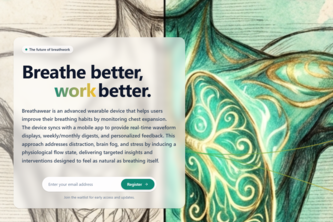
Breathawear is a self-reported wearable device that monitors chest expansion to help users improve breathing habits. The description states it uses Bluetooth and integrates with various technologies including React Native, Next.js, and Supabase.
What changed
This is a hackathon submission — no evidence of prior development or commercial activity.
The single most important open question
Is there any evidence of user testing, customer feedback, or product-market fit beyond the self-reported project description?
What The Product Actually Is
The description states: "Breathawear is an advanced wearable device that helps users improve their breathing habits by monitoring chest expansion."
- Product type: Wearable device
- Functionality: Monitors chest expansion to help improve breathing habits
- Technology stack: Bluetooth, React Native, Next.js, Supabase, among others
Inference: The product appears to be a prototype or proof-of-concept built for a hackathon. It is not evidenced to have been commercialized or deployed beyond the submission context.
Positioning & Claim Evolution
The description states: "Breathawear is an advanced wearable device that helps users improve their breathing habits by monitoring chest expansion."
- Positioning claim: A wearable tool for improving breathing
- Target benefit: Better breathing habits through monitoring
Inference: No evidence of prior positioning or evolution in claims. The project appears to be a one-off submission with no stated history of development or repositioning.
Target Customer & ICP
Not evidenced.
The description does not state who the target customer is, nor does it describe any customer persona or ideal customer profile (ICP).
Business Model & Pricing Evidence
Not evidenced.
There is no mention of pricing, monetization strategy, or business model in the provided description.
Technical & Delivery Signals
The author-declared tech stack includes:
- Bluetooth
- React Native
- Next.js
- Supabase
- Framer Motion
- Chart.js
- Vercel
- TypeScript
- Expo.io
- Codex
- ESP32
- Vitest
Inference: The project appears to be a full-stack web and mobile application prototype, likely built for demonstration or competition purposes. No evidence of production deployment or delivery.
Traction & Maturity Signals
Not evidenced.
There is no evidence of:
- Revenue
- Customers
- User engagement
- Product adoption
- Market traction
The project was submitted to a hackathon and has no stated history of development beyond that.
Competitive Context
Not evidenced.
No mention of competitors, market analysis, or competitive positioning in the description.
Open Questions & Risks
- No commercial traction: The product is only described as a hackathon submission.
- Unproven market fit: No evidence of user feedback or testing.
- Single founder: Team size is listed as one member.
- No business model: No indication of how the product would generate revenue.
Questions the description leaves open
- What inspired the creation of Breathawear?
- Has there been any user testing or feedback on the device?
- Is there a plan to commercialize this beyond the hackathon?
- How does the device collect and process data?
- What are the intended use cases for the product?
Overall Assessment
Not evidenced.
There is no evidence of:
- Revenue
- Customers
- Product-market fit
- Commercial viability
- Strategic value
This appears to be a hackathon submission with no demonstrated traction or business development. Any investment or partnership consideration would require further evidence of product development, user engagement, or commercial strategy.
Customer Segments
inferred
The description does not explicitly state customer segments. However, given that Breathawear is described as a wearable device aimed at improving breathing habits, it can be inferred that the primary users might include individuals interested in health and wellness, people with respiratory issues, or those practicing breathing exercises (e.g., yoga practitioners, meditation enthusiasts).
Value Propositions
inferred
The description states that Breathawear monitors chest expansion to help improve breathing habits. Based on this, it can be inferred that the value proposition centers around providing real-time feedback and data to users for better control over their breathing patterns.
Channels
not evidenced
There is no mention in the provided description of how the product reaches its customers or through which distribution channels it is offered.
Customer Relationships
not evidenced
The description does not provide any information about how the company interacts with its customers, whether through support, community building, or other relationship-building mechanisms.
Revenue Streams
not evidenced
No indication in the description of how the business intends to generate revenue, such as product sales, subscriptions, licensing, or other monetization methods.
Key Resources
inferred
The project was built using several technologies including ESP32, React Native, Supabase, and Next.js. It can be inferred that these tools and components are key resources used in the development and operation of the product.
Key Activities
inferred
Given that the project is a wearable device focused on monitoring breathing, it can be inferred that key activities include software development, hardware integration, data analysis, and possibly user experience design to ensure effective feedback delivery.
Key Partnerships
not evidenced
There is no mention in the description of any strategic partnerships or collaborations that may be involved in the creation or distribution of Breathawear.
Cost Structure
not evidenced
The description does not contain information regarding the costs associated with developing, producing, or marketing the product.
Evidence & Gaps
- Customer Segments: inferred — The description does not state customer segments; to evidence this, we would need explicit mention of target user groups.
- Value Propositions: inferred — The description does not explicitly state value propositions; to evidence this, we would need a clear articulation of what benefit the product delivers.
- Channels: not evidenced — No information on how customers are reached or how the product is distributed.
- Customer Relationships: not evidenced — No mention of customer interaction or relationship-building strategies.
- Revenue Streams: not evidenced — No indication of how revenue will be generated.
- Key Resources: inferred — The description lists technologies used but does not explicitly name key resources; to evidence this, we would need a direct statement about what assets are critical.
- Key Activities: inferred — The description does not list core activities; to evidence this, we would need explicit statements about the main operations involved in creating and maintaining the product.
- Key Partnerships: not evidenced — No mention of any business or technical partnerships.
- Cost Structure: not evidenced — No information provided on operational or development costs.
All sections are based solely on the self-reported description and lack corroboration. The absence of detailed information limits the ability to fully assess the business model.
User Stories BotA demo video on every pull request
Get a demo video on every new feature
GitHub App that watches your pull requests and records a narrated, captioned demo.
Save time on demo prep and make informed decisions faster with a video walkthrough of every new feature.
Source
Submitted to the OpenAI 2026 hackathon on Devpost. Project home on Devpost. Back to the full gallery on Devpost.
This competitive analysis was produced by top-founders.com (opens in a new tab)
Generated by a language model from this project's public Devpost page — its tagline and any built-with tags listed there, since the author published no write-up — as captured in August 2026. Short quotations are the author's words. It is an opinion on the idea as a business, not on the people behind it, and it reflects the description as published then. If the project has moved on, request a correction below. The analysis is not independent research and contains no verified traction, revenue or customer data.
An independent guide by KFG International LLC — not affiliated with, endorsed by, or connected to Devpost or OpenAI.