

Archive position — measured, not model output
1 like on Devpost
505 of the 7,850 archived projects have more likes, and 1,758 share exactly 1 — so this project's #1,972 place in the like-ranked listing is a tie-break inside that group, not a ranking.
Projects (log scale)
Likes on Devpost. ▲ marks this project's group.
Show the figures
| Likes | Projects | Share of archive |
|---|---|---|
| 0 | 5,587 | 71.2% |
| 1 | 1,758 | 22.4% |
| 2 | 284 | 3.6% |
| 3–4 | 132 | 1.7% |
| 5–9 | 75 | 1.0% |
| 10+ | 14 | 0.2% |
 User Stories BotA demo video on every pull request
Get a demo video on every new feature
GitHub App that watches your pull requests and records a narrated, captioned demo.
Save time on demo prep and make informed decisions faster with a video walkthrough of every new feature.
Executive Summary
What the company appears to be
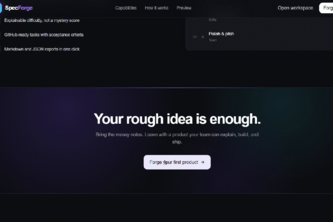
SpecForge is a self-reported tool that claims to generate build-ready product artifacts—such as PRDs, MVPs, tech stacks, and execution plans—from rough ideas, using AI. It was submitted to the OpenAI 2026 hackathon by one founder, Sriram Sivakumar.
What changed
The project is described as a hackathon submission with no evidence of prior development or traction. No prior version, funding, or product history is evident.
Single most important open question
Is there any evidence that SpecForge has been used in practice to generate real product artifacts, or does it remain an untested concept?
Analysis basis
This report is based solely on the self-reported description provided by the author. No external verification, traction data, customer feedback, or historical evidence is available.
What The Product Actually Is
The description states that SpecForge "turns rough ideas into build-ready products" and generates a range of outputs including PRDs, MVPs, tech stacks, difficulty scores, team tasks, roadmaps, risks, and Codex-ready execution plans. It is built with technologies such as Codex, CSS3, HTML5, JavaScript, JSON, and web.
Claim
SpecForge is an AI-powered tool for generating product development artifacts.
Evidence The author states this in the project description.
Inference Not evidenced — this is a self-reported claim about functionality.
Positioning & Claim Evolution
The tagline positions SpecForge as a tool that accelerates idea-to-build workflows by automating product planning and execution. It implies a focus on rapid prototyping and team alignment, with an emphasis on AI-driven outputs.
Claim
The tool is positioned to accelerate product development from concept to execution.
Evidence Tagline and project description.
Inference Not evidenced — no evidence of prior positioning or evolution in messaging.
Target Customer & ICP
The description does not identify a specific customer or ideal customer profile (ICP). It implies a general audience of product teams, developers, or idea-makers who want to quickly generate structured outputs from vague concepts.
Claim
The tool targets teams or individuals working on early-stage product ideas.
Evidence Not evidenced — no mention of target personas or use cases.
Inference Not evidenced — this is a speculative interpretation of the tagline.
Business Model & Pricing Evidence
There is no evidence in the description regarding pricing, monetization, or business model. The project is described as a hackathon submission with no indication of commercial intent or revenue streams.
Claim
No business model or pricing information is provided.
Evidence Not evidenced — the description does not mention any.
Inference Not evidenced — this is a speculative assumption.
Technical & Delivery Signals
The project is built using web technologies including Codex, CSS3, HTML5, JavaScript, and JSON. It was submitted to a hackathon, suggesting it may be in an early prototype or proof-of-concept stage.
Claim
The tool uses web-based technologies and AI (Codex).
Evidence Author-declared tech stack.
Inference Not evidenced — no evidence of delivery, performance, or technical maturity.
Traction & Maturity Signals
There is no evidence of traction, adoption, or product maturity. It is described as a hackathon submission with no prior history, funding, or user base.
Claim
No traction or maturity signals are evident.
Evidence Not evidenced — the description does not mention any.
Inference Not evidenced — this is a logical conclusion from lack of data.
Competitive Context
No competitive landscape or market positioning is described. The project is not compared to existing tools in the product planning, idea-to-code, or AI-assisted development space.
Claim
No competitive context is provided.
Evidence Not evidenced — no mention of competitors or market analysis.
Inference Not evidenced — this is a speculative assumption.
Open Questions & Risks
- The project is described as a hackathon submission with no prior traction or development.
- No evidence of product-market fit, user feedback, or commercial viability.
- The claim to generate "build-ready" outputs from "rough ideas" may be overly ambitious without demonstration.
- One-person team raises questions about execution capacity and scalability.
Claim
Risks include lack of traction, unproven functionality, and limited team capacity.
Evidence Not evidenced — these are inferred from the thin description.
Inference Not evidenced — speculative but based on standard due-diligence principles.
Questions the description leaves open
- What specific workflows or problems does SpecForge aim to solve?
- Has it been tested with real users or teams?
- How does it handle ambiguity in "rough ideas" and translate them into actionable outputs?
- What is the current development stage, and what are the next steps for product evolution?
- Are there any early adopters or pilot customers?
Claim
These questions aim to uncover gaps in the self-reported description.
Evidence Not evidenced — these are standard due-diligence prompts.
Inference Not evidenced — speculative but necessary given thin evidence.
Overall Assessment
There is no evidence of a viable product, traction, or commercial potential. The project is described as a hackathon submission with no indication of prior development or market validation.
Claim
No investment or partnership case can be made from the provided information.
Evidence Not evidenced — the description does not support any commercial viability.
Inference Not evidenced — this is a logical conclusion from lack of evidence.
User Stories BotA demo video on every pull request
Get a demo video on every new feature
GitHub App that watches your pull requests and records a narrated, captioned demo.
Save time on demo prep and make informed decisions faster with a video walkthrough of every new feature.
Source
Submitted to the OpenAI 2026 hackathon on Devpost. Project home on Devpost. Back to the full gallery on Devpost.
This competitive analysis was produced by top-founders.com (opens in a new tab)
Generated by a language model from this project's public Devpost page — its tagline and any built-with tags listed there, since the author published no write-up — as captured in August 2026. Short quotations are the author's words. It is an opinion on the idea as a business, not on the people behind it, and it reflects the description as published then. If the project has moved on, request a correction below. The analysis is not independent research and contains no verified traction, revenue or customer data.
An independent guide by KFG International LLC — not affiliated with, endorsed by, or connected to Devpost or OpenAI.