

Archive position — measured, not model output
0 likes on Devpost
2,263 of the 7,850 archived projects have more likes, and 5,587 share exactly 0 — so this project's #3,935 place in the like-ranked listing is a tie-break inside that group, not a ranking.
Projects (log scale)
Likes on Devpost. ▲ marks this project's group.
Show the figures
| Likes | Projects | Share of archive |
|---|---|---|
| 0 | 5,587 | 71.2% |
| 1 | 1,758 | 22.4% |
| 2 | 284 | 3.6% |
| 3–4 | 132 | 1.7% |
| 5–9 | 75 | 1.0% |
| 10+ | 14 | 0.2% |
 User Stories BotA demo video on every pull request
Get a demo video on every new feature
GitHub App that watches your pull requests and records a narrated, captioned demo.
Save time on demo prep and make informed decisions faster with a video walkthrough of every new feature.
Executive Summary
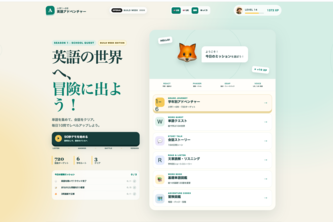
The company appears to be a single-person project (1 team member) that self-reports building an English learning game for Japanese elementary school students using AI tools like Codex and GPT-5.6. The author states the product is a mobile-friendly web application combining vocabulary, pronunciation, mini-games, and rewards in an adventure format.
What changed
The project was submitted to the OpenAI 2026 hackathon on Devpost. It is not evidenced that any commercial version has launched or gained users beyond the author's own development.
The single most important open question
Is there evidence of any revenue, customer traction, or product-market fit beyond the self-reported development effort?
Analysis basis
This report is based entirely on the self-reported description provided by the project author. No external verification, archived data, or third-party sources are available. All claims are stated by the author and not independently confirmed.
What The Product Actually Is
- The description states that English Adventure Island is a mobile-friendly English learning game.
- It is designed for Japanese elementary school students.
- The game combines:
- Vocabulary learning through picture identification
- Natural English pronunciation listening
- Mini-games
- Rewards and star collection
- Themed adventure stages
- It is built as a responsive web application, working on both desktop and mobile devices.
- The project was built using Codex and GPT-5.6 for development, content creation, and user experience design.
Inference The product is described as a playable game with educational goals, but no evidence of actual gameplay, user feedback, or monetization exists beyond the author's own account.
Positioning & Claim Evolution
- The project is positioned as a playful English learning adventure for Japanese elementary school students.
- It aims to make English learning feel like an adventure, rather than a traditional exercise.
- The author claims that the game:
- Makes learning feel natural and fun
- Combines education with game mechanics instead of quizzes
- Focuses on enjoyment over stress
Inference The positioning is clearly aimed at making English learning engaging for young learners. However, there is no evidence of how this positioning has evolved or been tested in the market beyond the author’s own claims.
Target Customer & ICP
- The target customer is Japanese elementary school students.
- The description states that the game is designed specifically for this age group.
- The game is built to be child-friendly, with a simple interface and smooth gameplay across screen sizes.
Inference The ICP is clearly defined as Japanese elementary school students. However, no evidence exists of actual customer data, usage patterns, or feedback from the target demographic.
Business Model & Pricing Evidence
- No business model or pricing information is provided.
- The description does not state whether the game will be:
- Free-to-play
- Paid
- Subscription-based
- Ad-supported
- There is no mention of monetization strategy, revenue streams, or user acquisition costs.
Inference The project has no evidenced business model or pricing structure. The author does not describe how the product would generate revenue.
Technical & Delivery Signals
- The game was built using:
- Codex
- GPT-5.6
- HTML5
- It is described as a responsive web application.
- The team used AI tools to:
- Design the game architecture
- Implement gameplay logic
- Improve user interface
- Create content and prompts
- The author notes that AI accelerated development, allowing faster iteration.
Inference The use of AI for development is a key technical signal. However, no evidence exists of scalability, performance, or delivery beyond the initial prototype.
Traction & Maturity Signals
- The project was submitted to the OpenAI 2026 hackathon.
- It is described as a complete playable game, with accomplishments including:
- A child-friendly adventure experience
- Educational integration with gameplay
- Use of AI for development
- Future plans include:
- AI-generated learning content
- Voice pronunciation practice
- Adaptive difficulty
- Parent dashboard
- Additional worlds and vocabulary packs
Inference There is no evidence of actual user traction, adoption, or product-market fit. The project remains in a prototype or early-stage development phase.
Competitive Context
- No competitive landscape is described.
- The author does not mention existing competitors or similar products in the English learning space for elementary school students.
- No information is provided about market size, pricing of alternatives, or differentiation strategy.
Inference There is no evidence of competitive analysis or positioning within a larger market. The project appears to be self-contained without reference to external players.
Open Questions & Risks
- Single-person team: Only one member listed (xiang yang), which may limit execution capacity.
- No revenue or traction: No data on users, monetization, or product adoption.
- Unverified claims: All descriptions are self-reported and unverified.
- AI dependency: Heavy reliance on AI tools for development raises questions about scalability and long-term viability if those tools change or become unavailable.
- Lack of clarity on commercialization: No roadmap or strategy for moving from prototype to market.
Inference The project lacks any evidence of a functioning product in the market, which is a major risk for investment or partnership consideration.
Questions the description leaves open
- What specific user feedback have you received from Japanese elementary school students or their parents?
- Have you conducted any testing with actual users, and what were the results?
- How do you plan to monetize the product beyond the current prototype?
- Is there a clear go-to-market strategy for reaching Japanese schools or families?
- What are your plans for scaling beyond the current AI-assisted development approach?
- Are there any existing partnerships with educational institutions or publishers in Japan?
Inference These questions aim to uncover whether the project has moved beyond self-reported claims into real-world testing, monetization, and market entry.
Overall Assessment
- The project is described as a single-person hackathon submission.
- It is not evidenced that the product has reached any commercial stage or gained users.
- There is no evidence of:
- Revenue
- Customers
- Product-market fit
- Business model
- Traction or adoption
Inference Based on the self-reported description, there is insufficient evidence to support a commercial due-diligence read. The project remains in an early development phase with no demonstrated market traction or viability.
User Stories BotA demo video on every pull request
Get a demo video on every new feature
GitHub App that watches your pull requests and records a narrated, captioned demo.
Save time on demo prep and make informed decisions faster with a video walkthrough of every new feature.
Source
Submitted to the OpenAI 2026 hackathon on Devpost. Project home on Devpost. Back to the full gallery on Devpost.
This competitive analysis was produced by top-founders.com (opens in a new tab)
Generated by a language model from this project's public Devpost page — its tagline, the author's own write-up and any built-with tags listed there — as captured in August 2026. Short quotations are the author's words. It is an opinion on the idea as a business, not on the people behind it, and it reflects the description as published then. If the project has moved on, request a correction below. The analysis is not independent research and contains no verified traction, revenue or customer data.
An independent guide by KFG International LLC — not affiliated with, endorsed by, or connected to Devpost or OpenAI.