

Archive position — measured, not model output
0 likes on Devpost
2,263 of the 7,850 archived projects have more likes, and 5,587 share exactly 0 — so this project's #5,898 place in the like-ranked listing is a tie-break inside that group, not a ranking.
Projects (log scale)
Likes on Devpost. ▲ marks this project's group.
Show the figures
| Likes | Projects | Share of archive |
|---|---|---|
| 0 | 5,587 | 71.2% |
| 1 | 1,758 | 22.4% |
| 2 | 284 | 3.6% |
| 3–4 | 132 | 1.7% |
| 5–9 | 75 | 1.0% |
| 10+ | 14 | 0.2% |
 User Stories BotA demo video on every pull request
Get a demo video on every new feature
GitHub App that watches your pull requests and records a narrated, captioned demo.
Save time on demo prep and make informed decisions faster with a video walkthrough of every new feature.
Executive Summary
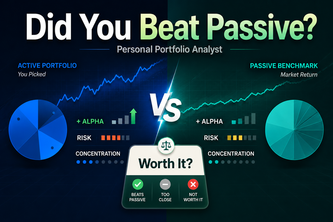
The description states that Personal Portfolio Analyst is a self-directed investor tool built by one person (Barry G) using AI agents (Codex), designed to analyze personal stock portfolio performance against benchmarks like the S&P 500, including risk-adjusted returns and passive ETF replication. The author claims it was developed in six days with 100+ commits, integrating Fidelity data via a guided import process, and includes analytics such as factor analysis, efficient frontiers, and Bayesian allocation adjustments.
The product appears to be an early-stage prototype or MVP, likely intended for personal use or limited beta testing. It is not evidenced to have any revenue, customers, or traction beyond the author's own development experience.
The single most important open question
Is there a viable commercial path from this prototype to a scalable SaaS offering that can attract retail users and potentially integrate with multiple brokerages?
What The Product Actually Is
The description states that Personal Portfolio Analyst is an application that:
- Collects personal stock portfolio data from Fidelity.
- Processes and analyzes the data to compare returns against benchmarks (e.g., S&P 500).
- Builds a passive ETF replica based on historical performance.
- Provides risk-adjusted return metrics, including factor analysis and efficient frontiers.
- Delivers results through a React/Vite dashboard with typed analytical outputs.
It uses technologies such as FastAPI, SQLite, pandas, NumPy, scikit-learn, React, Recharts, and others. The tool is described as being built using AI agents (Codex), which were used for scaffolding, ETL, feature development, legal review, and optimization.
Not evidenced Whether the app has been released publicly or is available to users beyond the author; what specific financial data it handles; whether any real-world user testing occurred.
Positioning & Claim Evolution
The description states that the product was built in response to a personal need: the author wanted to know if their time spent picking stocks was worth it compared to passive investing. The app aims to provide answers that Fidelity does not offer, including:
- Risk-adjusted performance comparisons.
- Passive ETF replication strategies.
- Benchmarking against aligned S&P 500 or custom benchmarks.
It positions itself as filling a gap in retail brokerage analytics and offers institutional-level tools (e.g., factor analysis, efficient frontier) to individual investors.
Inference The positioning evolved from solving a personal problem into a potential product for others with similar needs. However, no evidence exists that this has been validated or tested beyond the author’s own use case.
Target Customer & ICP
The description states that Personal Portfolio Analyst targets self-directed investors who:
- Use Fidelity or similar retail brokerages.
- Want to evaluate whether their stock-picking efforts are worth the time and effort.
- Are interested in passive investing alternatives.
- May be looking for benchmarking, risk-adjusted return analysis, or portfolio optimization.
It is described as a tool that could appeal to individuals who already invest in stocks but lack access to advanced analytics from their brokerages.
Not evidenced Specific customer segments, personas, or market size. No evidence of actual users or feedback from target customers.
Business Model & Pricing Evidence
The description does not state any business model or pricing strategy for Personal Portfolio Analyst. It is described as a single-person project built during a hackathon and does not mention monetization plans, subscription models, freemium tiers, or paid features.
Not evidenced Any revenue streams, pricing structure, or commercial viability beyond the author’s own use case.
Technical & Delivery Signals
The description states that:
- The tool was built using AI agents (Codex) for scaffolding, ETL, legal review, and feature development.
- It uses a structured repository approach with AGENTS.md, versioned execution plans, and mechanical checks to enforce architecture and compliance.
- Data is imported via guided steps, not automated scraping.
- Analytics are performed locally using Python libraries (pandas, NumPy, scikit-learn) and presented in a React/Vite frontend.
- The system includes CRAP analysis tools, architectural dependency checks, and validation harnesses.
It also mentions that Codex was used to draft features like Black-Litterman allocation views and to review Fidelity’s Terms of Service, which led to disabling an automated import feature due to compliance concerns.
Inference The technical approach suggests a strong emphasis on automation, code quality, and maintainability. However, there is no evidence that the tool has been scaled or deployed beyond the author's environment.
Traction & Maturity Signals
The description states:
- The app was built in six days with over 100 commits.
- It includes core functionality (import → assessment → risk → factors → passive replica) by day two.
- It implements features like QuantStats-class tear sheets and institutional analytics within a short timeframe.
- The author notes that the scarcity shifted from engineering to curation, suggesting early maturity in terms of feature set.
However, there is no evidence of:
- Public release or user adoption.
- Customer feedback or usage metrics.
- Revenue or monetization attempts.
- Any formal product launch or marketing efforts.
Not evidenced Traction beyond the author’s own development experience.
Competitive Context
The description does not provide any information about competitors. It implies that Fidelity and other retail brokerages do not offer the analytics provided by this tool, but no comparison to existing tools or platforms is made.
Not evidenced Competitor landscape, pricing, or differentiation from similar offerings in the market.
Open Questions & Risks
- Compliance Risk: The app disables an automated import feature due to Fidelity’s Terms of Service, indicating potential legal exposure.
- Scalability Concerns: Built for a single-user experience and local execution; unclear how it would scale to multiple users or brokerages.
- Lack of Commercial Viability Evidence: No evidence of revenue, customers, or traction beyond the author's own use case.
- Dependency on AI Agents: Reliance on Codex for development may not be sustainable or replicable outside of a specific environment.
- Limited Market Validation: The tool is described as solving a personal problem; no evidence of broader market demand.
Questions the description leaves open
- What are the exact legal risks associated with using Fidelity's APIs or scraping data, and how were they mitigated?
- How does the app plan to expand support to other brokerages (e.g., Schwab, Robinhood)?
- Is there any intention to monetize this product, and if so, what business model is being considered?
- What are the key assumptions behind the passive ETF replication strategy, and how robust is it?
- Has the app been tested with real users beyond the author, and what feedback has been received?
- How does the tool handle edge cases or data inconsistencies from different sources?
- What is the long-term vision for the product beyond its current scope?
Overall Assessment
The description states that Personal Portfolio Analyst was built by one person over a short period using AI agents, and includes advanced analytics typically found in institutional tools. However, there is no evidence of:
- Revenue or customer traction.
- A clear commercial path or business model.
- Market validation beyond the author’s own experience.
- Any formal product launch or marketing.
Assessment The project is an early-stage prototype with strong technical execution and a compelling personal use case. It lacks commercial viability indicators, and its potential for scaling or monetization remains unproven.
Confidence Level Low — based entirely on self-reported evidence, with no external validation or traction data.
User Stories BotA demo video on every pull request
Get a demo video on every new feature
GitHub App that watches your pull requests and records a narrated, captioned demo.
Save time on demo prep and make informed decisions faster with a video walkthrough of every new feature.
Source
Submitted to the OpenAI 2026 hackathon on Devpost. Project home on Devpost. Back to the full gallery on Devpost.
This competitive analysis was produced by top-founders.com (opens in a new tab)
Generated by a language model from this project's public Devpost page — its tagline, the author's own write-up and any built-with tags listed there — as captured in August 2026. Short quotations are the author's words. It is an opinion on the idea as a business, not on the people behind it, and it reflects the description as published then. If the project has moved on, request a correction below. The analysis is not independent research and contains no verified traction, revenue or customer data.
An independent guide by KFG International LLC — not affiliated with, endorsed by, or connected to Devpost or OpenAI.