

Archive position — measured, not model output
0 likes on Devpost
2,263 of the 7,850 archived projects have more likes, and 5,587 share exactly 0 — so this project's #3,933 place in the like-ranked listing is a tie-break inside that group, not a ranking.
Projects (log scale)
Likes on Devpost. ▲ marks this project's group.
Show the figures
| Likes | Projects | Share of archive |
|---|---|---|
| 0 | 5,587 | 71.2% |
| 1 | 1,758 | 22.4% |
| 2 | 284 | 3.6% |
| 3–4 | 132 | 1.7% |
| 5–9 | 75 | 1.0% |
| 10+ | 14 | 0.2% |
 User Stories BotA demo video on every pull request
Get a demo video on every new feature
GitHub App that watches your pull requests and records a narrated, captioned demo.
Save time on demo prep and make informed decisions faster with a video walkthrough of every new feature.
Executive Summary
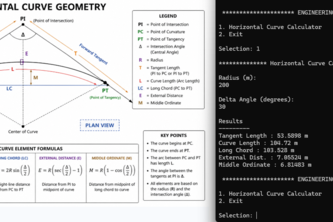
The description states that "Engineering Toolkit" is a C++-based console application for transportation engineering calculations, built by one developer (Dominique Gladeau) as part of a hackathon submission. The author claims it performs horizontal and vertical curve calculations, with plans to expand into stopping distance and safety factor computations. No evidence of revenue, customers, or product-market fit is provided beyond the self-reported project description.
What changed: The project was submitted to the OpenAI 2026 hackathon on Devpost, indicating a development milestone but not commercial traction.
Single most important open question: Is there any evidence that this tool has been adopted or used by engineers or firms in real-world applications?
What The Product Actually Is
The description states that "Engineering Toolkit" is a C++ Transportation Engineering toolkit with multiple calculations and classes, built as a console application. It includes:
- Horizontal Curve Calculation (curve length distance)
- Vertical Curve Calculation (sight distance and station elevations)
The author also mentions possible future additions:
- Stopping distance calculation
- Car speed and turning radius with safety factor calculation
It was built using classes and header files in C++.
Inference: The tool appears to be a software utility for civil or transportation engineers, focused on geometric design calculations within road or railway engineering. However, this is based solely on the author's own description and not independently verified.
Positioning & Claim Evolution
The description states that the project was built to "prove that console apps can perform better output than excel". This suggests a positioning around performance or functionality over traditional spreadsheet tools.
There is no evidence of any marketing claims, branding, or positioning beyond this single statement. No mention of target users, competitive differentiation, or strategic direction beyond the hackathon submission.
Inference: The author positions the tool as an alternative to Excel for engineering calculations, but this is not substantiated with data or user feedback.
Target Customer & ICP
The description does not state who the intended users are. It only mentions that it's a transportation engineering toolkit, and that the author is a single developer working on it.
There is no evidence of:
- Specific customer personas
- Industry verticals targeted
- Use cases beyond personal or academic development
- Any indication of whether this is aimed at professionals, students, or hobbyists
Inference: The tool may be intended for civil engineers or students in transportation engineering, but the author does not explicitly state this.
Business Model & Pricing Evidence
There is no evidence provided regarding:
- Revenue streams
- Pricing models
- Monetization strategy
- Subscription or licensing structures
The project is described as a hackathon submission, which typically implies no commercial intent at time of creation.
Inference: No business model or pricing information is evident from the description. The tool may have been built purely for educational or demonstration purposes.
Technical & Delivery Signals
The description states:
- Built in C++
- Uses classes and header files
- Includes horizontal and vertical curve calculations
- Future additions planned (stopping distance, speed/turning radius)
It also mentions a challenge with renaming folders, suggesting early-stage development or limited project structure.
Inference: The tool is technically basic, built using standard C++ practices. It shows minimal complexity but lacks evidence of scalability or production readiness.
Traction & Maturity Signals
The description states:
- Submitted to the OpenAI 2026 hackathon
- Built by one person (Dominique Gladeau)
- No mention of downloads, usage, or adoption
- No evidence of customer feedback or product iteration
Inference: The project is at a very early stage, likely a prototype or proof-of-concept. There is no indication of traction or market validation.
Competitive Context
The description does not provide any information about:
- Competitors in the transportation engineering software space
- Existing tools used by engineers for similar calculations
- Market positioning relative to other solutions
Inference: No competitive context is evident from the provided description. The tool may be niche or unique, but there's no evidence of existing alternatives or market presence.
Open Questions & Risks
- No commercial traction: Submitted to a hackathon, with no evidence of adoption or revenue.
- Single developer: Limited team size raises concerns about scalability and long-term maintenance.
- No pricing or monetization strategy: No indication of how the tool would generate value or income.
- Limited scope: Only basic calculations are described; future features are speculative.
- Unverified claims: All statements are self-reported, with no external validation.
Inference: The project is in a very early stage and lacks any commercial viability indicators. It may be a learning exercise or prototype, not a product ready for market.
Questions the description leaves open
- What specific engineering workflows does this tool aim to improve?
- Are there any real-world users or engineers who have tested the tool?
- How does this compare to existing tools in the transportation engineering space?
- Is there a plan for monetization or commercial deployment?
- What are the technical limitations of the current version, and how will they be addressed?
Overall Assessment
The description states that the project is a hackathon submission and does not provide any evidence of:
- Revenue
- Customers
- Product-market fit
- Commercial viability
Inference: At this stage, there is no basis for investment or partnership consideration. The tool appears to be an early-stage prototype with no demonstrated traction or business model.
The author states that the project was submitted to a hackathon, which indicates a focus on innovation or learning rather than commercialization. There is no evidence of any product development beyond this point.
User Stories BotA demo video on every pull request
Get a demo video on every new feature
GitHub App that watches your pull requests and records a narrated, captioned demo.
Save time on demo prep and make informed decisions faster with a video walkthrough of every new feature.
Source
Submitted to the OpenAI 2026 hackathon on Devpost. Project home on Devpost. Back to the full gallery on Devpost.
This competitive analysis was produced by top-founders.com (opens in a new tab)
Generated by a language model from this project's public Devpost page — its tagline, the author's own write-up and any built-with tags listed there — as captured in August 2026. Short quotations are the author's words. It is an opinion on the idea as a business, not on the people behind it, and it reflects the description as published then. If the project has moved on, request a correction below. The analysis is not independent research and contains no verified traction, revenue or customer data.
An independent guide by KFG International LLC — not affiliated with, endorsed by, or connected to Devpost or OpenAI.