

Archive position — measured, not model output
0 likes on Devpost
2,263 of the 7,850 archived projects have more likes, and 5,587 share exactly 0 — so this project's #3,934 place in the like-ranked listing is a tie-break inside that group, not a ranking.
Projects (log scale)
Likes on Devpost. ▲ marks this project's group.
Show the figures
| Likes | Projects | Share of archive |
|---|---|---|
| 0 | 5,587 | 71.2% |
| 1 | 1,758 | 22.4% |
| 2 | 284 | 3.6% |
| 3–4 | 132 | 1.7% |
| 5–9 | 75 | 1.0% |
| 10+ | 14 | 0.2% |
 User Stories BotA demo video on every pull request
Get a demo video on every new feature
GitHub App that watches your pull requests and records a narrated, captioned demo.
Save time on demo prep and make informed decisions faster with a video walkthrough of every new feature.
Executive Summary
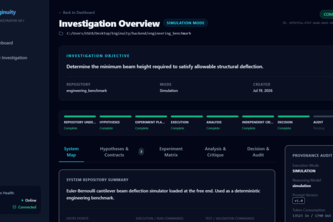
The company appears to be a solo-engineered project named Enginuity, submitted to the OpenAI 2026 hackathon. The description states it is an autonomous engineering investigation platform powered by GPT-5.6 and Codex, designed to support software teams in making evidence-backed technical decisions through structured workflows.
What changed: The author describes a shift from intuition-based or ad-hoc engineering decision-making toward reproducible, evidence-driven processes using AI. This is framed as an evolution in how engineering investigations are conducted.
The single most important open question: Is there any evidence of actual usage, traction, or commercial viability beyond the hackathon submission?
What The Product Actually Is
The description states that Enginuity is "an autonomous engineering investigation platform powered by GPT-5.6 and Codex."
It claims to:
- Understand repository structure
- Build evidence-backed hypotheses
- Generate bounded experiment plans
- Execute experiments in isolated workspaces
- Critique outcomes automatically
- Repair failed experiments within safe limits
- Produce auditable engineering recommendations
The system is described as combining a modern web interface with a deterministic investigation engine, using GPT-5.6 for reasoning and Codex for code generation.
Inference: The product appears to be a prototype or proof-of-concept built for a hackathon, not yet deployed in production.
Positioning & Claim Evolution
The author positions Enginuity as a tool that transforms engineering investigations from opinion-driven discussions into reproducible, evidence-backed workflows.
It is described as:
- An AI system that approaches engineering problems like a disciplined investigator
- A platform that supports controlled experimentation and decision-making
- A tool for helping engineers make higher-confidence technical decisions
Inference: The positioning reflects an ambition to move beyond generic AI assistants toward structured, trustworthy engineering tools.
Target Customer & ICP
The description states that Enginuity is intended for software engineering teams who "make critical decisions based on intuition, incomplete evidence, or ad-hoc experimentation."
It targets users who want:
- Reproducible engineering investigations
- Evidence-backed technical recommendations
- Transparent and auditable decision-making processes
Inference: The target customer is likely software development teams in enterprise or mid-sized tech companies that value rigor and traceability in their engineering workflows.
Business Model & Pricing Evidence
There is no evidence of any business model, pricing strategy, monetization approach, or revenue streams described by the author.
The project is presented as a hackathon submission with no indication of commercial intent beyond future roadmap items.
Technical & Delivery Signals
The description states that Enginuity was built using:
- GPT-5.6
- Codex
- FastAPI
- React
- Python
- TypeScript
- SQLite
- Tailwind
- Vite
- GitHub
It is described as having:
- A modern web interface
- Deterministic workflows
- Isolated experiment workspaces
- Bounded repair attempts
- Evidence contracts
- Complete audit trails
Inference: The technical stack suggests a full-stack application with backend orchestration and frontend visualization. The architecture is described as production-quality, but no evidence of deployment or scalability exists.
Traction & Maturity Signals
There is no evidence of traction, customers, usage data, or adoption metrics beyond the hackathon submission.
The project is described as a solo effort by one individual (stanley07 Okafor) and lacks any indication of:
- User feedback
- Beta testing
- Product-market fit
- Revenue or funding
Competitive Context
There is no evidence provided about competitors, market size, or competitive positioning.
The description does not mention existing tools in the space of AI-assisted engineering, experimentation platforms, or decision support systems.
Open Questions & Risks
Key risks and open questions include:
- The project is described as a hackathon submission with no commercial traction
- No evidence of revenue, customers, or product-market fit
- The use of GPT-5.6 and Codex implies reliance on proprietary models that may not be accessible to others
- The claim of deterministic workflows and bounded execution raises questions about scalability and real-world applicability
- Solo development suggests limited resources for long-term product evolution
Inference: Without traction or commercial validation, the project remains unproven in a market context.
Questions the description leaves open
- What specific engineering problems does Enginuity aim to solve in practice?
- How is the system tested for reliability and safety in real-world use cases?
- Are there any early adopters or pilot users of this platform?
- What are the technical limitations of using GPT-5.6 and Codex at scale?
- How does Enginuity ensure reproducibility across different environments?
- Is there a plan to monetize or commercialize this tool beyond the hackathon?
Overall Assessment
Not evidenced — there is no evidence of revenue, customers, traction, or any commercial viability beyond the author's own self-description.
This project appears to be a conceptual prototype, submitted for a hackathon. It has not demonstrated any market readiness, product-market fit, or sustainable business model.
The description states that it was built as part of a hackathon submission and does not contain any evidence of commercialization or real-world deployment.
Confidence level: Low — based entirely on self-reported claims with no external validation or data.
User Stories BotA demo video on every pull request
Get a demo video on every new feature
GitHub App that watches your pull requests and records a narrated, captioned demo.
Save time on demo prep and make informed decisions faster with a video walkthrough of every new feature.
Source
Submitted to the OpenAI 2026 hackathon on Devpost. Project home on Devpost. Back to the full gallery on Devpost.
This competitive analysis was produced by top-founders.com (opens in a new tab)
Generated by a language model from this project's public Devpost page — its tagline, the author's own write-up and any built-with tags listed there — as captured in August 2026. Short quotations are the author's words. It is an opinion on the idea as a business, not on the people behind it, and it reflects the description as published then. If the project has moved on, request a correction below. The analysis is not independent research and contains no verified traction, revenue or customer data.
An independent guide by KFG International LLC — not affiliated with, endorsed by, or connected to Devpost or OpenAI.