

Archive position — measured, not model output
0 likes on Devpost
2,263 of the 7,850 archived projects have more likes, and 5,587 share exactly 0 — so this project's #5,897 place in the like-ranked listing is a tie-break inside that group, not a ranking.
Projects (log scale)
Likes on Devpost. ▲ marks this project's group.
Show the figures
| Likes | Projects | Share of archive |
|---|---|---|
| 0 | 5,587 | 71.2% |
| 1 | 1,758 | 22.4% |
| 2 | 284 | 3.6% |
| 3–4 | 132 | 1.7% |
| 5–9 | 75 | 1.0% |
| 10+ | 14 | 0.2% |
 User Stories BotA demo video on every pull request
Get a demo video on every new feature
GitHub App that watches your pull requests and records a narrated, captioned demo.
Save time on demo prep and make informed decisions faster with a video walkthrough of every new feature.
Executive Summary
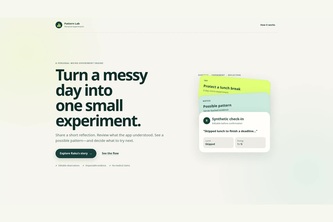
What the company appears to be: Personal Pattern Lab is a self-reported personal development tool that uses AI to interpret natural-language reflections into editable observations, inspectable patterns, and bounded experiments — without making causal claims or requiring complex tracking.
What changed: The author describes a shift from generic tracking tools toward a system where users begin with a messy daily reflection and end with one small, evidence-backed decision. This change is framed as moving from "recording history" to "making one reversible decision."
The single most important open question: Is there any evidence of user adoption or engagement beyond the author’s own development process? The description states no revenue, customers, or traction data exist.
Note: All claims are self-reported and unverified. This analysis is based solely on the project description provided by the caller.
What The Product Actually Is
The description states that Personal Pattern Lab turns a short natural-language check-in into:
- An editable observation
- An inspectable possible pattern
- One bounded experiment to try
It uses a synthetic persona named Raka as part of its user flow. The app extracts draft observations from user input, shows the source text, allows editing or removal, and only persists confirmed data.
The system integrates OpenAI's GPT-5.6 model via structured outputs and includes deterministic fallbacks when live providers are unavailable. It does not claim causality or medical validity.
Claim: The product is an AI-assisted reflection-to-decision tool.
Evidence: Author’s own write-up.
Inference: The product may be designed for personal habit formation or self-awareness.
Justification: Based on the stated goal of turning reflections into experiments and patterns, but not confirmed by usage data.
Positioning & Claim Evolution
The author positions Personal Pattern Lab as a tool that:
- Starts with messy daily reflections
- Avoids complex tracking or causal claims
- Focuses on evidence before advice
- Ensures user inspection and approval of AI interpretations
It is described as intentionally not a medical tool, nor one that pretends to know more than the data shows.
Claim: The product avoids traditional tracker + dashboard + AI advice models.
Evidence: Author's own write-up.
Inference: This suggests a niche positioning for users seeking low-effort, non-intrusive personal insight tools.
Justification: Based on emphasis on simplicity and lack of medical claims, but not substantiated by market data or user feedback.
Target Customer & ICP
The description does not name specific customer segments or personas. However, it implies a target audience that:
- Is already tired or busy
- Prefers natural-language input over structured forms
- Values transparency in AI interpretation
- Wants to make one small, reversible decision from reflection
It also notes the product is built for a narrow audience and avoids generic tracking tools.
Claim: The tool targets individuals looking for low-effort personal insight.
Evidence: Author’s own write-up.
Inference: Likely appeals to early adopters or those interested in AI-assisted self-improvement.
Justification: Not directly stated but implied by the design philosophy and use case.
Business Model & Pricing Evidence
There is no evidence of pricing, monetization strategy, or business model in the description. The project is presented as a hackathon submission with no indication of commercial intent or revenue streams.
Claim: No pricing or business model information provided.
Evidence: Author’s own write-up.
Technical & Delivery Signals
The application is built using:
- TypeScript
- Next.js
- React
- Node.js
- OpenAI API (GPT-5.6)
- Supabase + PostgreSQL
- Zod for validation
- Docker, GitHub Actions, Playwright, Vitest, axe-core
It includes features like:
- Row-level security
- Idempotent mutations
- Distributed rate limiting
- Synthetic workspace isolation
- Deterministic fallbacks
- Accessibility compliance (via axe-core)
The author mentions using Codex as a manager-led delivery team with defined roles and handoffs.
Claim: The technical stack supports secure, isolated, and deterministic operation.
Evidence: Author’s own write-up.
Inference: The architecture suggests a focus on safety, reproducibility, and user privacy.
Justification: Based on mention of credential-free testing, synthetic workspaces, and deterministic fallbacks.
Traction & Maturity Signals
There is no evidence of traction or maturity beyond the author’s own development process. No customers, users, or adoption metrics are mentioned. The project is described as a hackathon submission with no production deployment or user feedback.
Claim: No traction or user engagement data.
Evidence: Author’s own write-up.
Competitive Context
The description does not reference competitors or market positioning beyond stating that it avoids generic tracker + dashboard + AI advice models. It is unclear whether similar tools exist in the market, as no competitive landscape is described.
Claim: No competitive analysis provided.
Evidence: Author’s own write-up.
Open Questions & Risks
Key risks and open questions include:
- Lack of user data or feedback
- No commercial traction or revenue model
- Product is presented only as a hackathon submission
- No indication of scalability beyond the author's development environment
- Risk of over-engineering for a small, unproven audience
Claim: The product lacks evidence of real-world usage.
Evidence: Author’s own write-up.
Questions the description leaves open
- What is your plan to validate demand beyond the author's own experience?
- How do you intend to scale beyond a single developer’s development cycle?
- Are there any plans for monetization or user acquisition?
- What are the key assumptions about user behavior that underpin this product?
- Have you considered how users might interact with the bounded experiment feature in practice?
Overall Assessment
This is a self-reported hackathon project with no evidence of traction, revenue, or customer engagement. It presents an interesting concept around AI-assisted reflection and decision-making but lacks commercial viability indicators.
Claim: No investment or partnership value at this stage.
Evidence: Author’s own write-up.
Inference: The product may have potential if validated with users and scaled beyond the author's development cycle.
Justification: Not substantiated by current evidence.
User Stories BotA demo video on every pull request
Get a demo video on every new feature
GitHub App that watches your pull requests and records a narrated, captioned demo.
Save time on demo prep and make informed decisions faster with a video walkthrough of every new feature.
Source
Submitted to the OpenAI 2026 hackathon on Devpost. Project home on Devpost. Back to the full gallery on Devpost.
This competitive analysis was produced by top-founders.com (opens in a new tab)
Generated by a language model from this project's public Devpost page — its tagline, the author's own write-up and any built-with tags listed there — as captured in August 2026. Short quotations are the author's words. It is an opinion on the idea as a business, not on the people behind it, and it reflects the description as published then. If the project has moved on, request a correction below. The analysis is not independent research and contains no verified traction, revenue or customer data.
An independent guide by KFG International LLC — not affiliated with, endorsed by, or connected to Devpost or OpenAI.