

Archive position — measured, not model output
1 like on Devpost
505 of the 7,850 archived projects have more likes, and 1,758 share exactly 1 — so this project's #1,970 place in the like-ranked listing is a tie-break inside that group, not a ranking.
Projects (log scale)
Likes on Devpost. ▲ marks this project's group.
Show the figures
| Likes | Projects | Share of archive |
|---|---|---|
| 0 | 5,587 | 71.2% |
| 1 | 1,758 | 22.4% |
| 2 | 284 | 3.6% |
| 3–4 | 132 | 1.7% |
| 5–9 | 75 | 1.0% |
| 10+ | 14 | 0.2% |
 User Stories BotA demo video on every pull request
Get a demo video on every new feature
GitHub App that watches your pull requests and records a narrated, captioned demo.
Save time on demo prep and make informed decisions faster with a video walkthrough of every new feature.
Executive Summary
What the company appears to be
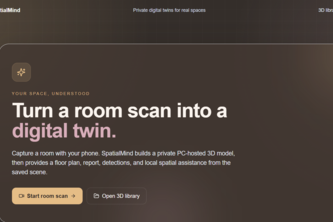
SpatialMind is a self-reported personal project by one developer (Ryann Binoy) that turns phone walkthroughs into private, PC-hosted 3D room twins using photogrammetry and local object detection. It builds on open-source tools like COLMAP, YOLO, and Ollama to reconstruct scenes from video input and provides an interactive viewer with scene understanding features.
What changed
The project is presented as a proof-of-concept or hackathon submission (Devpost entry for OpenAI 2026 hackathon). No evidence of product-market fit, revenue, customers, or traction beyond the author's own account. It is not a commercial product in operation.
Single most important open question
Is there any evidence that this concept has been validated with users beyond the author’s own testing? The description makes no claims about adoption, usage, or feedback from target users — only self-reported technical execution and capability.
What The Product Actually Is
The description states that SpatialMind:
- Takes a phone walkthrough video
- Sends it to a PC for processing
- Uses COLMAP for 3D reconstruction
- Includes local object detection (YOLO)
- Provides an interactive browser-based viewer with orbit, zoom, and export options
- Generates scene summaries, floor plans, and reports only when supported by evidence
- Keeps all data private and local
It is described as a tool that allows users to inspect and trust a digital twin of a room, rather than just admire it.
Evidence
- Author's own write-up
- Technology stack listed (COLMAP, YOLO, Ollama, etc.)
Inference The system appears to be a hybrid mobile-to-desktop workflow for photogrammetry-based 3D modeling with some semantic understanding and uncertainty reporting.
Positioning & Claim Evolution
The author positions SpatialMind as:
- A solution to the problem of “3D room scans that look cool but tell you nothing”
- A tool for homeowners, students, designers, or renters who want a usable digital twin
- Focused on accuracy and trustworthiness over visual appeal
- Capable of generating reliable reconstructions with diagnostics
The claim evolution shows:
- Initial inspiration: dissatisfaction with current 3D scanning tools
- Core value proposition: turning raw video into a trustworthy, inspectable 3D model
- Technical focus on honesty in output — not faking confidence
Evidence
- Author’s own write-up and tagline
Inference The positioning is focused on usability and reliability over aesthetics or commercial scale.
Target Customer & ICP
The description states that SpatialMind targets:
- Homeowners
- Students
- Designers
- Renters
These are described as people who want to “walk through a room with your phone, and end up with a private digital twin you can inspect and trust.”
Evidence
- Author’s own write-up
Inference The ICP is likely individuals or small teams needing personal or semi-professional 3D room modeling tools — not enterprise clients or large-scale commercial users.
Business Model & Pricing Evidence
Not evidenced.
There is no mention of pricing, monetization strategy, or business model in the description. The project is presented as a personal or hackathon effort with no indication of how it would be sold or used commercially.
Evidence
- Author’s own write-up
Technical & Delivery Signals
The author reports:
- End-to-end pipeline from phone video to validated 3D reconstruction
- Use of COLMAP for camera tracking and meshing
- Local object detection (YOLO)
- In-app assistant powered by Ollama + Qwen (no API key required)
- Frame selection, contrast boosting, parallax validation, registration tracking
- Output formats: GLB, PLY, OBJ
- Viewer features: orbit, zoom, top/front views, wireframe mode, export
Evidence
- Author’s own write-up and technology tags
Inference The system is built with open-source tools and designed to run locally without cloud dependencies. It emphasizes robustness over speed or scalability.
Traction & Maturity Signals
Not evidenced.
There is no mention of:
- Customers
- Revenue
- Usage metrics
- Product adoption
- Market validation
- Iteration history beyond the hackathon submission
The project is described as a single-person effort submitted to a hackathon, with no indication of prior traction or growth.
Evidence
- Author’s own write-up
Competitive Context
Not evidenced.
There is no mention of:
- Competitors
- Market analysis
- Prior art
- Differentiation from existing tools
The description does not place SpatialMind within a broader competitive landscape.
Evidence
- Author’s own write-up
Open Questions & Risks
Key risks and open questions based on the self-reported account:
- Single-person development: No team, no support structure
- No traction or validation: Only personal testing reported; no user feedback or adoption data
- Hackathon project: Likely not a mature product or scalable solution
- High technical complexity: Requires mobile-to-desktop upload flow and photogrammetry tuning — difficult to implement reliably at scale
- Limited commercial viability: No pricing, monetization, or business model described
Evidence
- Author’s own write-up
Questions the description leaves open
- What is the actual user feedback you’ve received from people trying this?
- Have you tested this with real users beyond yourself?
- How do you plan to scale beyond a single-person workflow?
- Is there any intention to monetize or commercialize this tool?
- What are the limitations of the current pipeline in real-world environments?
- Are there plans for integration with other platforms or tools?
Overall Assessment
Not evidenced.
There is no evidence of:
- Revenue
- Customers
- Traction
- Market demand
- Commercial viability
This appears to be a personal project submitted as part of a hackathon, not a commercial venture. The author states that the next direction is semantic 3D localization — but there is no indication of progress toward a product or market.
Confidence Level Low The description provides no evidence of traction, revenue, or customer validation. It is a self-reported technical demonstration with no commercial signal.
User Stories BotA demo video on every pull request
Get a demo video on every new feature
GitHub App that watches your pull requests and records a narrated, captioned demo.
Save time on demo prep and make informed decisions faster with a video walkthrough of every new feature.
Source
Submitted to the OpenAI 2026 hackathon on Devpost. Project home on Devpost. Back to the full gallery on Devpost.
This competitive analysis was produced by top-founders.com (opens in a new tab)
Generated by a language model from this project's public Devpost page — its tagline, the author's own write-up and any built-with tags listed there — as captured in August 2026. Short quotations are the author's words. It is an opinion on the idea as a business, not on the people behind it, and it reflects the description as published then. If the project has moved on, request a correction below. The analysis is not independent research and contains no verified traction, revenue or customer data.
An independent guide by KFG International LLC — not affiliated with, endorsed by, or connected to Devpost or OpenAI.