

Archive position — measured, not model output
1 like on Devpost
505 of the 7,850 archived projects have more likes, and 1,758 share exactly 1 — so this project's #1,846 place in the like-ranked listing is a tie-break inside that group, not a ranking.
Projects (log scale)
Likes on Devpost. ▲ marks this project's group.
Show the figures
| Likes | Projects | Share of archive |
|---|---|---|
| 0 | 5,587 | 71.2% |
| 1 | 1,758 | 22.4% |
| 2 | 284 | 3.6% |
| 3–4 | 132 | 1.7% |
| 5–9 | 75 | 1.0% |
| 10+ | 14 | 0.2% |
 User Stories BotA demo video on every pull request
Get a demo video on every new feature
GitHub App that watches your pull requests and records a narrated, captioned demo.
Save time on demo prep and make informed decisions faster with a video walkthrough of every new feature.
Executive Summary
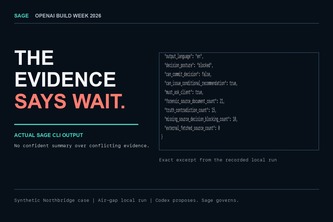
What the company appears to be: Sage is a self-reported local-first Python system designed for enterprise decision-making. It ingests dossiers and constructs governed, traceable analytical states rather than immediately generating recommendations. The system emphasizes evidence grounding, decision authority boundaries, and conditional outputs.
What changed: The project description indicates that prior work existed before the Build Week period, with the current submission representing an extension and industrialization of an existing system. Codex and GPT-5.6 were used during Build Week to extend Sage into a more complete resolution system.
Single most important open question: Does Sage's approach to evidence-grounded decision-making provide sufficient value to justify its complexity, or does it risk becoming overly cautious and unactionable?
What The Product Actually Is
The description states that Sage is a local-first Python system operated through a command-line workflow. It ingests dossiers and creates governed, traceable analytical state rather than immediately generating recommendations.
Key components include:
- Source custody and provenance
- Source-quality assessments
- Claims and observations
- Contradictions
- Evidence gaps
- Decision gates
- Canonical decision graph
- Case world-model surface
- Bounded scenarios and simulations
- Ranked but conditional options
- Consultant-facing reports
- Machine-readable audit artifacts
The system is described as producing "a canonical decision graph", "case world-model surface", and "bounded scenarios and simulations" rather than direct recommendations.
Positioning & Claim Evolution
The description states that Sage builds "evidence-grounded world models for mission-critical decisions". It emphasizes that:
- Every important conclusion must remain connected to evidence, uncertainty and decision authority
- If required information is unavailable, Sage does not silently fill the gap but records missing evidence and can block commitment
- Sage may prepare, compare and challenge decisions but does not commit the decision itself
The positioning appears to be a system for rigorous, evidence-based decision support that maintains human judgment as final authority.
Target Customer & ICP
Not evidenced. The description does not specify target customers or ideal customer profiles beyond the general use case of "mission-critical decisions" and enterprise transformation cases.
Business Model & Pricing Evidence
Not evidenced. There is no information provided about pricing, revenue models, or business model in the description.
Technical & Delivery Signals
The system is described as:
- A local-first Python system
- Operated through a command-line workflow
- Using Python 3.11
- Deterministic seeds and explicit run contracts
- Structured JSON state
- Markdown and PDF consultant artifacts
- pytest-based targeted and regression testing
- Content hashes and custody manifests
- Case-specific adapters isolated from the neutral core
- Explicit network and execution policies
- Human approval boundaries
The description states that Codex and GPT-5.6 were used as engineering partners during Build Week, not just for autocomplete or code generation.
Traction & Maturity Signals
Not evidenced. There is no mention of revenue, customers, adoption, or traction beyond the synthetic demonstration case.
Competitive Context
Not evidenced. The description does not discuss competitors or competitive positioning.
Open Questions & Risks
- The system explicitly refuses to commit decisions and only produces conditional options
- It may become overly cautious and unactionable if it frequently blocks commitment due to evidence gaps
- The local-first architecture with command-line interface suggests limited accessibility for non-technical users
- The approach of refusing unsupported conclusions could be perceived as a limitation rather than a strength by some users
- No evidence of real-world customer adoption or revenue generation
Questions the description leaves open
- What specific enterprise decision-making problems does Sage solve that existing tools don't?
- How do you plan to scale beyond the current command-line, local-first approach?
- What are the actual use cases where this level of evidence grounding adds measurable value?
- How do you handle situations where evidence gaps are so extensive that no meaningful options can be generated?
- What is the timeline for moving from the current demonstration state to a production-ready system?
Overall Assessment
Not evidenced. The description does not contain information about funding rounds, valuations, or investment status. No indication of whether this represents a commercial opportunity or a research prototype.
The project appears to be a self-reported technical demonstration with no evidence of commercial traction or business model. The approach is novel in emphasizing evidence grounding and human authority boundaries, but the lack of revenue, customers, or clear market positioning makes it difficult to assess its commercial viability.
User Stories BotA demo video on every pull request
Get a demo video on every new feature
GitHub App that watches your pull requests and records a narrated, captioned demo.
Save time on demo prep and make informed decisions faster with a video walkthrough of every new feature.
Source
Submitted to the OpenAI 2026 hackathon on Devpost. Project home on Devpost. Back to the full gallery on Devpost.
This competitive analysis was produced by top-founders.com (opens in a new tab)
Generated by a language model from this project's public Devpost page — its tagline, the author's own write-up and any built-with tags listed there — as captured in August 2026. Short quotations are the author's words. It is an opinion on the idea as a business, not on the people behind it, and it reflects the description as published then. If the project has moved on, request a correction below. The analysis is not independent research and contains no verified traction, revenue or customer data.
An independent guide by KFG International LLC — not affiliated with, endorsed by, or connected to Devpost or OpenAI.