

Archive position — measured, not model output
0 likes on Devpost
2,263 of the 7,850 archived projects have more likes, and 5,587 share exactly 0 — so this project's #3,809 place in the like-ranked listing is a tie-break inside that group, not a ranking.
Projects (log scale)
Likes on Devpost. ▲ marks this project's group.
Show the figures
| Likes | Projects | Share of archive |
|---|---|---|
| 0 | 5,587 | 71.2% |
| 1 | 1,758 | 22.4% |
| 2 | 284 | 3.6% |
| 3–4 | 132 | 1.7% |
| 5–9 | 75 | 1.0% |
| 10+ | 14 | 0.2% |
 User Stories BotA demo video on every pull request
Get a demo video on every new feature
GitHub App that watches your pull requests and records a narrated, captioned demo.
Save time on demo prep and make informed decisions faster with a video walkthrough of every new feature.
Executive Summary
What the company appears to be
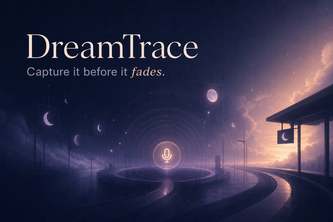
DreamTrace is a self-reported mobile-first Progressive Web App (PWA) designed for recording and organizing dream memories immediately after waking. The product is built around a core design principle: preserving the provenance of user-generated content versus AI-generated interpretations, with clear labeling of what is remembered vs. what is generated or organized by AI.
What changed
The project description indicates that DreamTrace was developed as part of a hackathon submission (OpenAI 2026). It reflects an early-stage prototype focused on technical feasibility and user experience design rather than commercial traction or product-market fit.
The single most important open question
Is there evidence of any real-world usage, customer feedback, or product adoption beyond the author's own development work? The description contains no data about users, revenue, or market response.
Note: This analysis is based entirely on the self-reported and unverified project description provided by the author. No external verification or historical data are available.
What The Product Actually Is
The description states that DreamTrace is a mobile-first Progressive Web App for recording dreams immediately after waking. It allows users to record voice, type text, or upload audio. The app uses Gemini AI models to transcribe and structure the content into an editable dream record.
Key features include:
- Voice memory recording with pause/resume capabilities
- Transcript correction before structuring
- Adaptive questioning (with “I don’t remember” treated as valid)
- Structured output including:
- Title and summary
- Scene sequence
- People, places, objects, motifs
- Emotional arc
- Unresolved fragments
- Original transcript
- AI-generated storyboard
- Optional reflection or cutscene
The app separates user memory from AI interpretation through labels and visual design. Generated media (images/video) are explicitly labeled as artistic visualizations or cutscenes, not recovered memories.
Inference: The product is described as a prototype with no commercial deployment or user base. It is built for demonstration purposes within a hackathon context.
Positioning & Claim Evolution
The description states that DreamTrace begins with the fastest natural action—speaking what is still there—and avoids adding AI invention as remembered truth. Its central design question is framed not as “How much can AI add?” but “How can AI help organize a memory without quietly changing it?”
It positions itself as a tool for truthful, editable dream records, emphasizing:
- Provenance-aware organization
- Separation of user memory from AI interpretation
- Minimalist, adaptive questioning
Claim vs. Fact: These are self-reported claims about intent and design philosophy. There is no evidence of actual market positioning or competitive differentiation beyond the author’s own narrative.
Target Customer & ICP
The description does not name specific target customers or personas. However, it implies a user base interested in:
- Dream journaling
- Memory preservation
- AI-assisted organization without distortion
It targets individuals who wake up and want to capture fleeting dream memories quickly, using voice input.
Inference: The app is likely aimed at people who value personal reflection or creative expression through dreams. No evidence of segmentation or targeting beyond this general interest.
Business Model & Pricing Evidence
There is no mention of pricing, monetization strategies, or business model in the description.
Not evidenced
Technical & Delivery Signals
The app is built using:
- Frontend: TypeScript, React, Next.js-compatible Vinext
- Backend: Cloudflare Worker deployment
- AI Services: Gemini (various models for transcription, structuring, image/video generation)
- Storage: Local storage, IndexedDB
- Security: Server-side handling of credentials; no exposure to client code
Key technical signals:
- Provider-neutral architecture
- Typed DreamRecord contract with runtime validation
- No credentials in browser code
- Offline capability via PWA shell
- Comprehensive test coverage across unit, integration, E2E, and live paths
Inference: The system is designed for reliability and security. It avoids common pitfalls like credential leakage or silent data corruption.
Traction & Maturity Signals
There is no evidence of:
- Revenue
- Customers
- User adoption
- Product-market fit
- Market traction
The project is described as a hackathon submission, with no indication of ongoing development, user feedback, or commercial viability.
Not evidenced
Competitive Context
No mention of competitors or competitive landscape in the description.
Not evidenced
Open Questions & Risks
Key risks and open questions based on the self-reported information:
- Unproven market demand: No evidence of real-world usage or customer interest.
- Limited scope: The project is described as a prototype, not a scalable product.
- High dependency on AI providers: Reliance on Google Cloud and Gemini APIs without clear fallbacks or multi-provider support beyond the hackathon context.
- No monetization strategy: No indication of how the product would generate revenue.
- Low team size: Only one developer (Kazari Uiharu) is listed, which may limit scalability.
Inference: The project lacks commercial readiness and market validation.
Questions the description leaves open
- What inspired the idea for DreamTrace? Was there any prior user research or feedback?
- How did you validate that users actually want to record and organize dreams this way?
- Are there plans to expand beyond the current PWA prototype into a native app or broader platform?
- What are your thoughts on potential monetization models (e.g., subscription, premium features)?
- How do you plan to scale beyond a single developer’s capacity?
- Have you considered how to handle privacy and data retention for sensitive dream content?
Overall Assessment
Not evidenced
The description provides no information about:
- Revenue or financials
- Customers or user base
- Market traction or adoption
- Commercial viability
This is a self-reported hackathon prototype, not a product in the market. It shows strong technical execution and thoughtful design but lacks any evidence of commercial traction or business development.
Confidence level: Low — based on thin, self-reported evidence only.
User Stories BotA demo video on every pull request
Get a demo video on every new feature
GitHub App that watches your pull requests and records a narrated, captioned demo.
Save time on demo prep and make informed decisions faster with a video walkthrough of every new feature.
Source
Submitted to the OpenAI 2026 hackathon on Devpost. Project home on Devpost. Back to the full gallery on Devpost.
This competitive analysis was produced by top-founders.com (opens in a new tab)
Generated by a language model from this project's public Devpost page — its tagline, the author's own write-up and any built-with tags listed there — as captured in August 2026. Short quotations are the author's words. It is an opinion on the idea as a business, not on the people behind it, and it reflects the description as published then. If the project has moved on, request a correction below. The analysis is not independent research and contains no verified traction, revenue or customer data.
An independent guide by KFG International LLC — not affiliated with, endorsed by, or connected to Devpost or OpenAI.