

Archive position — measured, not model output
0 likes on Devpost
2,263 of the 7,850 archived projects have more likes, and 5,587 share exactly 0 — so this project's #3,811 place in the like-ranked listing is a tie-break inside that group, not a ranking.
Projects (log scale)
Likes on Devpost. ▲ marks this project's group.
Show the figures
| Likes | Projects | Share of archive |
|---|---|---|
| 0 | 5,587 | 71.2% |
| 1 | 1,758 | 22.4% |
| 2 | 284 | 3.6% |
| 3–4 | 132 | 1.7% |
| 5–9 | 75 | 1.0% |
| 10+ | 14 | 0.2% |
 User Stories BotA demo video on every pull request
Get a demo video on every new feature
GitHub App that watches your pull requests and records a narrated, captioned demo.
Save time on demo prep and make informed decisions faster with a video walkthrough of every new feature.
Executive Summary
What the company appears to be
DriftGuard is a self-reported tool that uses AI (specifically GPT-5.6) to scan codebases of AI-built apps, infer data invariants from them, and detect silent data corruption — including cases where data integrity issues are not explicitly coded or documented. It also attempts to repair such issues using AI-generated SQL transactions.
What changed
The author states that they built this tool during an OpenAI hackathon, primarily with Codex and GPT-5.6, in a single-threaded project approach. The tool is described as being capable of scanning, checking, and healing data integrity issues in apps that use SQLite databases and are written in Node.js.
The single most important open question
Is there any evidence of real-world usage or testing beyond the author's own development environment? The description makes no claims about revenue, customers, or adoption — only self-reported functionality and a demo.
What The Product Actually Is
The description states that DriftGuard is an "immune system for AI-built apps". It operates through three core components:
- driftguard scan: Uses GPT-5.6 to read app schema and source code, generating invariants (e.g., referential integrity, freshness, volume bounds, domain rules inferred from semantics).
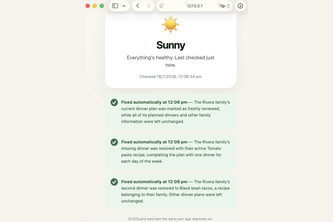
- driftguard check: Runs these invariants against a database and renders a plain-English report (sunny/cloudy/stormy) without stack traces.
- driftguard heal: On breach, proposes a single SQL transaction via GPT-5.6, applies it to a sandboxed copy, re-runs checks, and promotes the fix only if all pass.
The tool is designed to work on apps with SQLite databases and Node.js source code. It is claimed to be able to infer rules not explicitly written down — such as cross-household recipe rules in a demo app.
Evidence
- The description states this.
- It includes a CLI interface (
driftguard scan <your-app-dir>) and YAML output (mine.yaml). - It mentions the use of
better-sqlite3,node.js,openai-api,gpt-5.6, andyaml.
Inference It is inferred that DriftGuard is a proof-of-concept or prototype built in a hackathon setting, not yet deployed at scale.
Positioning & Claim Evolution
The author positions DriftGuard as a solution to the problem of silent data corruption in AI-built apps — particularly where bugs are not noticed by users but cause long-term abandonment. The core claim is that:
- AI tools that build apps should also be able to reason about their own logic.
- Invariants can be inferred from code, not just written down.
- The system provides a family-friendly way to report and fix data issues.
Evidence
- The tagline: “AI-built apps are everywhere. DriftGuard generates invariants from your code, catches silent corruption, reports it in plain English your family will trust - and heals it.”
- The author’s own write-up emphasizes the idea that AI should be able to "write the assertions about it" — meaning the same AI that built the app can also validate its behavior.
Inference The positioning is framed as a solution to a common problem in personal or small-scale AI apps, but not yet proven at scale. The claim of “healing” data corruption is presented as a novel feature, though it’s limited to sandboxed environments and demo use cases.
Target Customer & ICP
The description does not clearly identify a target customer or ideal customer profile (ICP). It implies that DriftGuard is for developers who build AI apps, particularly those using SQLite and Node.js. The author's own experience with personal apps suggests a focus on individual developers or small teams building personal tools.
Evidence
- The author builds personal apps ("menu planners, trackers, family utilities").
- The tool is designed to work with SQLite and Node.js.
- It targets silent corruption in AI-built apps — not yet defined as a commercial market.
Inference It is inferred that the initial user base would be developers building personal or small-scale AI tools, but there is no evidence of any actual customers or target markets beyond the author’s own use case.
Business Model & Pricing Evidence
There is no evidence in the description of a business model or pricing structure. The tool is described as a hackathon project with no mention of monetization or commercial deployment.
Evidence
- No revenue, pricing, or customer data.
- The tool is presented as a demo and prototype.
Inference It is inferred that DriftGuard has not yet reached a commercial stage, nor does it have any known business model beyond its own development.
Technical & Delivery Signals
The project was built entirely with Codex and GPT-5.6, using an AGENTS.md spec for structure. It includes:
- A CLI interface (
driftguard scan,check,heal) - YAML output files
- Use of SQLite and Node.js
- Sandboxed repair logic to avoid real data corruption
Evidence
- Built with
better-sqlite3,node.js,openai-api,gpt-5.6,yaml - The author describes how Codex was used in a structured way, including testing and validation loops
- A demo app is included (
examples/chore-chart) - The tool works on SQLite databases and Node.js apps
Inference It is inferred that the tool is technically feasible but not yet production-ready. It uses AI for both inference and repair, but with guardrails to prevent unsafe behavior.
Traction & Maturity Signals
There is no evidence of traction or maturity beyond the author’s own development environment. No customers, revenue, or adoption data are provided.
Evidence
- The project was submitted to a hackathon.
- No mention of real-world usage or testing.
- The tool is described as a demo and prototype.
Inference It is inferred that DriftGuard has not yet reached a market-ready stage. It is a proof-of-concept, not a product with real users or adoption metrics.
Competitive Context
The description does not mention any competitors or existing tools in the space of AI-built app integrity or data corruption detection.
Evidence
- No competitive analysis.
- No references to similar tools or platforms.
Inference It is inferred that there is no known competitive landscape for this specific tool, though it may overlap with general data validation or integrity-checking tools used in software development.
Open Questions & Risks
Several risks and open questions are present:
- Unproven in real-world usage: The tool has not been tested beyond the author’s own environment.
- Model variance: GPT-5.6 output is non-deterministic, which could affect reliability.
- Limited scope: Works only on SQLite/Node.js apps; no support for other databases or languages.
- Demo-only functionality: Healing is sandboxed and not production-ready.
- No commercial viability: No evidence of monetization or customer base.
Evidence
- The author states that tests passed but the product was unproven.
- Model variance was a challenge during development.
- The tool is limited to specific tech stacks (Node.js, SQLite).
- Healing only works in demo mode with guardrails.
Inference It is inferred that DriftGuard is not yet ready for commercial or production use and lacks any real-world validation.
Questions the description leaves open
- Has the tool been tested on apps outside of your own development environment?
- What are the specific limitations of the AI inferences? Are there cases where it fails to detect corruption?
- How does the tool handle edge cases or complex data structures beyond simple SQLite schemas?
- Is there any plan for supporting other databases (e.g., PostgreSQL)?
- What is the current state of the healing logic — is it safe enough for production use?
- Are there any known issues with model variance that affect reliability?
- How does DriftGuard integrate into existing CI/CD or deployment pipelines?
Overall Assessment
Not evidenced.
There is no evidence of revenue, customers, traction, or a clear path to monetization. The tool is described as a hackathon project with no commercial application yet demonstrated.
Inference It is inferred that DriftGuard is not yet ready for investment or partnership discussions. It may be a promising idea, but it has not yet proven its value in real-world applications or markets.
User Stories BotA demo video on every pull request
Get a demo video on every new feature
GitHub App that watches your pull requests and records a narrated, captioned demo.
Save time on demo prep and make informed decisions faster with a video walkthrough of every new feature.
Source
Submitted to the OpenAI 2026 hackathon on Devpost. Project home on Devpost. Back to the full gallery on Devpost.
This competitive analysis was produced by top-founders.com (opens in a new tab)
Generated by a language model from this project's public Devpost page — its tagline, the author's own write-up and any built-with tags listed there — as captured in August 2026. Short quotations are the author's words. It is an opinion on the idea as a business, not on the people behind it, and it reflects the description as published then. If the project has moved on, request a correction below. The analysis is not independent research and contains no verified traction, revenue or customer data.
An independent guide by KFG International LLC — not affiliated with, endorsed by, or connected to Devpost or OpenAI.