

Archive position — measured, not model output
0 likes on Devpost
2,263 of the 7,850 archived projects have more likes, and 5,587 share exactly 0 — so this project's #5,772 place in the like-ranked listing is a tie-break inside that group, not a ranking.
Projects (log scale)
Likes on Devpost. ▲ marks this project's group.
Show the figures
| Likes | Projects | Share of archive |
|---|---|---|
| 0 | 5,587 | 71.2% |
| 1 | 1,758 | 22.4% |
| 2 | 284 | 3.6% |
| 3–4 | 132 | 1.7% |
| 5–9 | 75 | 1.0% |
| 10+ | 14 | 0.2% |
 User Stories BotA demo video on every pull request
Get a demo video on every new feature
GitHub App that watches your pull requests and records a narrated, captioned demo.
Save time on demo prep and make informed decisions faster with a video walkthrough of every new feature.
Executive Summary
Company: OUTLIER
Self-reported basis: The description is entirely self-reported and unverified, based on a Devpost submission for the OpenAI 2026 hackathon. No external corroboration exists.
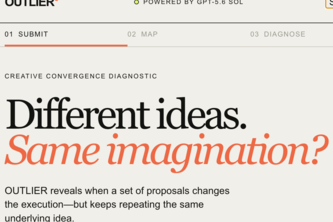
What it appears to be: A diagnostic tool that uses GPT-5.6-sol to analyze creative campaign proposals and identify when different ideas share underlying logic, distinguishing valuable outliers from mere deviations.
What changed: The author describes a shift in focus from measuring creativity to identifying structural similarity and divergence in creative work.
Single most important open question: Does the tool produce actionable insights that teams actually use for decision-making, or is it a proof-of-concept with limited practical utility?
What The Product Actually Is
The description states that OUTLIER:
- Accepts a creative brief and 6–12 campaign proposals.
- Uses GPT-5.6-sol to analyze ideas across five structural dimensions.
- Maps similar ideas into territories.
- Identifies the dominant creative logic.
- Distinguishes a valuable outlier from off-brief deviation.
- Recommends a counter-direction by reversing the dominant logic.
- Suggests the smallest experiment needed to test that direction.
The author describes it as a "diagnostic and decision-support tool" for human teams, not a creativity scorer or scientific instrument. It is built with Next.js, TypeScript, and OpenAI's Responses API (gpt-5.6-sol), using structured outputs and server-side API key handling.
Confidence: Low — the description is self-reported and lacks evidence of actual use, testing, or feedback from users.
Positioning & Claim Evolution
The author states:
- Creative teams are good at producing visible variety but poor at recognizing when ideas share the same underlying logic.
- OUTLIER helps teams avoid false confidence in their range of options.
- It is not a creativity score, nor does it pretend to be scientific.
- The tool distinguishes between surface variation and structural change.
The positioning has evolved from a general creative decision-support tool to one that specifically addresses the problem of "false confidence" in idea diversity. It emphasizes diagnostic clarity over scoring or ranking.
Confidence: Low — this is a self-described evolution, not validated by usage or feedback.
Target Customer & ICP
The author states:
- The tool is designed for creative decision-makers.
- It focuses on teams working with campaign proposals and creative briefs.
- It does not target general AI users or developers.
No further segmentation or customer personas are described. The team size is listed as one, suggesting a solo developer approach.
Confidence: Very low — no evidence of actual customers or user feedback.
Business Model & Pricing Evidence
The description states:
- No accounts or databases are required.
- API keys remain securely on the server.
- The tool does not charge for use.
There is no mention of monetization, pricing tiers, subscriptions, or any business model beyond a hackathon MVP.
Confidence: Not evidenced — no commercial structure described.
Technical & Delivery Signals
The author states:
- Built with Next.js, TypeScript, OpenAI’s gpt-5.6-sol via Responses API.
- Uses structured outputs and Zod for validation.
- Codex was used as a collaborator in development.
- The product requires no database or user accounts.
- Tests are written using Vitest.
The tool is described as server-side only, with no client-side data persistence or user tracking. It uses a minimal architecture to avoid complexity.
Confidence: Medium — technical details are self-reported but consistent with a prototype.
Traction & Maturity Signals
The description states:
- This is an MVP built during OpenAI 2026 hackathon.
- Future versions may include visual board support, team collaboration features, and organizational memory.
- The author intentionally excluded advanced features to focus on core functionality.
No evidence of actual users, adoption, or feedback is provided. No revenue, customer base, or usage metrics are mentioned.
Confidence: Not evidenced — no traction data available.
Competitive Context
The author states:
- The tool was built during a hackathon.
- Codex helped with research and scope reduction.
- It addresses a gap in creative decision-making tools that rely on surface-level variety rather than structural logic.
No mention of existing tools or competitors is provided. No competitive analysis, market positioning, or differentiation from other AI-powered creative tools is evident.
Confidence: Not evidenced — no competitive landscape described.
Open Questions & Risks
- The tool is presented as a hackathon MVP with no commercial traction.
- It is built by one person and lacks any evidence of team or user testing.
- No pricing, monetization, or business model is described.
- The author explicitly avoids scientific claims but does not clarify how the system’s logic is validated or interpreted.
- The tool does not store data or require accounts — this may limit scalability or long-term utility.
Confidence: Medium — risks are inferred from lack of evidence and self-reported limitations.
Questions the description leaves open
- What specific creative teams have you tested this with, and what feedback did they give?
- How do you validate that the model's structural logic mapping is accurate or useful in practice?
- Are there any real-world use cases where this tool was applied beyond the hackathon?
- What would a full commercial version look like, and how does it differ from the MVP?
- Is there any plan to collect user data or build a database for future iterations?
Overall Assessment
The description states that OUTLIER is an MVP built during a hackathon. It is not evidenced to have any commercial traction, revenue, or customer base. The tool is described as a diagnostic and decision-support mechanism but lacks evidence of real-world application or impact.
Confidence: Very low — no commercial due-diligence signals are present beyond the author’s own claims.
Assessment: Not ready for investment or partnership consideration without further evidence of traction, user feedback, or business model development.
User Stories BotA demo video on every pull request
Get a demo video on every new feature
GitHub App that watches your pull requests and records a narrated, captioned demo.
Save time on demo prep and make informed decisions faster with a video walkthrough of every new feature.
Source
Submitted to the OpenAI 2026 hackathon on Devpost. Project home on Devpost. Back to the full gallery on Devpost.
This competitive analysis was produced by top-founders.com (opens in a new tab)
Generated by a language model from this project's public Devpost page — its tagline, the author's own write-up and any built-with tags listed there — as captured in August 2026. Short quotations are the author's words. It is an opinion on the idea as a business, not on the people behind it, and it reflects the description as published then. If the project has moved on, request a correction below. The analysis is not independent research and contains no verified traction, revenue or customer data.
An independent guide by KFG International LLC — not affiliated with, endorsed by, or connected to Devpost or OpenAI.