

Archive position — measured, not model output
1 like on Devpost
505 of the 7,850 archived projects have more likes, and 1,758 share exactly 1 — so this project's #1,848 place in the like-ranked listing is a tie-break inside that group, not a ranking.
Projects (log scale)
Likes on Devpost. ▲ marks this project's group.
Show the figures
| Likes | Projects | Share of archive |
|---|---|---|
| 0 | 5,587 | 71.2% |
| 1 | 1,758 | 22.4% |
| 2 | 284 | 3.6% |
| 3–4 | 132 | 1.7% |
| 5–9 | 75 | 1.0% |
| 10+ | 14 | 0.2% |
 User Stories BotA demo video on every pull request
Get a demo video on every new feature
GitHub App that watches your pull requests and records a narrated, captioned demo.
Save time on demo prep and make informed decisions faster with a video walkthrough of every new feature.
Executive Summary
What the company appears to be
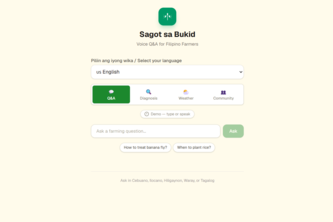
Sagot sa Bukid is a voice-based Q&A platform designed for Filipino farmers, enabling them to ask farming questions in local languages (Cebuano, Ilocano, Hiligaynon, Waray, Tagalog) and receive spoken answers — even when offline. It was built as a submission to the OpenAI 2026 hackathon.
What changed
The project is presented as a self-contained prototype or proof-of-concept submitted for a hackathon. No evidence of prior development, traction, or commercial deployment exists in the description.
The single most important open question
Is there any evidence of real-world use, adoption, or engagement by farmers? The description provides no indication of whether this is a working product or just an idea.
Note: This analysis is based solely on the self-reported, unverified description provided by the author. All claims are stated by the project description and not independently verified. There is no evidence of revenue, customers, funding, or traction.
What The Product Actually Is
The description states that Sagot sa Bukid is a voice Q&A system for Filipino farmers. It allows users to ask farming questions in local languages (Cebuano, Ilocano, Hiligaynon, Waray, Tagalog) and receive spoken answers back. It works offline.
- The product uses technologies such as Next.js 16, Google Gemini API, Meta NLLB-200 (Hugging Face), OpenAI Whisper (Hugging Face), React 19, Tailwind CSS 4, and TypeScript.
- It was built for the OpenAI 2026 hackathon.
Inference: The system appears to be a voice-enabled application that leverages AI models for language translation and speech recognition. However, no evidence of actual functionality or deployment is provided.
Positioning & Claim Evolution
The project description states: “Voice Q&A for Filipino farmers — ask farming questions in Cebuano, Ilocano, Hiligaynon, Waray, or Tagalog, get spoken answers back. Works offline.”
- The positioning is clear: a localized, offline-capable voice assistant for agricultural communities.
- There is no indication of how the product evolved from an idea to a prototype or whether it has moved beyond the hackathon stage.
Claim: The author positions this as a tool for farmers in rural Philippines who may not have internet access or English proficiency. This is a stated intent, not verified traction.
Target Customer & ICP
The description states that Sagot sa Bukid targets Filipino farmers and supports local languages (Cebuano, Ilocano, Hiligaynon, Waray, Tagalog).
- The target customer is described as rural farmers in the Philippines.
- No further segmentation or definition of ideal customer profile (ICP) is provided.
Claim: Farmers who speak local Philippine languages and may not have reliable internet access. This is a self-stated positioning, not validated by data or user feedback.
Business Model & Pricing Evidence
No information is provided about the business model or pricing structure.
- The description does not mention monetization, licensing, subscriptions, or any revenue streams.
- No evidence of pricing, partnerships, or commercialization strategy exists.
Not evidenced: There is no indication of how this product would generate value or income.
Technical & Delivery Signals
The project was built with the following technologies:
- Front-end: Next.js 16, React 19, Tailwind CSS 4, TypeScript
- Back-end: Next.js API routes
- AI/ML tools: Google Gemini API, Meta NLLB-200 (Hugging Face), OpenAI Whisper (Hugging Face)
Inference: The use of AI models and voice technologies suggests a technical foundation for speech-to-text and text-to-speech functionality. However, no evidence of actual delivery or performance is provided.
Traction & Maturity Signals
The project was submitted to the OpenAI 2026 hackathon.
- No evidence of user adoption, customer engagement, or product maturity beyond a hackathon submission.
- The team size is listed as one (Ramenagii Lonrezo).
- There is no mention of beta users, pilot programs, or real-world testing.
Not evidenced: No signs of traction, growth, or product development beyond the initial prototype.
Competitive Context
No information is provided about competitors or market context.
- The description does not reference existing solutions in the agricultural tech or voice assistant space.
- There is no indication of how this project compares to other tools or platforms serving similar needs.
Not evidenced: No competitive analysis or positioning relative to existing players.
Open Questions & Risks
- Prototype-only: The product appears to be a hackathon submission with no evidence of real-world deployment.
- No traction or adoption: No users, customers, or engagement metrics are reported.
- Single founder: Limited team size raises questions about execution capability and scalability.
- Unverified claims: All stated features and use cases are self-reported without corroboration.
Inference: The lack of evidence for real-world usage or product development suggests a high risk of misalignment between the stated vision and actual progress.
Questions the description leaves open
- What is the current status of the product beyond the hackathon? Is it being tested with farmers?
- How many farmers have been reached or engaged with the system?
- Has the team conducted any user research or field testing?
- Are there plans to monetize or scale this solution?
- What are the technical limitations or scalability concerns of the current implementation?
Overall Assessment
The project is presented as a hackathon submission with no evidence of traction, revenue, or adoption.
- Confidence level: Low.
- Assessment: Not ready for investment or partnership consideration without further development and proof of concept. The description does not provide sufficient evidence to assess viability, scalability, or commercial potential.
Inference: While the idea has a clear social purpose and technical foundation, it lacks real-world validation or business momentum.
User Stories BotA demo video on every pull request
Get a demo video on every new feature
GitHub App that watches your pull requests and records a narrated, captioned demo.
Save time on demo prep and make informed decisions faster with a video walkthrough of every new feature.
Source
Submitted to the OpenAI 2026 hackathon on Devpost. Project home on Devpost. Back to the full gallery on Devpost.
This competitive analysis was produced by top-founders.com (opens in a new tab)
Generated by a language model from this project's public Devpost page — its tagline and any built-with tags listed there, since the author published no write-up — as captured in August 2026. Short quotations are the author's words. It is an opinion on the idea as a business, not on the people behind it, and it reflects the description as published then. If the project has moved on, request a correction below. The analysis is not independent research and contains no verified traction, revenue or customer data.
An independent guide by KFG International LLC — not affiliated with, endorsed by, or connected to Devpost or OpenAI.