

Archive position — measured, not model output
1 like on Devpost
505 of the 7,850 archived projects have more likes, and 1,758 share exactly 1 — so this project's #1,850 place in the like-ranked listing is a tie-break inside that group, not a ranking.
Projects (log scale)
Likes on Devpost. ▲ marks this project's group.
Show the figures
| Likes | Projects | Share of archive |
|---|---|---|
| 0 | 5,587 | 71.2% |
| 1 | 1,758 | 22.4% |
| 2 | 284 | 3.6% |
| 3–4 | 132 | 1.7% |
| 5–9 | 75 | 1.0% |
| 10+ | 14 | 0.2% |
 User Stories BotA demo video on every pull request
Get a demo video on every new feature
GitHub App that watches your pull requests and records a narrated, captioned demo.
Save time on demo prep and make informed decisions faster with a video walkthrough of every new feature.
Executive Summary
Project: Salamenos
Self-reported basis: Author's own description of a project submitted to the OpenAI 2026 hackathon on Devpost. No external verification, no revenue, customers, or traction data provided.
Commercial due-diligence read: The author describes an ambitious project that attempts to solve inefficiencies in AI-assisted development by introducing deterministic formats and dynamic settings. However, there is no evidence of product-market fit, customer traction, or viable monetization strategy. The project appears to be a conceptual prototype with limited execution and no clear path to commercial viability.
Key open question: Is this a concept that could evolve into a scalable product, or is it an unproven idea that lacks the resources or execution capability for meaningful development?
What The Product Actually Is
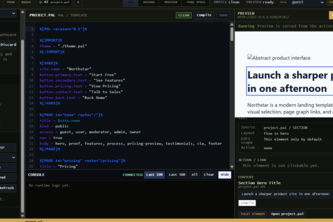
The description states that Salamenos uses custom formats (.pal) to create a language easy for AI to understand and edit. These formats are said to include:
- Variables at the top of code
- Custom instructions and blocks baked into the code
- Dynamic settings that allow users to adjust values directly without AI involvement
- Templates to integrate assets easily, with modular design
It also introduces:
- Deterministic fixes, where simple UI changes (e.g., color or font) are handled locally and instantly, bypassing AI
- A system for directly baking permissions into how a website works, allowing different user roles to be seen without extra code
- An easy-to-understand page documentation that flags dead ends or outdated pages
- Dirt-cheap/free hosting using overrides on templates and unified database formats
The author claims this is not a clone of existing tools like "Lovable" or "Codex", but rather a novel approach to AI interaction in development.
Inference: The product appears to be a conceptual framework for structuring code and workflows that can be interpreted by AI, with an emphasis on reducing reliance on AI for small tasks.
Positioning & Claim Evolution
The author positions Salamenos as:
- A solution to inefficiencies in AI-assisted development
- A way to reduce resource waste from simple fixes (e.g., changing colors or fonts)
- A system that allows users to avoid consuming AI credits for minor changes
- A platform that supports deterministic shortcuts and dynamic settings
The project evolved over time, with the author noting:
- It was "too ambitious" at the start
- It has been postponed, canceled, and rethought multiple times
- The idea originated before the "agentic era" became popular
- The author now believes an individual cannot compete with large platforms like Lovable or Codex
Inference: The positioning is that of a developer tool aimed at improving AI workflows, but it has undergone significant shifts in scope and ambition. The current version seems to be a conceptual prototype rather than a working product.
Target Customer & ICP
The description states:
- The target is normal users who are not coders
- These users should not worry about consuming resources or AI credits
- It aims to make AI interaction more efficient and less burdensome for non-developers
It also mentions:
- Users can select a UI element (button, text) and ask an "agent" to change it instantly
- The system supports modular integration of assets into apps like oath flows or newsletters
Inference: The ICP is likely non-technical users or small teams who want to make quick edits without relying heavily on AI. However, no specific customer segments or personas are defined.
Business Model & Pricing Evidence
The author states:
- They cannot process payments, which is a major barrier
- There is no mention of pricing models, monetization strategies, or revenue streams
- The project is described as being in a "pause" due to lack of ability to earn money easily
Inference: No business model or pricing evidence is provided. The author explicitly states they cannot monetize the product.
Technical & Delivery Signals
The author reports:
- Built with Codex, Vite, JavaScript, backend, Docker
- Multiple phases of development over months
- A prototype was built, but it’s unclear if it's functional or scalable
- The project is described as a "single person" effort
Inference: Technical execution is limited to a single developer. No evidence of scalability, robustness, or production-ready features.
Traction & Maturity Signals
The description states:
- The project has been postponed, canceled, and rethought multiple times
- It’s currently on pause
- The author says they are focusing on other projects and "my teen years"
- No evidence of customers, users, or adoption is provided
- The author acknowledges that the idea was ahead of its time but lacks execution
Inference: There is no traction or maturity. The project remains conceptual with no measurable user engagement or product development.
Competitive Context
The author mentions:
- It’s not a clone of tools like Lovable or Codex
- It aims to be more efficient than current AI workflows
- It introduces concepts like dynamic settings and deterministic fixes, which are claimed to be unique
Inference: The competitive landscape is unclear. No direct competitors are named, but the project attempts to differentiate itself from existing AI development tools.
Open Questions & Risks
- No product-market fit or traction — no evidence of users, customers, or adoption
- Single-person development — no team or scalable execution capability
- Monetization barriers — no payment processing, no revenue model
- Ambition vs. execution — the idea is described as "too ambitious" and has been repeatedly delayed
- Unproven concepts — features like deterministic fixes and dynamic settings are not demonstrated or validated
Inference: The project lacks commercial viability due to lack of traction, scalability, and monetization.
Questions the description leaves open
- What is the current state of the prototype? Is it functional or just conceptual?
- How do you plan to monetize this product, especially given that you cannot process payments?
- What are your plans for scaling beyond a single-person effort?
- Have you validated any of the core assumptions with potential users?
- What is the timeline for development and launch?
Overall Assessment
Not evidenced: There is no evidence of revenue, customers, or traction to support an investment or partnership decision.
Inference: Based on the self-reported description, this project is a conceptual idea with no demonstrated product-market fit or commercial viability. It lacks execution capability and monetization strategy. The author acknowledges that it’s not yet ready for market and is currently paused.
User Stories BotA demo video on every pull request
Get a demo video on every new feature
GitHub App that watches your pull requests and records a narrated, captioned demo.
Save time on demo prep and make informed decisions faster with a video walkthrough of every new feature.
Source
Submitted to the OpenAI 2026 hackathon on Devpost. Project home on Devpost. Back to the full gallery on Devpost.
This competitive analysis was produced by top-founders.com (opens in a new tab)
Generated by a language model from this project's public Devpost page — its tagline, the author's own write-up and any built-with tags listed there — as captured in August 2026. Short quotations are the author's words. It is an opinion on the idea as a business, not on the people behind it, and it reflects the description as published then. If the project has moved on, request a correction below. The analysis is not independent research and contains no verified traction, revenue or customer data.
An independent guide by KFG International LLC — not affiliated with, endorsed by, or connected to Devpost or OpenAI.