

Archive position — measured, not model output
1 like on Devpost
505 of the 7,850 archived projects have more likes, and 1,758 share exactly 1 — so this project's #1,852 place in the like-ranked listing is a tie-break inside that group, not a ranking.
Projects (log scale)
Likes on Devpost. ▲ marks this project's group.
Show the figures
| Likes | Projects | Share of archive |
|---|---|---|
| 0 | 5,587 | 71.2% |
| 1 | 1,758 | 22.4% |
| 2 | 284 | 3.6% |
| 3–4 | 132 | 1.7% |
| 5–9 | 75 | 1.0% |
| 10+ | 14 | 0.2% |
 User Stories BotA demo video on every pull request
Get a demo video on every new feature
GitHub App that watches your pull requests and records a narrated, captioned demo.
Save time on demo prep and make informed decisions faster with a video walkthrough of every new feature.
Executive Summary
What the company appears to be
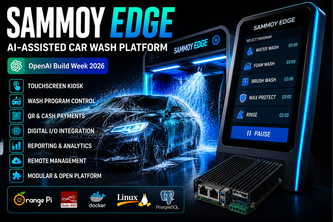
SAMMOY Edge is a self-reported AI-assisted control platform for self-service car washes. The description states it combines kiosk UI, payments, wash programs, industrial I/O, reporting, and remote management on an Orange Pi hardware platform.
What changed
The project evolved from a real industrial automation project into a complete software and hardware platform with help from OpenAI Codex. It began as a solution for one car wash operator and aims to become a configurable alternative to proprietary controllers.
Single most important open question
Is there evidence of actual traction, revenue or customer adoption beyond the author's own prototype?
The description is self-reported and unverified. No evidence of revenue, customers, or market validation exists in the provided information. The project appears to be an early-stage prototype built by one person using AI tools.
What The Product Actually Is
The description states that SAMMOY Edge is:
- An AI-assisted control platform for self-service car washes
- A modular system combining kiosk UI, payments, wash programs, industrial I/O, reporting and remote management
- Designed to run on an Orange Pi Zero 3 using Linux, Docker, Node-RED, and a browser-based kiosk interface
- Capable of handling digital input/output integration with equipment like buttons, relays, sensors, valves, pumps
- Supporting QR payment workflow, cash payment workflow, tariff configuration, balance calculation, pause functionality
The system is described as having:
- Portrait touchscreen kiosk interface
- Configurable wash programs
- Operator and reporting pages
- Remote administration capabilities
- Configurable branding for different operators
Positioning & Claim Evolution
The description states that SAMMOY Edge was inspired by the need to replace expensive, closed proprietary controllers that are difficult to customize and maintain. The author claims it's designed to be more open and modular.
Positioning evolution:
- Started as a real industrial automation project for one car wash
- Evolved into a complete software and hardware platform
- Aims to become a configurable alternative to proprietary car wash controllers
The description states that the system was built with help from OpenAI Codex throughout the engineering workflow, including code analysis, refactoring, debugging, interface development, documentation, and validation.
Target Customer & ICP
The description states that SAMMOY Edge targets:
- Self-service car wash operators
- Operators who depend on closed proprietary controllers that are expensive to customize and difficult to maintain
- Car washes seeking more open and modular control systems
The author notes that the platform is designed to support different car wash brands through configurable branding.
Business Model & Pricing Evidence
Not evidenced. The description does not state any pricing information, revenue model or commercial arrangements.
Technical & Delivery Signals
The description states that SAMMOY Edge uses:
- Orange Pi Zero 3 hardware
- Linux operating system
- Docker for deployment and service isolation
- Node-RED for control logic, events, device communication and kiosk workflows
- Browser-based kiosk UI
- Digital I/O integration with industrial equipment
- Payment workflows for QR and cash-based balance replenishment
- PostgreSQL database
- REST APIs
The system is described as having modular architecture that separates hardware-specific logic from reusable application logic to support different equipment configurations.
Traction & Maturity Signals
Not evidenced. The description states this is a prototype built by one person, but provides no evidence of:
- Revenue generation
- Customer adoption
- Market traction
- Product-market fit validation
- Commercial deployment
The author mentions preparing a "real industrial prototype rather than a purely conceptual demonstration" but does not provide any data on usage or performance.
Competitive Context
Not evidenced. The description does not mention:
- Direct competitors
- Market size or share
- Competitive advantages
- Industry positioning
- Market dynamics
Open Questions & Risks
- Single-person team (1 member) with no evidence of additional contributors or support
- Prototype-only status with no commercial traction or revenue data
- No evidence of customer validation or market testing
- Self-reported claims without independent verification
- Industrial automation requirements may require safety certifications not addressed in description
- Hardware-specific implementation may limit scalability
- AI-assisted development may create dependency on specific tools without clear path to independent maintenance
Questions the description leaves open
- What is the actual industrial automation experience of the single team member?
- Has there been any real-world testing with actual car wash operators?
- What are the safety and regulatory requirements for industrial control systems in this context?
- How does the system handle hardware failures or maintenance issues?
- What specific payment providers are supported, and how is compliance handled?
- Are there any existing partnerships or pilot programs with car wash operators?
- What is the timeline for moving from prototype to commercial deployment?
- How will the platform scale beyond a single installation?
Overall Assessment
Not evidenced. The description provides no information about:
- Revenue or financial performance
- Customer base or adoption metrics
- Market opportunity size
- Commercial traction
- Financial requirements or funding needs
The project appears to be an early-stage prototype with no evidence of commercial viability or market validation. The single-person team and lack of traction data make it difficult to assess investment potential or partnership value at this stage.
User Stories BotA demo video on every pull request
Get a demo video on every new feature
GitHub App that watches your pull requests and records a narrated, captioned demo.
Save time on demo prep and make informed decisions faster with a video walkthrough of every new feature.
Source
Submitted to the OpenAI 2026 hackathon on Devpost. Project home on Devpost. Back to the full gallery on Devpost.
This competitive analysis was produced by top-founders.com (opens in a new tab)
Generated by a language model from this project's public Devpost page — its tagline, the author's own write-up and any built-with tags listed there — as captured in August 2026. Short quotations are the author's words. It is an opinion on the idea as a business, not on the people behind it, and it reflects the description as published then. If the project has moved on, request a correction below. The analysis is not independent research and contains no verified traction, revenue or customer data.
An independent guide by KFG International LLC — not affiliated with, endorsed by, or connected to Devpost or OpenAI.