

Archive position — measured, not model output
0 likes on Devpost
2,263 of the 7,850 archived projects have more likes, and 5,587 share exactly 0 — so this project's #3,815 place in the like-ranked listing is a tie-break inside that group, not a ranking.
Projects (log scale)
Likes on Devpost. ▲ marks this project's group.
Show the figures
| Likes | Projects | Share of archive |
|---|---|---|
| 0 | 5,587 | 71.2% |
| 1 | 1,758 | 22.4% |
| 2 | 284 | 3.6% |
| 3–4 | 132 | 1.7% |
| 5–9 | 75 | 1.0% |
| 10+ | 14 | 0.2% |
 User Stories BotA demo video on every pull request
Get a demo video on every new feature
GitHub App that watches your pull requests and records a narrated, captioned demo.
Save time on demo prep and make informed decisions faster with a video walkthrough of every new feature.
Executive Summary
What the company appears to be
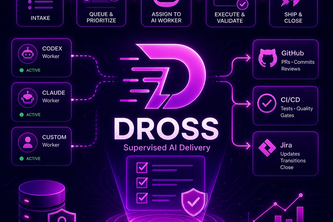
Dross is a self-reported local control plane for supervised AI software delivery. It aims to automate repeatable components of the software development lifecycle by orchestrating interactions between project management tools (like Jira), Git, and AI coding agents. The system separates deterministic workflow tasks from model reasoning, managing state, coordination, validation, recovery, and delivery through a dedicated orchestration layer.
What changed
The description indicates an evolution from a simple AI-assisted coding loop to a complex, multi-system workflow that requires explicit identity, durable state, and evidence-based transitions. The project grew out of the observation that AI agents spend significant time on non-model tasks like context switching, dependency resolution, and handoff management.
Single most important open question
Is there any evidence of actual usage or adoption by developers or teams? The description is entirely self-reported and lacks any data on real-world deployment, customer feedback, or product-market fit beyond the authors' own account.
What The Product Actually Is
The description states that Dross is an Electron and Node.js application backed by SQLite. It functions as a local control plane for supervised AI software delivery, automating workflows between Jira, Git, GitHub, and AI coding agents.
- It reads work from selected Jira projects and evaluates ticket eligibility.
- It creates isolated Git branches and worktrees for each assignment.
- It dispatches work through a supervised Codex or Claude runtime host.
- It tracks worker progress, checklist state, messages, diagnostics, and recovery actions via an Electron desktop interface.
- It validates results before allowing delivery to continue through commit, push, pull request, CI, review, merge, Jira closeout, and cleanup.
The system is built around a provider-neutral runtime-host interface that supports Codex and Claude. It uses SQLite for durable state management across workers, assignments, dispatches, hosts, turns, checklists, workspaces, notifications, retries, recovery claims, shipping checkpoints, and component policies.
Not evidenced: No information on actual product usage, user base, or real-world implementation beyond the authors' own account.
Positioning & Claim Evolution
The description states that Dross augments existing AI harnesses by automating repeatable components of the software development lifecycle. It positions itself as a way to use tokens efficiently, allocate AI budgets by project and priority, and move coordination, state management, validation, recovery, and delivery into a dedicated orchestration layer.
It evolved from a simple workflow loop into a complex system designed to handle asynchronous transitions across multiple tools with explicit identity, durable state, and evidence-based handling of interruptions and failures.
The authors claim Dross does not infer success from silence or process state but instead represents input acceptance, meaningful progress, transport loss, interruption, and terminal completion separately. They also state that it deliberately separates deterministic workflow work from model work.
Not evidenced: No claims about market positioning, competitive differentiation, or strategic direction beyond the self-reported narrative.
Target Customer & ICP
The description implies Dross targets developers working with AI coding agents who need to manage complex workflows involving Jira, Git, and other tools. It is positioned for teams that want to supervise AI-assisted software delivery and reduce token waste on non-model tasks.
It supports any project management tool via a modular customizable workflow graph with connectors, though it currently focuses on Jira.
Not evidenced: No information about specific customer segments, personas, or adoption patterns beyond the authors' own experience.
Business Model & Pricing Evidence
The description does not contain any information about pricing, monetization strategy, or business model. It is entirely focused on describing the technical architecture and functionality of the product.
Not evidenced: No details on revenue streams, pricing tiers, or commercial arrangements.
Technical & Delivery Signals
Dross is built using Electron, Node.js, JavaScript, TypeScript, and Codex. It uses SQLite for durable state management and Git worktrees for assignment isolation. The system includes:
- Dependency-aware Jira dashboard
- Project-specific intake and lifecycle policies
- Worker readiness and capability checks
- Per-worker work scopes
- Isolated assignment workspaces
- Durable SQLite checklists
- Ticket-scoped checklist and chat views
- Live progress and exact-turn controls
- Component-level pause controls
- A unified notification center
- Recovery and rebase workflows
- Pull-request, CI, merge, and Jira closeout automation
- Detailed operational diagnostics
It implements a provider-neutral runtime-host interface with capability descriptors for Codex and Claude. It handles interruptions, continuations, transport-loss recovery, and validates external mutations before performing them.
Not evidenced: No information on scalability, performance metrics, or delivery history beyond the authors' own account.
Traction & Maturity Signals
The description states that this was a Build Week project submitted to the OpenAI 2026 hackathon. It includes an iterative development process using Codex and GPT-5.6 Sol, with automated tests, operational runbooks, architecture references, state-machine documentation, and validation evidence.
It is described as a proof of concept that works end-to-end rather than a collection of disconnected scripts.
Not evidenced: No data on user adoption, customer feedback, or product-market fit beyond the authors' own account. No mention of any revenue, customers, or traction indicators.
Competitive Context
The description does not provide any information about competitors or competitive landscape. It focuses solely on the internal architecture and functionality of Dross without reference to existing solutions in the market.
Not evidenced: No analysis of competitive positioning, alternative products, or market dynamics.
Open Questions & Risks
- Lack of traction: The project is described as a hackathon submission with no evidence of real-world usage or adoption.
- Unproven commercial viability: There is no indication of any monetization strategy or business model.
- High technical complexity: The system handles many asynchronous systems and requires explicit identities, generation fences, transactions, bounded recovery operations, and idempotent external effects — all of which are challenging to implement correctly.
- Limited scope: While it supports Jira currently, there is no evidence of broader integration or scalability beyond the authors' own use case.
- Self-reported nature: All information comes from the authors’ own account; no independent verification exists.
Questions the description leaves open
- What specific problems are you solving in your target market?
- Have you tested Dross with real users or teams? If so, what feedback have you received?
- How do you plan to monetize this product?
- What is the timeline for moving from prototype to a production-ready version?
- Are there any technical limitations that prevent scaling beyond the current scope?
- How does Dross handle edge cases and failures in complex workflows?
- What are your plans for expanding support beyond Jira and Codex/Claude?
Overall Assessment
The description indicates that Dross is a self-reported prototype built during a hackathon, with no evidence of revenue, customers, or traction. It presents a technically ambitious solution to a problem in AI-assisted software delivery but lacks any demonstration of market demand or commercial viability.
Given the lack of verified data on usage, adoption, or business model, this project cannot be evaluated for investment or partnership potential at this time.
Confidence level Low — based entirely on self-reported evidence with no external corroboration.
User Stories BotA demo video on every pull request
Get a demo video on every new feature
GitHub App that watches your pull requests and records a narrated, captioned demo.
Save time on demo prep and make informed decisions faster with a video walkthrough of every new feature.
Source
Submitted to the OpenAI 2026 hackathon on Devpost. Project home on Devpost. Back to the full gallery on Devpost.
This competitive analysis was produced by top-founders.com (opens in a new tab)
Generated by a language model from this project's public Devpost page — its tagline, the author's own write-up and any built-with tags listed there — as captured in August 2026. Short quotations are the author's words. It is an opinion on the idea as a business, not on the people behind it, and it reflects the description as published then. If the project has moved on, request a correction below. The analysis is not independent research and contains no verified traction, revenue or customer data.
An independent guide by KFG International LLC — not affiliated with, endorsed by, or connected to Devpost or OpenAI.