

Archive position — measured, not model output
0 likes on Devpost
2,263 of the 7,850 archived projects have more likes, and 5,587 share exactly 0 — so this project's #5,778 place in the like-ranked listing is a tie-break inside that group, not a ranking.
Projects (log scale)
Likes on Devpost. ▲ marks this project's group.
Show the figures
| Likes | Projects | Share of archive |
|---|---|---|
| 0 | 5,587 | 71.2% |
| 1 | 1,758 | 22.4% |
| 2 | 284 | 3.6% |
| 3–4 | 132 | 1.7% |
| 5–9 | 75 | 1.0% |
| 10+ | 14 | 0.2% |
 User Stories BotA demo video on every pull request
Get a demo video on every new feature
GitHub App that watches your pull requests and records a narrated, captioned demo.
Save time on demo prep and make informed decisions faster with a video walkthrough of every new feature.
Executive Summary
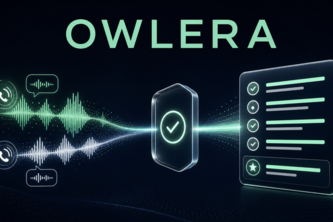
OWLERA is a self-reported technical pre-sales call processing system built for B2B SaaS companies. The project description states that it turns live technical calls into bilingual conversations and then converts those into structured buyer briefs using GPT-5.6, all without blocking caller latency.
The author claims the system uses Twilio SIP for voice input, Cloudflare Workers for compute, OpenAI Realtime APIs for live conversation handling, and GPT-5.6 for post-call analysis. It includes a consent-aware workflow where users must explicitly agree before any buyer brief is generated.
What changed: The project description indicates an extension built during the OpenAI Build Week, which added structured output validation using GPT-5.6, improved fallbacks, and public Judge Mode.
Single most important open question: Is there evidence of actual adoption or revenue generation from this system? The description makes no claims about customers, usage metrics, or commercial traction beyond its own demonstration.
What The Product Actually Is
The description states that OWLERA:
- Accepts technical pre-sales calls via Twilio SIP.
- Uses OpenAI Realtime for live voice interaction.
- Employs a Cloudflare Durable Object to manage call state.
- Processes the conversation post-call using GPT-5.6 with strict schema validation.
- Generates a "Technical Buyer Brief" containing:
- Call outcome and executive summary;
- Confirmed needs and fit signals;
- Risks and unknowns;
- Concrete next steps.
- Requires explicit consent before sending anything.
- Excludes caller phone numbers from prompts.
- Uses store: false in OpenAI API requests.
- Rejects malformed output at runtime.
Inferred: The system is designed to reduce friction for buyers during technical calls while ensuring that post-call artifacts are grounded and actionable. It separates latency-sensitive voice processing from deeper analysis using different models.
Not evidenced: No information on whether the system has been deployed in production, how many calls it handles, or what kind of feedback it receives from users.
Positioning & Claim Evolution
The author positions OWLERA as a tool that:
- Turns live technical calls into grounded bilingual conversations.
- Produces consent-aware GPT-5.6 buyer briefs without caller wait time.
- Avoids generic summaries by focusing on structured outcomes.
Claims suggest a shift from traditional call recording or transcription to decision-ready artifacts, with an emphasis on:
- Groundedness (no invented details),
- Consent awareness,
- Bilingual support,
- Low-latency voice experience.
Inferred: The positioning implies a move toward more actionable and automated follow-up in technical pre-sales workflows, possibly targeting SaaS vendors who want better quality leads or faster decision cycles.
Not evidenced: No indication of prior versions or how this evolved from earlier concepts. No mention of market feedback or competitive positioning beyond the hackathon context.
Target Customer & ICP
The description states that OWLERA is intended for:
- B2B SaaS companies conducting technical pre-sales calls.
- Buyers who need detailed integration constraints, risks, open questions, and next owners.
- Teams looking to convert call data into structured buyer briefs without manual effort.
Inferred: The target customer likely includes sales engineers or technical account managers in SaaS organizations who want to streamline their lead qualification process.
Not evidenced: No evidence of specific customer segments, personas, or use cases beyond the general idea of "technical pre-sales." No mention of existing customers or pilot programs.
Business Model & Pricing Evidence
The description does not contain any information about:
- Revenue streams,
- Pricing models,
- Monetization strategy,
- Customer acquisition costs,
- Unit economics.
Inferred: Since this is a hackathon submission, it's likely not yet monetized. The system appears to be built for internal or demonstration use rather than commercial deployment.
Not evidenced: No indication of how the product would be sold, if at all.
Technical & Delivery Signals
The description indicates:
- Built with Cloudflare Workers and TypeScript.
- Uses Durable Objects, Queues, R2 storage, Email Routing.
- Implements WebSocket connections to OpenAI Realtime.
- Handles provider events as at-least-once and potentially out-of-order.
- Includes idempotent transitions and bounded duplicate WebSockets.
- Runs automated tests (915 pass).
- Has a public Judge Mode for evaluation.
- Uses gpt-realtime-2.1 for voice, GPT-5.6 for structured output.
Inferred: The architecture suggests a robust, scalable system designed to handle asynchronous processing and maintain call integrity even under failure conditions.
Not evidenced: No evidence of actual deployment, performance benchmarks, or scalability testing beyond the demo setup.
Traction & Maturity Signals
The description states:
- A public demo exists (Judge Mode).
- Live number available (+64 9 873 7321).
- Repository includes timestamped Build Week extension.
- 915 automated tests pass.
- Includes smoke checks for build, deployment, readiness, and email delivery.
Inferred: The project shows some maturity in terms of code quality and testing. However, there is no evidence of real-world usage or adoption.
Not evidenced: No data on user engagement, call volume, customer feedback, or commercial traction.
Competitive Context
The description does not mention:
- Direct competitors,
- Market size,
- Competitive advantages,
- Differentiation from other voice-to-text or AI-powered sales tools.
Inferred: OWLERA operates in the intersection of voice automation and structured lead generation. It may compete with tools that offer call summarization, CRM integrations, or conversational AI platforms for B2B sales.
Not evidenced: No competitive analysis or market positioning beyond its own claims.
Open Questions & Risks
Key risks identified from the description:
- Unproven commercial viability: This is a hackathon project with no evidence of revenue or customer adoption.
- Over-reliance on proprietary APIs: Uses OpenAI Realtime and GPT-5.6, which may not be stable or scalable for enterprise use.
- Limited scalability assumptions: While architecture supports async processing, there's no evidence of large-scale testing or production load handling.
- No clear path to monetization: No indication of how the product would generate value or revenue.
Open questions:
- Lack of customer data or feedback.
- No mention of compliance or privacy considerations beyond excluding phone numbers.
- No evidence of integration with CRM or other enterprise tools.
Not evidenced: No risk assessments, failure modes, or mitigation strategies beyond internal architecture design.
Questions the description leaves open
- What is the current stage of development? Is this a prototype or something closer to production?
- Have you conducted any real-world testing with actual buyers or sales teams?
- How do you plan to monetize this product, if at all?
- Are there any known limitations in terms of call volume, latency, or accuracy?
- What are the technical constraints around integrating with existing CRM systems?
- Can you provide examples of how the buyer briefs are used in practice?
- How do you ensure data privacy and consent compliance across different jurisdictions?
- What is your roadmap for scaling beyond the current demo setup?
Overall Assessment
The description presents OWLERA as a technical pre-sales automation tool built during a hackathon. It includes detailed architecture and implementation notes but lacks evidence of traction, revenue, or customer adoption.
Confidence level: Low — based entirely on self-reported information with no external validation.
Assessment: This is an early-stage idea with strong engineering execution. However, without proof of commercial viability, user feedback, or market demand, it cannot be considered a viable investment or partnership opportunity at this time.
Not evidenced: No financials, no customer base, no product-market fit indicators, and no clear path to monetization.
User Stories BotA demo video on every pull request
Get a demo video on every new feature
GitHub App that watches your pull requests and records a narrated, captioned demo.
Save time on demo prep and make informed decisions faster with a video walkthrough of every new feature.
Source
Submitted to the OpenAI 2026 hackathon on Devpost. Project home on Devpost. Back to the full gallery on Devpost.
This competitive analysis was produced by top-founders.com (opens in a new tab)
Generated by a language model from this project's public Devpost page — its tagline, the author's own write-up and any built-with tags listed there — as captured in August 2026. Short quotations are the author's words. It is an opinion on the idea as a business, not on the people behind it, and it reflects the description as published then. If the project has moved on, request a correction below. The analysis is not independent research and contains no verified traction, revenue or customer data.
An independent guide by KFG International LLC — not affiliated with, endorsed by, or connected to Devpost or OpenAI.