

Archive position — measured, not model output
1 like on Devpost
505 of the 7,850 archived projects have more likes, and 1,758 share exactly 1 — so this project's #1,851 place in the like-ranked listing is a tie-break inside that group, not a ranking.
Projects (log scale)
Likes on Devpost. ▲ marks this project's group.
Show the figures
| Likes | Projects | Share of archive |
|---|---|---|
| 0 | 5,587 | 71.2% |
| 1 | 1,758 | 22.4% |
| 2 | 284 | 3.6% |
| 3–4 | 132 | 1.7% |
| 5–9 | 75 | 1.0% |
| 10+ | 14 | 0.2% |
 User Stories BotA demo video on every pull request
Get a demo video on every new feature
GitHub App that watches your pull requests and records a narrated, captioned demo.
Save time on demo prep and make informed decisions faster with a video walkthrough of every new feature.
Executive Summary
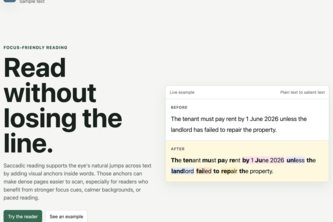
The description states that Salient Reader (aka ReadMePls) is a browser-based web application designed to support neurodivergent readers, particularly in legal contexts, by guiding eye movements during reading to reduce cognitive effort. The tool is built using modern web technologies and deployed via Cloudflare Workers. It was developed as part of a hackathon submission and has no evidenced traction, revenue, or customer data.
The most important open question is whether the described approach to reading guidance—based on saccadic eye movement research—is technically feasible and scalable in practice, especially for legal documents that vary widely in structure and complexity.
What The Product Actually Is
- The description states that Salient Reader is a "lightweight browser based web app" using modern web technologies.
- It is described as a "Saccadic Guided Reader", intended to support reading by guiding eye movements.
- The tool is designed for use with any text but was built with legal documents in mind.
- It uses JavaScript-based reading guidance and dynamic text rendering.
- Deployment is via Cloudflare Workers.
- It was built using author-declared technologies: codex, gemma4, ollama, pdf-alchemy, pypdf, python.
Positioning & Claim Evolution
- The description states that the project began from a conversation about legal document reading challenges and the need for accessibility support for neurodivergent users.
- It evolved into an experiment focused on "support[ing] the way people naturally read rather than expecting readers to adapt to traditional document formats."
- The author claims it is designed to make legal information feel more approachable without changing content.
- The project is positioned as a tool that supports different reading styles and cognitive needs, avoiding assumptions about neurodiversity.
- It aims to be part of a "wider suite of AI-powered legal accessibility tools."
Target Customer & ICP
- The description states the primary users are "neurodivergent readers," particularly those dealing with legal documents.
- Specific user groups mentioned include individuals with ADHD and others who struggle with long, dense texts.
- The tool is intended for use by people reading legal information in stressful situations such as workplace disputes or tribunal claims.
- No specific customer segments beyond neurodivergent users are identified.
Business Model & Pricing Evidence
- Not evidenced. The description does not mention any pricing model, monetization strategy, or business model.
Technical & Delivery Signals
- The application is described as a "lightweight browser based web app" that runs entirely within the browser.
- It uses responsive front-end development and JavaScript-based reading guidance.
- Deployment is via Cloudflare Workers.
- Technologies mentioned include: codex, gemma4, ollama, pdf-alchemy, pypdf, python.
- The project was built using modern web technologies.
- No evidence of API integrations, data pipelines, or backend infrastructure beyond the browser-based approach.
Traction & Maturity Signals
- Not evidenced. There is no mention of users, customers, revenue, usage metrics, or adoption.
- The project is described as a hackathon submission.
- No evidence of product-market fit, user feedback loops, or iterative development beyond initial experimentation.
- No evidence of team growth, funding rounds, or partnerships.
Competitive Context
- Not evidenced. No mention of competitors, market size, or competitive positioning.
- The description does not reference existing tools for legal document accessibility or reading guidance.
- No evidence of market analysis or differentiation from other solutions.
Open Questions & Risks
- The project is described as a hackathon submission with no traction or commercialization history.
- It relies heavily on academic research (saccadic eye movements, visual attention) that may not translate directly into practical application.
- The tool is designed for "neurodivergent readers" but lacks specific user testing or validation data.
- The author notes challenges in balancing guidance with avoiding distraction, suggesting potential usability issues.
- No evidence of scalability beyond the current prototype or demonstration.
Questions the description leaves open
- What specific research or studies informed the saccadic eye movement approach?
- How was the user experience validated with actual neurodivergent users?
- What are the technical limitations of implementing reading guidance in a browser-based environment?
- How does the tool handle different document formats and structures (e.g., contracts vs. case law)?
- Are there any plans to integrate with existing legal document platforms or services?
- What is the roadmap for moving beyond the current prototype into a production-ready product?
Overall Assessment
- Not evidenced. No financial data, valuation, or investment history provided.
- The project is described as a hackathon submission with no commercial traction.
- The description does not indicate any interest from investors or partners.
- Given the lack of evidence for revenue, customers, or product-market fit, there is insufficient basis to assess investment potential at this stage.
User Stories BotA demo video on every pull request
Get a demo video on every new feature
GitHub App that watches your pull requests and records a narrated, captioned demo.
Save time on demo prep and make informed decisions faster with a video walkthrough of every new feature.
Source
Submitted to the OpenAI 2026 hackathon on Devpost. Project home on Devpost. Back to the full gallery on Devpost.
This competitive analysis was produced by top-founders.com (opens in a new tab)
Generated by a language model from this project's public Devpost page — its tagline, the author's own write-up and any built-with tags listed there — as captured in August 2026. Short quotations are the author's words. It is an opinion on the idea as a business, not on the people behind it, and it reflects the description as published then. If the project has moved on, request a correction below. The analysis is not independent research and contains no verified traction, revenue or customer data.
An independent guide by KFG International LLC — not affiliated with, endorsed by, or connected to Devpost or OpenAI.