

Archive position — measured, not model output
0 likes on Devpost
2,263 of the 7,850 archived projects have more likes, and 5,587 share exactly 0 — so this project's #5,776 place in the like-ranked listing is a tie-break inside that group, not a ranking.
Projects (log scale)
Likes on Devpost. ▲ marks this project's group.
Show the figures
| Likes | Projects | Share of archive |
|---|---|---|
| 0 | 5,587 | 71.2% |
| 1 | 1,758 | 22.4% |
| 2 | 284 | 3.6% |
| 3–4 | 132 | 1.7% |
| 5–9 | 75 | 1.0% |
| 10+ | 14 | 0.2% |
 User Stories BotA demo video on every pull request
Get a demo video on every new feature
GitHub App that watches your pull requests and records a narrated, captioned demo.
Save time on demo prep and make informed decisions faster with a video walkthrough of every new feature.
Executive Summary
The company appears to be a solo project by a pharmacist-turned-developer, named Overthink Analyzer, which self-claims to offer an AI-powered mental health tool for detecting and interrupting overthinking loops. The author states the tool uses Codex and GPT-5, and was built during an OpenAI hackathon. No revenue, customers or traction data are evidenced.
The single most important open question is: What is the actual commercial viability of a self-described "mental health tool" built by one person in a hackathon, with no demonstrated user base or monetization strategy?
This analysis is based entirely on the author's own description and is unverified. The project has not been independently corroborated.
What The Product Actually Is
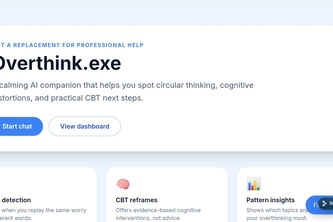
The description states that Overthink Analyzer is an AI-powered mental health tool designed to detect overthinking loops in real time, with the goal of interrupting them when users are overwhelmed or anxious — particularly at night. It is described as a tool that functions as a therapist alternative, but not replacement.
- The product uses Codex and GPT-5 (author claims).
- It was built during an OpenAI hackathon.
- It includes real-time loop detection functionality.
- It is intended to be available 24/7 for immediate help when overthinking strikes.
Not evidenced: What the tool actually does beyond detection, how it interacts with users, or whether it has any clinical validation or therapeutic efficacy.
Positioning & Claim Evolution
The author positions Overthink Analyzer as a solution to the problem of "overthinking" — specifically, the anxiety and sleepless nights caused by excessive worry about health, side effects, etc. The tool is framed as an always-available AI therapist that can help users break the loop when they are alone and distressed.
- It is described as a "mental health tool."
- The tagline: “Break the loop, free your mind. Stop overthinking, Start living.”
- The author claims to have built it as a non-programmer.
- It was submitted to an OpenAI hackathon.
Not evidenced: Whether this is a new or differentiated product in the mental health space, how it compares to existing tools, or whether the claim of "real-time loop detection" has been validated.
Target Customer & ICP
The author states that the inspiration came from working as a pharmacist and observing patients’ anxiety and overthinking about medications. The target customer is implied to be individuals who suffer from anxiety, particularly around health concerns, and who may not have access to traditional therapy or who seek immediate help.
- The tool is aimed at people who experience overthinking, especially at night.
- It is intended for those who are anxious or stressed about their health.
- The author has a waitlist already (self-reported).
Not evidenced: Who the actual users are, how many there are, what their demographics are, or whether they have been validated.
Business Model & Pricing Evidence
The description does not contain any information on pricing, monetization, or business model. The author mentions a beta test with 100 users and plans to partner with therapists for validation, but no revenue streams or pricing models are described.
Not evidenced: How the product will be monetized, whether it will be free, subscription-based, or otherwise priced.
Technical & Delivery Signals
The project was built using Codex and GPT-5, as stated by the author. It was developed during a hackathon and is described as a working tool.
- Built with: Codex, GitHub, Replit.
- Uses GPT-5 (author claims).
- The tool includes real-time loop detection.
- The author states they are a non-programmer who built it from scratch.
Not evidenced: Technical architecture, scalability, or whether the tool is production-ready. No evidence of deployment, infrastructure, or performance metrics.
Traction & Maturity Signals
The author claims to have a waitlist and plans for beta testing with 100 users. There is no mention of actual users, revenue, or product adoption.
- Beta test planned with 100 users.
- Waitlist already exists (self-reported).
- No evidence of user engagement, retention, or feedback.
Not evidenced: Actual user base, usage data, or any traction beyond the waitlist and beta plan.
Competitive Context
The author does not provide any information on competitors. The project is described as a hackathon product with no indication of market analysis or competitive positioning.
Not evidenced: Who the competitors are, what they do, or how this tool differentiates from existing mental health tools or AI assistants.
Open Questions & Risks
- Solo development by one person (no team).
- Built in a hackathon — no evidence of product-market fit or long-term development.
- No revenue, customers, or traction.
- Claims about AI capabilities (e.g., GPT-5) not independently verified.
- Mental health tool without clinical validation or therapeutic oversight.
- No pricing model or monetization strategy.
Not evidenced: Whether the tool is safe or effective for mental health use, whether it complies with healthcare regulations, or whether there are legal or ethical concerns around AI therapy tools.
Questions the description leaves open
- What is the actual mechanism by which the tool detects overthinking loops?
- How does the tool ensure safety and ethical use in mental health contexts?
- What clinical or therapeutic validation has been done, if any?
- How will you scale beyond a beta test with 100 users?
- Is there any plan to partner with licensed therapists or mental health professionals?
- What are your plans for monetization and pricing?
- How do you intend to validate the effectiveness of the tool in reducing overthinking?
Overall Assessment
Not evidenced: No commercial due-diligence basis to recommend investment or partnership.
This is a self-reported, unverified hackathon project by one person with no demonstrated traction, revenue, or business model. The author makes claims about AI and mental health tools but provides no evidence of product-market fit, user validation, or scalability. It is not clear whether this represents a viable commercial opportunity or a prototype in early development.
Confidence: Low. This analysis is based entirely on the author’s own account, which lacks any independent corroboration or data about users, revenue, or performance.
User Stories BotA demo video on every pull request
Get a demo video on every new feature
GitHub App that watches your pull requests and records a narrated, captioned demo.
Save time on demo prep and make informed decisions faster with a video walkthrough of every new feature.
Source
Submitted to the OpenAI 2026 hackathon on Devpost. Project home on Devpost. Back to the full gallery on Devpost.
This competitive analysis was produced by top-founders.com (opens in a new tab)
Generated by a language model from this project's public Devpost page — its tagline, the author's own write-up and any built-with tags listed there — as captured in August 2026. Short quotations are the author's words. It is an opinion on the idea as a business, not on the people behind it, and it reflects the description as published then. If the project has moved on, request a correction below. The analysis is not independent research and contains no verified traction, revenue or customer data.
An independent guide by KFG International LLC — not affiliated with, endorsed by, or connected to Devpost or OpenAI.