

Archive position — measured, not model output
1 like on Devpost
505 of the 7,850 archived projects have more likes, and 1,758 share exactly 1 — so this project's #1,827 place in the like-ranked listing is a tie-break inside that group, not a ranking.
Projects (log scale)
Likes on Devpost. ▲ marks this project's group.
Show the figures
| Likes | Projects | Share of archive |
|---|---|---|
| 0 | 5,587 | 71.2% |
| 1 | 1,758 | 22.4% |
| 2 | 284 | 3.6% |
| 3–4 | 132 | 1.7% |
| 5–9 | 75 | 1.0% |
| 10+ | 14 | 0.2% |
 User Stories BotA demo video on every pull request
Get a demo video on every new feature
GitHub App that watches your pull requests and records a narrated, captioned demo.
Save time on demo prep and make informed decisions faster with a video walkthrough of every new feature.
Executive Summary
Riciplay is a self-reported AI-powered bug bounty research tool designed to run reconnaissance, scanning, and vulnerability hunting from a terminal. The author describes it as a CLI system that chains security tools based on natural language commands, integrating AI to automate workflows for solo workers in cybersecurity.
The project appears to be early-stage, with no evidence of revenue, customers or adoption beyond the author’s own development efforts. It is built by one person (Zaidu Abubakar), and the tool is described as unique in its approach to combining AI with terminal-based security workflows.
Key open question
How does Riciplay intend to scale beyond a solo developer's prototype, especially given the complexity of cybersecurity toolchains and AI hallucinations?
What The Product Actually Is
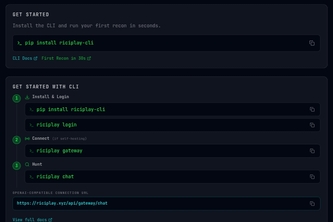
The description states that Riciplay is a CLI-based tool for bug bounty research. It allows users to perform reconnaissance, scanning, and vulnerability hunting directly from their terminal using natural language commands.
It integrates AI to orchestrate tools such as:
- Subfinder
- Httpx
- Nmap
- Katana
The system also includes features like:
- A credits system
- A notebook for AI to track facts per target, reusable across targets
- A /learn command that builds skills from successful sessions
- A scheduler for routine checks
- Code generation capabilities
It was initially built as a web platform but shifted focus to CLI due to user behavior patterns.
Inference The tool is described as being designed for solo workers in cybersecurity, not for enterprise or large teams.
Positioning & Claim Evolution
The author positions Riciplay as an AI-powered tool that helps bug hunters and security researchers by automating reconnaissance and vulnerability hunting workflows directly from the terminal.
It claims to be:
- An evolution of CLI tools like Codex and Kilo
- A way to use AI for both code-based and non-code-based bug hunting
- Meant for solo workers in cybersecurity
The positioning evolved from a web platform to a terminal-first tool, based on user behavior insights.
Inference The author sees Riciplay as filling a gap in the market for AI-assisted, terminal-based security workflows — but no evidence of market validation or customer feedback is provided.
Target Customer & ICP
The description states that Riciplay is meant for:
- Solo workers
- Bug hunters
- Security teams
- Normal users who use AI in other work like coding
It is described as a tool for people who work in cybersecurity, particularly those who prefer terminal-based workflows.
Inference The ICP appears to be individuals or small teams working in cybersecurity, especially those using command-line tools and looking for automation.
Business Model & Pricing Evidence
The description mentions:
- A credits system is implemented
- No pricing details are provided
- No evidence of revenue model or monetization strategy
Inference The tool may be monetized via a credits-based system, but there is no clarity on how this would scale or what the pricing structure might look like.
Technical & Delivery Signals
The project is built using:
- Frontend: React
- Backend: FastAPI
- Database: PostgreSQL
- Styling: Tailwind
- Caching: Redis
- Language: Python
It includes features such as:
- AI orchestration of security tools
- Notebook for tracking facts per target
- /learn command to build skills from sessions
- Scheduler for routine checks
- Code generation capabilities
Inference The project is technically ambitious, integrating AI with a range of cybersecurity tools. However, the author notes challenges like AI hallucinations and false positives, suggesting that technical maturity is still evolving.
Traction & Maturity Signals
The description states:
- The tool was built for the OpenAI 2026 hackathon
- It is currently in early development
- No evidence of revenue, customers, or adoption beyond the author’s own work
- The author mentions challenges like scanners not working properly and AI hallucinations
Inference There is no evidence of traction or user adoption. The project appears to be a prototype or proof-of-concept, not yet a product with real-world usage.
Competitive Context
The description does not provide any information about competitors or market context.
Inference No competitive landscape is described, which leaves open questions about how Riciplay differentiates from existing tools in the bug bounty and cybersecurity space.
Open Questions & Risks
- Single-person team: The project is built by one person (Zaidu Abubakar), raising concerns about scalability and long-term maintenance.
- No revenue or traction: No evidence of monetization, customers, or adoption.
- AI hallucinations and false positives: The author acknowledges these as ongoing challenges, which could limit the tool’s utility.
- Early-stage prototype: Built for a hackathon, not yet validated in real-world use cases.
- Lack of competitive analysis: No mention of existing tools or how Riciplay would compete.
Questions the description leaves open
- What is the current state of AI hallucinations and false positives in Riciplay? How are they being mitigated?
- Is there a plan to validate the tool with real users or security teams before scaling?
- How does the credits system work, and what is the monetization strategy?
- Are there any partnerships or integrations with existing cybersecurity tools or platforms?
- What are the technical challenges that remain in making Riciplay reliable for enterprise use?
- What is the roadmap for model training and AI improvements?
Overall Assessment
Not evidenced.
The description provides no information on:
- Revenue
- Customers
- Traction
- Market size or validation
- Financials or funding
This project is described as a self-developed hackathon prototype, not yet a product with commercial viability.
Inference At this stage, Riciplay is an idea or early prototype. It has potential in the cybersecurity and AI space but lacks evidence of traction, scalability, or a clear path to monetization. A follow-up investment or partnership would require further validation of its utility, adoption, and technical maturity.
User Stories BotA demo video on every pull request
Get a demo video on every new feature
GitHub App that watches your pull requests and records a narrated, captioned demo.
Save time on demo prep and make informed decisions faster with a video walkthrough of every new feature.
Source
Submitted to the OpenAI 2026 hackathon on Devpost. Project home on Devpost. Back to the full gallery on Devpost.
This competitive analysis was produced by top-founders.com (opens in a new tab)
Generated by a language model from this project's public Devpost page — its tagline, the author's own write-up and any built-with tags listed there — as captured in August 2026. Short quotations are the author's words. It is an opinion on the idea as a business, not on the people behind it, and it reflects the description as published then. If the project has moved on, request a correction below. The analysis is not independent research and contains no verified traction, revenue or customer data.
An independent guide by KFG International LLC — not affiliated with, endorsed by, or connected to Devpost or OpenAI.