

Archive position — measured, not model output
0 likes on Devpost
2,263 of the 7,850 archived projects have more likes, and 5,587 share exactly 0 — so this project's #5,753 place in the like-ranked listing is a tie-break inside that group, not a ranking.
Projects (log scale)
Likes on Devpost. ▲ marks this project's group.
Show the figures
| Likes | Projects | Share of archive |
|---|---|---|
| 0 | 5,587 | 71.2% |
| 1 | 1,758 | 22.4% |
| 2 | 284 | 3.6% |
| 3–4 | 132 | 1.7% |
| 5–9 | 75 | 1.0% |
| 10+ | 14 | 0.2% |
 User Stories BotA demo video on every pull request
Get a demo video on every new feature
GitHub App that watches your pull requests and records a narrated, captioned demo.
Save time on demo prep and make informed decisions faster with a video walkthrough of every new feature.
Executive Summary
What the company appears to be
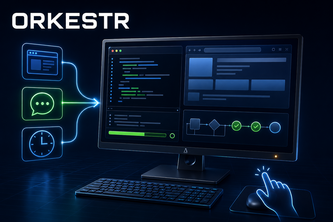
Orkestr is a self-hosted TypeScript application that turns OpenAI Codex into an always-on operator with persistent context, a Linux desktop environment, and multi-channel input (web, WhatsApp, schedule). It allows users to start tasks from various interfaces and continue them in a shared workspace, with optional live monitoring and control.
What changed
The author built Orkestr as a solution to personal workflow inefficiencies involving Codex. The project was reduced for the OpenAI Build Week hackathon to focus on one user, one continuous Codex conversation, and one persistent Linux workstation.
Single most important open question — commercial due-diligence read
Is there a viable path from this single-user, self-hosted prototype to a scalable SaaS or platform product that can attract paying customers beyond the founder’s own use case?
What The Product Actually Is
The description states that Orkestr is a self-hosted TypeScript application built with Docker Compose. It integrates Codex as an agentic runtime and provides:
- A web interface for interaction;
- WhatsApp self-chat support;
- Scheduling capabilities;
- Persistent Linux desktop (Ubuntu 24.04) via XFCE, Chromium, noVNC, tmux, xterm.js;
- File access and output handling;
- Live Desk functionality allowing human takeover of Codex operations.
It does not replace or imitate Codex but instead gives it a durable environment and coordinates how work reaches it.
Inference The product appears to be an orchestration layer for AI agents operating in a persistent, shared workspace — specifically designed to support continuous, multi-channel workflows.
Positioning & Claim Evolution
The author states that Orkestr was built to turn an improvised setup into one coherent product:
“Codex does the work. Orkestr keeps the workstation running.”
It positions itself as a tool for persistent AI agents, not just automation bots.
The project evolved from a broader idea to a focused prototype during OpenAI Build Week, emphasizing:
- One user
- One continuous Codex conversation
- One persistent Linux workstation
Claim
Orkestr aims to eliminate the need for users to assemble surrounding infrastructure themselves when working with capable AI workers.
Inference This is a niche positioning — addressing personal productivity use cases rather than enterprise or multi-user environments. The evolution suggests an intent to simplify complex workflows, not scale broadly.
Target Customer & ICP
The description indicates that Orkestr targets a single user, likely someone who uses Codex for ongoing tasks like research, outreach, job applications, and recurring checks.
It is described as a self-hosted, single-user tool with no mention of multi-tenancy or team features.
Claim
The target is individuals who want persistent AI agents without managing infrastructure.
Inference There is no evidence of targeting enterprises, teams, or developers building platforms. The focus remains on personal use and self-hosting.
Business Model & Pricing Evidence
No explicit business model or pricing information is provided in the description.
The project is described as:
- Self-hosted
- Single-user
- Not yet commercialized
Claim
There is no stated revenue model, customer acquisition strategy, or monetization plan.
Inference It appears to be a prototype or proof-of-concept with no evidence of any monetization mechanism at this stage.
Technical & Delivery Signals
The system uses:
- Angular.js for frontend
- NestJS for backend control plane
- Docker Compose for packaging
- TypeScript, Node.js, RxJS, SQLite, Playwright, OpenAI APIs (GPT-5.6), WhatsApp API via linked-device auth
- Ubuntu 24.04 with XFCE desktop and Chromium
- Persistent file storage using SQLite in WAL mode
Claim
Orkestr handles asynchronous inputs (browser, WhatsApp, schedule) while maintaining execution order, preventing overlap, and supporting recovery.
Inference The architecture shows a deliberate attempt to manage complexity around state consistency and failure recovery — key signals for reliability in agent-based systems.
Traction & Maturity Signals
There is no evidence of:
- Revenue
- Customers
- Users
- Product adoption
- Market traction
- Any form of monetization or commercial deployment
The project was submitted to a hackathon (OpenAI Build Week), and the author notes it's intentionally local, self-hosted, and single-user.
Claim
No traction data is presented. The product exists only as a prototype.
Inference This is early-stage development with no signs of market validation or user growth.
Competitive Context
The description does not reference competitors directly.
However, it implies a space involving:
- AI agents
- Persistent conversational contexts
- Multi-channel input (web, messaging)
- Self-hosted tools for AI workflows
Inference
This likely competes with or overlaps with:
- Other agent orchestration tools
- Workflow automation platforms
- Personal productivity AI tools
- Self-hosted AI environments
But no specific competitor names or market positioning are given.
Open Questions & Risks
- Single-user, self-hosted model:
The lack of multi-user support and managed deployment options may limit scalability and commercial appeal.
- No revenue or monetization strategy:
No indication of how Orkestr will generate income beyond the founder’s own usage.
- High technical complexity for end-users:
Requires Docker, Linux, and manual setup — not suitable for general consumers.
- Limited audience:
The focus on personal use may restrict market size unless expanded into team or enterprise settings.
- Unproven commercial viability:
No evidence of customer interest, demand, or traction beyond the author’s own workflow.
Questions the description leaves open
- What is your plan to move from a single-user, self-hosted prototype to a scalable product?
- Have you identified any potential customers outside of yourself who might pay for this tool?
- How do you intend to monetize Orkestr? Are there plans for SaaS or managed hosting?
- What are the technical challenges in scaling beyond one user and one machine?
- Do you have any early feedback from users or testers on usability or value?
- What is your timeline for moving from prototype to market-ready product?
Overall Assessment
Not evidenced
There is no evidence of:
- Revenue
- Customers
- Traction
- Product-market fit
- Commercial viability
- Funding history
The project is described as a self-hosted, single-user prototype, built for personal use during a hackathon.
It shows technical sophistication and clear intent to solve a real problem — but lacks any indication of commercial readiness or market validation.
Confidence level Low This is a pre-product-stage idea, not a product with demonstrated traction or business model.
User Stories BotA demo video on every pull request
Get a demo video on every new feature
GitHub App that watches your pull requests and records a narrated, captioned demo.
Save time on demo prep and make informed decisions faster with a video walkthrough of every new feature.
Source
Submitted to the OpenAI 2026 hackathon on Devpost. Project home on Devpost. Back to the full gallery on Devpost.
This competitive analysis was produced by top-founders.com (opens in a new tab)
Generated by a language model from this project's public Devpost page — its tagline, the author's own write-up and any built-with tags listed there — as captured in August 2026. Short quotations are the author's words. It is an opinion on the idea as a business, not on the people behind it, and it reflects the description as published then. If the project has moved on, request a correction below. The analysis is not independent research and contains no verified traction, revenue or customer data.
An independent guide by KFG International LLC — not affiliated with, endorsed by, or connected to Devpost or OpenAI.