

Archive position — measured, not model output
1 like on Devpost
505 of the 7,850 archived projects have more likes, and 1,758 share exactly 1 — so this project's #1,829 place in the like-ranked listing is a tie-break inside that group, not a ranking.
Projects (log scale)
Likes on Devpost. ▲ marks this project's group.
Show the figures
| Likes | Projects | Share of archive |
|---|---|---|
| 0 | 5,587 | 71.2% |
| 1 | 1,758 | 22.4% |
| 2 | 284 | 3.6% |
| 3–4 | 132 | 1.7% |
| 5–9 | 75 | 1.0% |
| 10+ | 14 | 0.2% |
 User Stories BotA demo video on every pull request
Get a demo video on every new feature
GitHub App that watches your pull requests and records a narrated, captioned demo.
Save time on demo prep and make informed decisions faster with a video walkthrough of every new feature.
Executive Summary
What the company appears to be
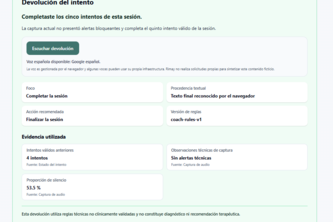
Rimay Adaptive Voice Coach is a browser-based, static single-page application designed for post-stroke speech rehabilitation. It guides users through structured practice sessions using local processing and deterministic coaching rules. The system does not use AI models at runtime, avoids backend services or cloud uploads, and emphasizes privacy, accessibility, and transparency.
What changed
The project was built as a technical demonstration for the OpenAI 2026 hackathon. It represents an early-stage prototype focused on proving a browser-native approach to speech therapy practice with no clinical claims or commercial deployment.
Single most important open question
Is there any evidence that this product has been validated by speech-language professionals, tested in real-world settings, or used by individuals beyond the development team?
What The Product Actually Is
The description states that Rimay Adaptive Voice Coach is a browser-based application built with React, Vite, TypeScript, and Tailwind CSS. It uses:
- Web Audio API
- MediaRecorder
- Web Speech API
- Testing Library and Vitest for testing
It does not use OpenAI models, Supabase, serverless functions, or commercial APIs during runtime.
The application supports three input modes:
- Browser speech recognition (optional)
- Manual text input
- Deterministic demo mode (no microphone or network required)
It provides local acoustic and textual metrics, deterministic coaching feedback, and session tracking without sending data to a backend.
Inference The product is a technical prototype, not a commercial tool or medical device.
Positioning & Claim Evolution
The description states that Rimay is:
- A technical demonstration
- Not a medical device
- Does not diagnose, classify severity, prescribe treatment, or replace speech-language professionals
- Designed around principles of privacy, accessibility, and transparency
It positions itself as an alternative to digital tools that are difficult to follow, depend on external services, or present scores that can be mistaken for clinical evaluations.
Inference The positioning is clearly defined as a non-clinical, educational tool, intended for demonstration rather than clinical use.
Target Customer & ICP
The description states that Rimay targets people who have had a stroke and need structured opportunities to practice speech production. It is designed for those who want to remain in control of every step of their practice session.
Inference The target customer is likely stroke survivors undergoing speech therapy, though the product does not claim to be a replacement for professional care.
Business Model & Pricing Evidence
The description states that Rimay is:
- A technical demonstration
- Not a commercial product
- Does not collect or upload user data
- Has no pricing model or monetization strategy described
Not evidenced No business model, pricing structure, revenue streams, or customer acquisition plans are mentioned.
Technical & Delivery Signals
The application is built as:
- A static single-page application
- Uses only browser-native APIs (no backend)
- Supports local processing of audio and text
- Employs deterministic coaching rules instead of AI services
- Includes 361 automated tests
- Deployed via Vite and hosted on Vercel
Inference The delivery approach is self-contained, low-risk, and privacy-focused, but not scalable or production-ready.
Traction & Maturity Signals
The description states:
- The project was submitted to the OpenAI 2026 hackathon
- It is a technical demonstration
- No revenue, customers, or adoption data are provided
- The current version intentionally focuses on a stable participant experience
- Future work includes larger exercise catalogs and local persistence
Not evidenced No traction, usage metrics, customer feedback, or market validation.
Competitive Context
The description does not mention any competitors. It only describes the product’s unique features:
- Local processing
- Deterministic coaching
- No backend or cloud dependencies
- Privacy-first design
Inference The competitive landscape is unclear, but it likely competes with other digital speech therapy tools that rely on external services or AI models.
Open Questions & Risks
- No clinical validation: The product explicitly states it is not a medical device and does not replace professionals.
- Limited scope: It only supports Spanish language and lacks broader accessibility testing.
- Prototype nature: Built for demonstration, not commercial use.
- No data governance or regulatory compliance: Not designed for clinical environments.
- Browser dependency: Relies on browser APIs that may behave inconsistently across platforms.
Questions the description leaves open
- Has the product been tested with actual stroke survivors or speech-language professionals?
- What is the plan for expanding beyond the current exercise catalog and language support?
- Are there any plans to integrate with clinical workflows or regulatory frameworks?
- How does the team intend to validate the effectiveness of the coaching rules?
- Is there any intention to move from a demo mode to a production-ready version?
Overall Assessment
The project is a technical demonstration built for a hackathon, not a commercial product or investment-ready venture.
It shows strong engineering rigor and adherence to privacy and accessibility principles, but lacks evidence of:
- Clinical validation
- Market traction
- Commercial viability
- Customer adoption
Assessment Not suitable for investment or partnership at this stage. It may be relevant as a proof-of-concept or research prototype, but not as a scalable business opportunity.
User Stories BotA demo video on every pull request
Get a demo video on every new feature
GitHub App that watches your pull requests and records a narrated, captioned demo.
Save time on demo prep and make informed decisions faster with a video walkthrough of every new feature.
Source
Submitted to the OpenAI 2026 hackathon on Devpost. Project home on Devpost. Back to the full gallery on Devpost.
This competitive analysis was produced by top-founders.com (opens in a new tab)
Generated by a language model from this project's public Devpost page — its tagline, the author's own write-up and any built-with tags listed there — as captured in August 2026. Short quotations are the author's words. It is an opinion on the idea as a business, not on the people behind it, and it reflects the description as published then. If the project has moved on, request a correction below. The analysis is not independent research and contains no verified traction, revenue or customer data.
An independent guide by KFG International LLC — not affiliated with, endorsed by, or connected to Devpost or OpenAI.