

Archive position — measured, not model output
0 likes on Devpost
2,263 of the 7,850 archived projects have more likes, and 5,587 share exactly 0 — so this project's #5,754 place in the like-ranked listing is a tie-break inside that group, not a ranking.
Projects (log scale)
Likes on Devpost. ▲ marks this project's group.
Show the figures
| Likes | Projects | Share of archive |
|---|---|---|
| 0 | 5,587 | 71.2% |
| 1 | 1,758 | 22.4% |
| 2 | 284 | 3.6% |
| 3–4 | 132 | 1.7% |
| 5–9 | 75 | 1.0% |
| 10+ | 14 | 0.2% |
 User Stories BotA demo video on every pull request
Get a demo video on every new feature
GitHub App that watches your pull requests and records a narrated, captioned demo.
Save time on demo prep and make informed decisions faster with a video walkthrough of every new feature.
Executive Summary
What the company appears to be
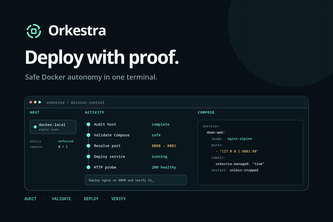
Orkestra is a self-reported autonomous terminal agent for infrastructure automation, built as a hackathon project. It enables users to describe services in a textual UI, which are then converted into verified Docker deployments using GPT-5.6 and FastMCP. The system enforces policy checks, handles port conflicts, and verifies container health.
What changed
The project is described as a single-person effort submitted to the OpenAI 2026 hackathon. It represents an experimental approach to combining LLMs with infrastructure automation in a development workspace, emphasizing safety and verification over generic tooling.
Single most important open question
Is there any evidence of traction, revenue, or customer adoption beyond the author’s own description?
What The Product Actually Is
The description states that Orkestra is an autonomous, MCP-driven terminal agent for infrastructure automation. It allows users to describe a service in a textual UI and converts that into verified Docker deployments natively within a development workspace.
- The system uses GPT-5.6 to audit the host and generate Docker Compose files.
- A local FastMCP server is involved in execution.
- Python enforces safety by rejecting unsafe configurations, resolving port conflicts, deploying stacks, and verifying container health or HTTP endpoints.
- Failed deployments trigger one evidence-based repair.
- The UI exposes each agent stage, final Compose file, and logs.
- CLI tools manage stack cleanup, TTLs, and workspace mounts.
Inference The product appears to be a developer-focused tool for automating Docker-based infrastructure using LLMs, with an emphasis on safety and verification. It is not described as a commercial product or platform but as a prototype or proof-of-concept.
Positioning & Claim Evolution
The author states that Orkestra makes the loop of inspecting hosts, writing Compose files, discovering collisions, starting containers, reading logs, and deciding if services work into a product. It is positioned as a solution to repetitive and fragile workflows in homelab environments.
- The system distinguishes between "healthy" and "running_unverified" states to ensure honest verification.
- It avoids generic shell tools by enforcing policy checks outside the prompt.
- The UI is designed to expose agent stages, making it inspectable and trustworthy.
- The tool surface is said to improve agent security by expressing product intent clearly.
Claim vs. Fact
These are claims made by the author about the product’s design philosophy and intent. No evidence of actual customer feedback or market validation is provided.
Target Customer & ICP
The description implies that Orkestra targets developers working in homelab environments, particularly those who want to automate Docker deployments with minimal friction and maximum safety.
- It is designed for use within a development workspace.
- The system supports local stacks and workspace mounts.
- It includes features like TTLs, cleanup controls, and macOS support — suggesting a focus on personal or small-scale developers.
Inference The primary user base appears to be individual developers or small teams managing their own infrastructure. There is no indication of enterprise customers or B2B use cases.
Business Model & Pricing Evidence
Not evidenced.
The description does not mention any pricing model, monetization strategy, or business model. It is presented as a hackathon project without commercial intent or revenue streams.
Technical & Delivery Signals
- Built with: CLI, Docker, FastMCP, GPT-5.6, OpenAI Codex, Python, Tailscale, Ubuntu.
- Uses a textual terminal UI (TUI).
- Integrates with Docker Compose and local Docker environments.
- Enforces policy checks via Python before deployment.
- Supports verification of container health or HTTP endpoints.
- Includes retry logic for transient API failures.
- Offers offline command fallback after deploy call starts.
Inference The technical stack suggests a lightweight, developer-centric tool built on open-source components. It is not described as cloud-native or scalable beyond local environments.
Traction & Maturity Signals
Not evidenced.
There is no evidence of revenue, customers, user adoption, or product maturity beyond the author’s own account. The project is explicitly described as a hackathon submission with no mention of traction or growth.
Competitive Context
Not evidenced.
The description does not provide information about competitors or market positioning. No comparison to existing tools for infrastructure automation or LLM-powered deployment systems is made.
Open Questions & Risks
- Single-person team: The project is described as a solo effort, which raises questions about scalability and long-term maintenance.
- No commercial traction: There is no evidence of revenue, customers, or adoption beyond the author’s own description.
- Unverified claims: The system is described as secure and autonomous, but there is no independent validation or demonstration of these capabilities.
- Limited scope: The tool appears to be designed for local development environments and lacks enterprise features or cloud integration.
Questions the description leaves open
- What specific problems in homelab automation were you trying to solve?
- How does Orkestra handle edge cases or failures not covered in the current implementation?
- Have you tested Orkestra with real-world infrastructure beyond your own development environment?
- Is there any plan for commercialization or monetization of this tool?
- What are the limitations of the current architecture that would prevent scaling to larger deployments?
Overall Assessment
Not evidenced.
There is no evidence of revenue, customer traction, or market validation to support an investment or partnership decision. The project is described as a hackathon submission with no commercial or operational data available. Any potential value lies in its conceptual innovation and prototype quality, but this does not constitute a basis for due-diligence-level evaluation.
User Stories BotA demo video on every pull request
Get a demo video on every new feature
GitHub App that watches your pull requests and records a narrated, captioned demo.
Save time on demo prep and make informed decisions faster with a video walkthrough of every new feature.
Source
Submitted to the OpenAI 2026 hackathon on Devpost. Project home on Devpost. Back to the full gallery on Devpost.
This competitive analysis was produced by top-founders.com (opens in a new tab)
Generated by a language model from this project's public Devpost page — its tagline, the author's own write-up and any built-with tags listed there — as captured in August 2026. Short quotations are the author's words. It is an opinion on the idea as a business, not on the people behind it, and it reflects the description as published then. If the project has moved on, request a correction below. The analysis is not independent research and contains no verified traction, revenue or customer data.
An independent guide by KFG International LLC — not affiliated with, endorsed by, or connected to Devpost or OpenAI.