

Archive position — measured, not model output
0 likes on Devpost
2,263 of the 7,850 archived projects have more likes, and 5,587 share exactly 0 — so this project's #3,790 place in the like-ranked listing is a tie-break inside that group, not a ranking.
Projects (log scale)
Likes on Devpost. ▲ marks this project's group.
Show the figures
| Likes | Projects | Share of archive |
|---|---|---|
| 0 | 5,587 | 71.2% |
| 1 | 1,758 | 22.4% |
| 2 | 284 | 3.6% |
| 3–4 | 132 | 1.7% |
| 5–9 | 75 | 1.0% |
| 10+ | 14 | 0.2% |
 User Stories BotA demo video on every pull request
Get a demo video on every new feature
GitHub App that watches your pull requests and records a narrated, captioned demo.
Save time on demo prep and make informed decisions faster with a video walkthrough of every new feature.
Executive Summary
What the company appears to be
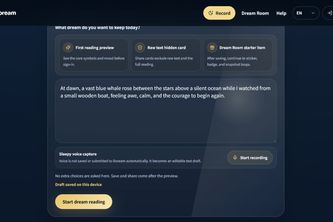
Doream is a solo-founder project that claims to offer an AI-powered tool for capturing and reflecting on personal dreams. The product allows users to record a dream scene in under a minute, with AI generating a private "Dream Card" based only on user-provided content. It emphasizes non-diagnostic reflection, privacy, and emotional restraint.
What changed
During the OpenAI Build Week hackathon, the founder integrated GPT-5.6 via Codex to implement a grounded-reflection contract for sensitive dream data. This update focused on limiting AI-generated interpretations to only what the user provided, avoiding diagnosis or invented facts.
Single most important open question
Is there any evidence of actual user engagement, adoption, or revenue beyond the author’s own claims?
What The Product Actually Is
The description states that Doream is a private AI dream capture and reflection tool. It allows users to record a remembered dream scene without complicated tagging. The AI organizes emotions, symbols, and real-life context already present in the user's words into a private Dream Card. These cards are stored in a private Dream Room where users can revisit them over time.
The product implements:
- A one-minute capture wedge
- Private-by-default Dream Cards and Dream Rooms
- AI-assisted reflection grounded only in user input
- Optional sharing (not currently implemented)
- Non-diagnostic output
Inference The tool appears to be a web-based application built with React, TypeScript, Node.js, and uses OpenAI Codex for AI assistance.
Positioning & Claim Evolution
The author positions Doream as:
- A private dream journaling experience
- Grounded in user-provided content
- Non-diagnostic and emotionally restrained
- Focused on preserving uncertainty and avoiding invented facts
Claim evolution
- The initial version was a live product before the hackathon.
- During Build Week, it added a grounded-reflection contract using GPT-5.6 via Codex.
- This new behavior includes:
- Mirroring only user-supplied details
- Separating observation from interpretation
- Preserving uncertainty
- Avoiding diagnosis or invented facts
- Asking one optional clarifying question when context is too thin
Inference The positioning has evolved from a basic dream capture tool to a more nuanced, emotionally sensitive AI reflection system.
Target Customer & ICP
The description does not state who the target customer is. It implies that users are individuals interested in personal dream reflection and journaling.
Inference The ICP likely includes people who:
- Are interested in self-reflection
- Value privacy in emotional content
- May be interested in AI-assisted introspection or creative expression
Not evidenced No specific demographic, psychographic, or behavioral data about the target user base.
Business Model & Pricing Evidence
The description does not provide any information on pricing, monetization, or business model. It mentions that features like trading, ownership transfer, and donations are part of the roadmap but not currently implemented.
Inference There is no current evidence of a functioning business model or pricing structure.
Technical & Delivery Signals
The project was built by a solo founder with over 18 years of IT experience. It uses:
- React
- TypeScript
- Node.js
- OpenAI Codex (GPT-5.6)
- Web technologies
Key technical claims include:
- Use of GPT-5.6 via Codex to implement grounded-reflection contract
- 22/22 contract checks passed
- TypeScript typecheck validation
- Production build passing in scoped CI
- A public demo video and pull request for review
Inference The project shows technical capability, but no evidence of scale or production deployment beyond the solo founder’s environment.
Traction & Maturity Signals
The description states:
- A live seven-language consumer AI product
- Public demo with screens and engineering evidence
- Live product available at https://doream.org
- Pull request and CI logs are publicly accessible
Not evidenced No data on user engagement, retention, revenue, or customer adoption. The product is described as a prototype or early-stage tool.
Competitive Context
The description does not mention any competitors or market context. It does not describe how Doream compares to existing dream journals, AI reflection tools, or privacy-focused personal apps.
Inference No competitive positioning or market differentiation is evident from the self-reported description.
Open Questions & Risks
- Solo founder with no team: The project is built by a single person; lack of team structure may limit scalability.
- No traction or revenue data: No evidence of users, customers, or monetization.
- Unproven market demand: The product’s value proposition is self-reported and not independently validated.
- Limited scope: Features like trading, ownership transfer, and donations are labeled as roadmap items, not current offerings.
- Self-reported validation only: All technical claims rely on the author’s own testing and documentation.
Questions the description leaves open
- What is your actual user base or engagement data?
- How do you plan to scale beyond a solo founder?
- Are there any early adopters or beta users who have provided feedback?
- What are the specific use cases driving demand for this type of dream reflection tool?
- How do you intend to monetize this product in the future?
- Can you provide more details on how the grounded-reflection contract is enforced and validated?
- What are the technical limitations or bottlenecks in scaling this AI-assisted experience?
Overall Assessment
Not evidenced: There is no evidence of revenue, customers, traction, or a clear path to monetization.
Confidence level: Low — based entirely on self-reported claims and a single founder’s account.
Assessment: This appears to be an early-stage prototype or personal project with strong technical execution but no demonstrated commercial viability. It lacks any signs of market traction or scalable business model. Any investment or partnership would require further validation of user demand, team capability, and monetization strategy.
User Stories BotA demo video on every pull request
Get a demo video on every new feature
GitHub App that watches your pull requests and records a narrated, captioned demo.
Save time on demo prep and make informed decisions faster with a video walkthrough of every new feature.
Source
Submitted to the OpenAI 2026 hackathon on Devpost. Project home on Devpost. Back to the full gallery on Devpost.
This competitive analysis was produced by top-founders.com (opens in a new tab)
Generated by a language model from this project's public Devpost page — its tagline, the author's own write-up and any built-with tags listed there — as captured in August 2026. Short quotations are the author's words. It is an opinion on the idea as a business, not on the people behind it, and it reflects the description as published then. If the project has moved on, request a correction below. The analysis is not independent research and contains no verified traction, revenue or customer data.
An independent guide by KFG International LLC — not affiliated with, endorsed by, or connected to Devpost or OpenAI.