

Archive position — measured, not model output
0 likes on Devpost
2,263 of the 7,850 archived projects have more likes, and 5,587 share exactly 0 — so this project's #3,791 place in the like-ranked listing is a tie-break inside that group, not a ranking.
Projects (log scale)
Likes on Devpost. ▲ marks this project's group.
Show the figures
| Likes | Projects | Share of archive |
|---|---|---|
| 0 | 5,587 | 71.2% |
| 1 | 1,758 | 22.4% |
| 2 | 284 | 3.6% |
| 3–4 | 132 | 1.7% |
| 5–9 | 75 | 1.0% |
| 10+ | 14 | 0.2% |
 User Stories BotA demo video on every pull request
Get a demo video on every new feature
GitHub App that watches your pull requests and records a narrated, captioned demo.
Save time on demo prep and make informed decisions faster with a video walkthrough of every new feature.
Executive Summary
The company appears to be a single-person project, DormMatch AI, submitted as a hackathon entry. The author describes it as an AI-powered tool for matching students into housing groups, with a focus on fairness and transparency in roommate allocation.
Key change: This is a self-reported prototype built in a hackathon context, not yet a product with customers or revenue.
The single most important open question: Is there evidence of traction, customer validation, or a clear path to monetization beyond the prototype?
What The Product Actually Is
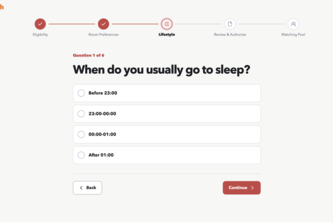
The description states that DormMatch AI is a system designed to match students into housing groups of 7–8 people, using an allocation engine that considers roommate preferences and eligibility. It includes features such as:
- Individual student verification
- Room-type selection
- Roommate-preference survey
- Payment authorization
- Fair allocation through a lottery and matching system
- Waitlist management for unsuccessful applicants
It is described as a bilingual prototype, built with React, Vite, JavaScript, and supported by OpenAI Codex.
Inference: The product is not yet live or deployed in production. It is a proof-of-concept or prototype.
Positioning & Claim Evolution
The author states that DormMatch AI aims to solve the problem of group housing instability caused by one student dropping out or delaying payment. It positions itself as a tool that:
- Ensures stable, payment-ready housing teams
- Allocates rooms fairly
- Prepares backups before dropout risks occur
Claim: The system is designed to be transparent and fair.
Inference: This is a self-described positioning based on the author’s stated problem and solution. No external validation or customer feedback is provided.
Target Customer & ICP
The description states that DormMatch AI targets students who must form groups of 7–8 before applying for housing, particularly in university settings where group dynamics and payment risks are high.
Inference: The target is likely college/university students in group housing scenarios. No evidence of a defined ICP beyond this general audience.
Business Model & Pricing Evidence
The description does not state any business model or pricing structure. It mentions that:
- Payment is collected only after a successful match
- The system includes administrator tools (implying potential for SaaS-style monetization)
Inference: There is no evidence of a monetization strategy beyond the prototype.
Technical & Delivery Signals
The project was built using:
- Frontend: React, Vite, JavaScript, Lucide icons
- Backend/AI: OpenAI Codex (for design, debugging, and testing)
- Deployment: Vercel
- Features tested: 10,000 randomized simulations, large-scale scenarios with up to 498 applicants
Inference: The prototype is technically functional and has been tested at scale. However, no evidence of production deployment or real-world usage.
Traction & Maturity Signals
The description states:
- A bilingual prototype
- Automated testing (10,000 simulations)
- Large-scale scenario testing (up to 498 applicants)
However, there is no evidence of:
- Customers
- Revenue
- Product-market fit
- Adoption or usage metrics
Inference: The project is at a prototype stage and has not demonstrated traction.
Competitive Context
The description does not mention any competitors. It is unclear whether similar tools exist in the market for student housing allocation or roommate matching.
Inference: No competitive landscape is described, and no evidence of existing solutions is provided.
Open Questions & Risks
- Single-person team: The project is built by one individual (jiaxuan xu), which may limit scalability.
- Prototype only: No live product or customer feedback.
- No monetization strategy: No indication of how the tool will be monetized beyond a hackathon prototype.
- Unverified claims: All features and outcomes are self-reported, with no independent validation.
Questions the description leaves open
- What is the actual problem you're solving, and how did you validate it?
- Have you tested this with real students or universities?
- How do you plan to scale beyond a single prototype?
- What is your path to monetization?
- Are there any existing tools in this space that you are aware of?
Overall Assessment
Not evidenced
There is no evidence of revenue, customers, or product-market fit. The project is described as a hackathon prototype with no indication of traction or commercial viability.
Inference: At this stage, DormMatch AI is not ready for investment or partnership consideration. It requires further development and validation before any strategic move can be made.
User Stories BotA demo video on every pull request
Get a demo video on every new feature
GitHub App that watches your pull requests and records a narrated, captioned demo.
Save time on demo prep and make informed decisions faster with a video walkthrough of every new feature.
Source
Submitted to the OpenAI 2026 hackathon on Devpost. Project home on Devpost. Back to the full gallery on Devpost.
This competitive analysis was produced by top-founders.com (opens in a new tab)
Generated by a language model from this project's public Devpost page — its tagline, the author's own write-up and any built-with tags listed there — as captured in August 2026. Short quotations are the author's words. It is an opinion on the idea as a business, not on the people behind it, and it reflects the description as published then. If the project has moved on, request a correction below. The analysis is not independent research and contains no verified traction, revenue or customer data.
An independent guide by KFG International LLC — not affiliated with, endorsed by, or connected to Devpost or OpenAI.