

Archive position — measured, not model output
0 likes on Devpost
2,263 of the 7,850 archived projects have more likes, and 5,587 share exactly 0 — so this project's #3,793 place in the like-ranked listing is a tie-break inside that group, not a ranking.
Projects (log scale)
Likes on Devpost. ▲ marks this project's group.
Show the figures
| Likes | Projects | Share of archive |
|---|---|---|
| 0 | 5,587 | 71.2% |
| 1 | 1,758 | 22.4% |
| 2 | 284 | 3.6% |
| 3–4 | 132 | 1.7% |
| 5–9 | 75 | 1.0% |
| 10+ | 14 | 0.2% |
 User Stories BotA demo video on every pull request
Get a demo video on every new feature
GitHub App that watches your pull requests and records a narrated, captioned demo.
Save time on demo prep and make informed decisions faster with a video walkthrough of every new feature.
Executive Summary
Company: Dossier Marine & Auto
Self-reported basis: The analysis is based entirely on the project description provided by the caller — its name, tagline, the author's own write-up and any technology tags. No third-party verification or archived evidence is available.
What it appears to be: A tool that estimates the real cost of owning a car or boat, using AI-assisted data extraction and deterministic financial modeling. It provides low, base, and high estimates with explanations of assumptions and uncertainty.
What changed: The project evolved from a personal attempt to help a brother understand car ownership into a system designed to help people make major financial decisions by making the cost estimation process transparent and explainable.
Single most important open question: Is there a viable commercial model or market need beyond the authors' own use case, and how would the tool scale beyond Sweden?
What The Product Actually Is
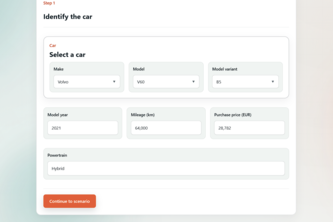
The description states that Dossier Marine & Auto estimates the real cost of owning a specific car or boat under a specific ownership scenario. It allows users to input data from a listing and add personal assumptions about usage, ownership duration, and financing.
It separates AI-assisted extraction of facts from financial calculation, ensuring that the latter is deterministic. The tool provides low, base, and high estimates and explains what drives them, including assumptions, sources, confidence, limitations, and sensitivity factors.
The system is calibrated for Sweden and models costs relevant to that market.
Evidence:
- "Dossier Marine & Auto estimates the real cost of owning a specific car or boat under a specific ownership scenario."
- "A user can start from a listing, let Dossier extract the available facts, and then add what the advertisement cannot know: how much they will use it, how long they plan to own it, and how they intend to finance it."
- "Instead of hiding uncertainty behind one precise number, Dossier gives low, base, and high estimates and shows what drives them."
Inference: The tool is built for a specific market (Sweden) and uses AI for data extraction but not for decision-making.
Positioning & Claim Evolution
The description states that the project began as a personal effort to help a brother understand car ownership. It evolved into a broader system aimed at helping people make major financial decisions by making cost estimation transparent and explainable.
It positions itself as a tool that helps users understand the full financial commitment of ownership, rather than just showing one number.
Evidence:
- "Dossier started because my younger brother, Yadid, wants to buy a car."
- "We built the system we wished we had."
- "a tool for people who are expected to make major financial decisions before anyone has properly taught them how to evaluate them."
Inference: The positioning is rooted in personal experience and aims to improve decision-making transparency.
Target Customer & ICP
The description does not clearly identify a target customer or ideal customer profile (ICP). It implies the tool is for people making major financial decisions, particularly young buyers of cars or boats, but does not define a specific segment or persona.
Evidence:
- "a tool for people who are expected to make major financial decisions before anyone has properly taught them how to evaluate them."
Inference: The target is likely young or novice buyers in Sweden, but no explicit segmentation or persona is defined.
Business Model & Pricing Evidence
The description does not provide any information on pricing, monetization, or business model. It is unclear whether the tool will be offered as a freemium service, a paid product, or through other means.
Evidence:
- No mention of pricing, subscriptions, or revenue streams.
Inference: The business model remains unknown and unreported.
Technical & Delivery Signals
The project was built using technologies such as Next.js, React, Node.js, TypeScript, OpenAI APIs (GPT), and Zod for validation. It uses AI for data extraction but separates that from financial modeling.
The system is deterministic once inputs are normalized, and it supports both cars and boats with separate financial engines.
Evidence:
- "Built with (author-declared): api, codex, github, gpt-5.6, next.js, node.js, npm, openai, react, typescript, vitest, zod"
- "Extraction may suggest facts from a listing, but it never decides the financial answer."
- "Cars and boats also have separate financial engines."
Inference: The tool uses modern web stack with AI integration, and has modular design for different asset types.
Traction & Maturity Signals
There is no evidence of traction, customers, revenue, or adoption. The project is described as a hackathon submission and a personal effort by two brothers.
Evidence:
- "This project was submitted to the OpenAI 2026 hackathon on Devpost."
- "Team size: 2"
- No mention of users, customers, or usage metrics.
Inference: The tool is in early development and lacks any commercial traction.
Competitive Context
The description does not mention competitors or similar tools. It implies that existing solutions may hide uncertainty behind a single number, but no direct comparison to other platforms is made.
Evidence:
- "Most tools reduced a complicated ownership decision to one confident-looking number."
Inference: The tool positions itself as different from current offerings by being more transparent and explainable, but no competitive landscape is described.
Open Questions & Risks
- No commercial traction or market validation: The project is a hackathon submission with no evidence of adoption.
- Limited scope: It's calibrated for Sweden and may not scale to other markets.
- Unclear monetization: No business model or pricing strategy is described.
- Dependency on AI accuracy: The tool relies on AI extraction, which may be unreliable or inconsistent.
- Founder background: Founders are students with no prior commercial experience in finance or SaaS.
Evidence:
- "No revenue, customer or traction data is available beyond what they state."
- "The project is calibrated for Sweden and models the costs that actually matter here."
Inference: The tool may not be ready for commercial deployment without further development and market testing.
Questions the description leaves open
- What is your plan to validate demand beyond personal use?
- How do you intend to monetize this tool, and what pricing model are you considering?
- What are the key assumptions in your financial models, and how do they differ from real-world usage?
- How would you scale this beyond Sweden?
- What is the long-term vision for the product, and how does it evolve from a hackathon idea to a commercial offering?
Overall Assessment
Not evidenced: There is no evidence of revenue, customers, traction or a clear path to monetization. The tool is described as a hackathon project with no commercial viability or market validation.
The authors are students working on a personal problem, and the product lacks any indication of scalability or commercial readiness.
Confidence level: Low — based entirely on self-reported description with no external verification or traction data.
Assessment: Not ready for investment or partnership. Requires significant development, market testing, and business model validation before it can be considered viable.
User Stories BotA demo video on every pull request
Get a demo video on every new feature
GitHub App that watches your pull requests and records a narrated, captioned demo.
Save time on demo prep and make informed decisions faster with a video walkthrough of every new feature.
Source
Submitted to the OpenAI 2026 hackathon on Devpost. Project home on Devpost. Back to the full gallery on Devpost.
This competitive analysis was produced by top-founders.com (opens in a new tab)
Generated by a language model from this project's public Devpost page — its tagline, the author's own write-up and any built-with tags listed there — as captured in August 2026. Short quotations are the author's words. It is an opinion on the idea as a business, not on the people behind it, and it reflects the description as published then. If the project has moved on, request a correction below. The analysis is not independent research and contains no verified traction, revenue or customer data.
An independent guide by KFG International LLC — not affiliated with, endorsed by, or connected to Devpost or OpenAI.