

Archive position — measured, not model output
1 like on Devpost
505 of the 7,850 archived projects have more likes, and 1,758 share exactly 1 — so this project's #1,815 place in the like-ranked listing is a tie-break inside that group, not a ranking.
Projects (log scale)
Likes on Devpost. ▲ marks this project's group.
Show the figures
| Likes | Projects | Share of archive |
|---|---|---|
| 0 | 5,587 | 71.2% |
| 1 | 1,758 | 22.4% |
| 2 | 284 | 3.6% |
| 3–4 | 132 | 1.7% |
| 5–9 | 75 | 1.0% |
| 10+ | 14 | 0.2% |
 User Stories BotA demo video on every pull request
Get a demo video on every new feature
GitHub App that watches your pull requests and records a narrated, captioned demo.
Save time on demo prep and make informed decisions faster with a video walkthrough of every new feature.
Executive Summary
What the company appears to be
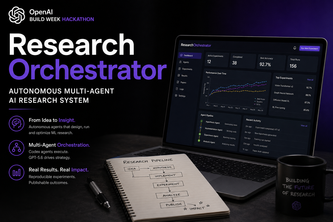
ResearchOrchestrator is described as an autonomous multi-agent AI system designed to automate machine learning (ML) research workflows. The author states it uses GPT-5.6 and Codex agents to generate hypotheses, implement models, run experiments, and analyze results—aiming for end-to-end autonomy in scientific discovery.
What changed
The project is self-reported as a production-grade system built for continuous operation with four specialized autonomous agent layers. It claims to integrate with existing research tools like ArXiv, PapersWithCode, and Weights & Biases, and to support outcome-focused metrics rather than just code generation or token output.
Single most important open question
Is there any evidence of actual use, traction, revenue, or customer adoption beyond the author’s own description? The system is described as autonomous but not demonstrated in practice; no real-world deployment or performance data are provided.
What The Product Actually Is
The description states that ResearchOrchestrator is a production-grade system composed of four core autonomous agent layers:
- Hypothesis Agent (GPT-5.6 + Reasoning)
- Analyzes research papers from ArXiv and PapersWithCode
- Generates novel hypotheses for improvement on SOTA benchmarks
- Uses Chain-of-Thought to reason about architectural innovations
- Creates structured research proposals with predicted impact
- Implementation Agent (Codex Autonomous)
- Receives hypotheses from Hypothesis Agent
- Autonomously generates complete ML training pipelines
- Searches GitHub for reference implementations
- Creates test cases and validation scripts
- Runs code quality checks and security scanning
- Outputs production-ready, reproducible code
- Experiment Agent (Codex + Environment Control)
- Executes training on distributed compute (supports GPU/TPU)
- Monitors training metrics in real-time
- Performs automated hyperparameter search
- Detects anomalies and handles failures gracefully
- Runs A/B testing protocols autonomously
- Logs everything to Weights & Biases
- Analysis Agent (GPT-5.6 + Vision)
- Analyzes experiment results and generates insights
- Compares against SOTA baselines
- Identifies statistical significance
- Proposes next research directions
- Generates paper-draft sections using research findings
- Creates interactive dashboards with Plotly
Additionally, a central Orchestrator manages agent workflows using Celery, coordinates communication and state management, prioritizes experiments, and publishes results to ArXiv, Papers, and GitHub.
The system is built using technologies including FastAPI, Celery, Docker, Kubernetes, PostgreSQL, MongoDB, LangChain, CrewAI, GCP/AWS, OpenAI APIs (including GPT-5.6 Luna/Terra/Sol), and others.
Inference This appears to be a conceptual framework for an autonomous research OS that integrates multiple AI agents into a pipeline for ML experimentation and discovery.
Positioning & Claim Evolution
The author positions ResearchOrchestrator as:
- A multi-agent system for scientific discovery, replacing human researchers with autonomous agents.
- An autonomous research operating system that accumulates work over time and pursues outcomes, not just outputs.
- A production-grade tool capable of running continuously without human intervention.
- A cost-optimized solution using different GPT-5.6 model tiers (Luna, Terra, Sol) for routine vs. strategic tasks.
The project evolved from inspiration drawn from OpenAI’s hackathon-winning system (Rippletide), which emphasized agentic systems over code generation alone. The author notes that this shift—from generating code to executing full research cycles—is what impressed judges in Rippletide's win.
Claim
It is positioned as a next-generation platform for ML research automation, focused on outcome-driven metrics and integrated with existing tools like ArXiv, PapersWithCode, and W&B.
Inference The positioning reflects a belief that future AI will be more about autonomous execution than just generation. However, no evidence of adoption or validation exists beyond the author’s own claims.
Target Customer & ICP
The description does not explicitly define target customers or ideal customer profiles (ICP). It implies usage by:
- ML researchers working in academia or industry
- Research institutions seeking to automate parts of their research pipeline
- Teams focused on SOTA improvements, particularly those using large language models, vision transformers, or multimodal architectures
It also suggests integration with major research platforms (MIT, Stanford, DeepMind) and support for publishing to ArXiv.
Claim
The system targets researchers who want to reduce boilerplate work and focus on innovation while maintaining reproducibility and scalability.
Inference Given the complexity of the stack and its focus on autonomous experimentation, it likely appeals to advanced research teams or institutions with significant compute resources and domain expertise.
Business Model & Pricing Evidence
There is no evidence in the description of a business model or pricing structure. The author does not mention monetization strategies, licensing terms, or any commercial arrangements.
Claim
The system may eventually be offered as a B2B API service, a research-as-a-service platform, or an open-source framework for custom agent development.
Inference Based on the roadmap and stated goals (e.g., spin-off into standalone service, API offerings), it seems likely that the eventual business model will involve either subscription-based access or enterprise licensing. But no such details are provided.
Technical & Delivery Signals
The system is described as production-grade, with:
- Real-time monitoring via WebSocket connections
- Distributed task execution using Celery and Redis
- State persistence using PostgreSQL and MongoDB
- Support for distributed compute (GPU/TPU)
- Integration with W&B, ArXiv, PapersWithCode, GitHub APIs
- Error handling, logging, checkpointing, and rollback capabilities
It uses frameworks like CrewAI, LangChain, FastAPI, Docker, Kubernetes, and Python 3.11+.
Claim
The architecture supports continuous operation, fault tolerance, reproducibility, and extensibility.
Inference These are strong technical signals indicating a mature engineering approach, though they do not confirm actual deployment or performance in real-world settings.
Traction & Maturity Signals
There is no evidence of traction, revenue, customers, or adoption beyond the author’s own description. The system is described as:
- Built for a hackathon (submitted to OpenAI 2026)
- Not yet deployed in production environments
- Not tested at scale or integrated into real research workflows
Claim
It is claimed to be fully autonomous, outcome-driven, and capable of running continuously.
Inference While the system is described as mature and production-ready, there is no independent verification or demonstration of its operation outside of the author’s own account. No metrics, logs, or user feedback are included.
Competitive Context
The description references:
- OpenAI's Rippletide (a winning hackathon project)
- The broader trend toward agentic AI systems, especially in code generation and research automation
- Tools like Codex, GPT-5.6, LangChain, CrewAI, Weights & Biases, ArXiv, PapersWithCode
It also mentions the importance of outcome-focused metrics over token output, suggesting alignment with trends in judging AI systems based on impact rather than just performance.
Claim
ResearchOrchestrator competes within a growing category of autonomous research platforms and AI agents designed to accelerate scientific discovery.
Inference The competitive landscape includes other agentic frameworks, research automation tools, and platforms like Hugging Face, PapersWithCode, and ArXiv-based research infrastructure. However, no direct comparison or differentiation is made in the description.
Open Questions & Risks
- No real-world validation: The system is described as autonomous but not demonstrated in practice.
- Unverified claims: All features are self-reported; no third-party verification or performance data.
- Unclear monetization path: No indication of how the product will generate revenue or be sold.
- High technical complexity: Requires deep integration with multiple tools and platforms, raising risk of implementation failure or scalability issues.
- Model dependency risks: Heavy reliance on GPT-5.6 and Codex APIs introduces potential instability if these services change or become unavailable.
- Lack of user feedback or iteration history: No evidence of prior versions or improvements based on usage.
Questions the description leaves open
- Has the system been tested in real-world research environments? What were the results?
- How does it handle failures during long-running experiments, and what safeguards are in place?
- Are there any known limitations or edge cases where the system fails to deliver expected outcomes?
- What is the current status of integration with major research institutions or platforms (e.g., MIT, Stanford)?
- Can you provide examples of actual research hypotheses generated or papers produced by the system?
- How does the system ensure reproducibility across different runs and environments?
- What are the plans for monetization and go-to-market strategy?
- Are there any existing partnerships or pilot programs with academic or industry users?
Overall Assessment
Not evidenced
There is no evidence of revenue, customers, traction, or financials beyond the author’s own description. The system is described as a conceptual framework and prototype built for a hackathon.
Confidence Level Low This analysis is based entirely on self-reported information without any external validation or demonstration of use. Any assessment of commercial viability must be speculative at this stage.
Conclusion
ResearchOrchestrator appears to be an ambitious concept for autonomous ML research automation, but lacks evidence of real-world application or commercial traction. It may represent a promising direction for future development, but no investment or partnership decision can be made without further validation.
User Stories BotA demo video on every pull request
Get a demo video on every new feature
GitHub App that watches your pull requests and records a narrated, captioned demo.
Save time on demo prep and make informed decisions faster with a video walkthrough of every new feature.
Source
Submitted to the OpenAI 2026 hackathon on Devpost. Project home on Devpost. Back to the full gallery on Devpost.
This competitive analysis was produced by top-founders.com (opens in a new tab)
Generated by a language model from this project's public Devpost page — its tagline, the author's own write-up and any built-with tags listed there — as captured in August 2026. Short quotations are the author's words. It is an opinion on the idea as a business, not on the people behind it, and it reflects the description as published then. If the project has moved on, request a correction below. The analysis is not independent research and contains no verified traction, revenue or customer data.
An independent guide by KFG International LLC — not affiliated with, endorsed by, or connected to Devpost or OpenAI.