

Archive position — measured, not model output
1 like on Devpost
505 of the 7,850 archived projects have more likes, and 1,758 share exactly 1 — so this project's #1,817 place in the like-ranked listing is a tie-break inside that group, not a ranking.
Projects (log scale)
Likes on Devpost. ▲ marks this project's group.
Show the figures
| Likes | Projects | Share of archive |
|---|---|---|
| 0 | 5,587 | 71.2% |
| 1 | 1,758 | 22.4% |
| 2 | 284 | 3.6% |
| 3–4 | 132 | 1.7% |
| 5–9 | 75 | 1.0% |
| 10+ | 14 | 0.2% |
 User Stories BotA demo video on every pull request
Get a demo video on every new feature
GitHub App that watches your pull requests and records a narrated, captioned demo.
Save time on demo prep and make informed decisions faster with a video walkthrough of every new feature.
Executive Summary
The company appears to be a single-person project by Joshua Fisherkeller, a social worker, developing an AI-powered app for children ages 6–8 focused on resilience-building through illustrated stories and structured AI conversations. The product is described as not therapy or diagnostic, and is intended for use with adult guidance.
What changed
The author reports using GPT-5.6, Codex, and related tools to build the entire application, including UI, backend logic, safety checks, illustrations, and deployment — all within a hackathon context.
Key open question
Is there any evidence of real-world use or feedback from caregivers or children? The description lacks data on adoption, engagement, or impact beyond the author’s own claims.
What The Product Actually Is
- The description states that Resilience Coach is an adult-guided, evidence-informed practice app for children ages 6–8.
- It offers two complementary experiences:
- Picture Story: illustrated, tap-based scenarios following a resilience arc (notice, choose, practice, check, plan).
- Talk It Through: a bounded conversation where the child taps choices or enters made-up words and receives short, age-appropriate responses.
- The app is not described as therapy, diagnostic, or replacement for professional care.
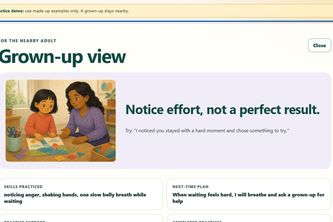
- A transcript-free Grown-up View summarizes skills practiced, support used, and next-time plans — without scores, diagnoses, or surveillance-style transcripts.
- The app uses GPT-5.6 via the OpenAI Responses API, constrained to a strict structure with low reasoning effort.
- Safety features include deterministic server-side screening for danger, abuse, neglect, or self-harm; flagged content is not sent to the model and activity locks with fixed language directing child to adult.
Note: The author states that Codex was used throughout the primary build session to generate database schema, TypeScript server, tools, safety logic, tests, interface, deployment, documentation, and illustration system. This is self-reported and unverified.
Positioning & Claim Evolution
- The project is positioned as a tool for caregivers to help children develop resilience skills during everyday moments like waiting, sharing, making mistakes, or coping with changes.
- It is framed as a free resource, with the author noting he runs a website (skillforchildren.com) that provides such resources.
- The app is described as not therapy or diagnostic, and not a replacement for professional care.
- The use of AI tools like GPT-5.6 and Codex is presented as enabling rapid prototyping and development, especially in the context of a hackathon.
Inference: The positioning suggests a focus on early childhood emotional regulation and skill-building, with an emphasis on accessibility and safety for young users.
Target Customer & ICP
- The primary user group is children ages 6–8.
- The secondary user group is trusted adults, such as parents or caregivers, who guide the child through the activities.
- The app is intended to be used in a guided setting, not independently by children.
- The author is a social worker, suggesting an ICP rooted in caregiver needs and child development support.
Not evidenced: No mention of specific caregiver personas, target demographics beyond age range, or customer segments beyond the general “caregiver” role.
Business Model & Pricing Evidence
- The app is described as a free resource, with no pricing structure mentioned.
- The author states he runs a website called skillforchildren.com that provides free resources to caregivers.
- There is no indication of monetization, subscriptions, or paid features in the description.
- No evidence of revenue streams, customer acquisition costs, or pricing tiers.
Inference: If this project evolves into a commercial product, it may follow a freemium or B2C model, but no such evolution is evidenced here.
Technical & Delivery Signals
- Built using:
- Codex for code generation and documentation
- GPT-5.6 via OpenAI Responses API for conversational coaching
- Express.js, TypeScript, OpenAI Apps SDK, Model Context Protocol (MCP)
- Supabase for data storage
- Vercel for hosting and deployment
- The app uses a transcript-free interface, with no surveillance-style transcripts.
- Safety logic includes:
- Deterministic server-side screening before text reaches the model
- Locking mechanism if flagged content is detected
- Fixed language directing child to adult in case of risk
Inference: The technical stack suggests a fast, lightweight, and AI-integrated solution built for rapid prototyping and deployment — consistent with hackathon development.
Traction & Maturity Signals
- The project was submitted to the OpenAI 2026 hackathon.
- A live demo is available, and users can try it without account or credentials.
- No evidence of:
- Customer base
- Usage metrics
- Feedback from caregivers or children
- Product iteration history
- Revenue or monetization
Not evidenced: No data on adoption, retention, or impact beyond the author’s own claims.
Competitive Context
- The description does not mention competitors.
- It is positioned as a child resilience-building tool, which could overlap with:
- Emotional learning apps
- Parenting tools
- AI-powered educational platforms
- Child therapy or counseling apps (though this app explicitly avoids being therapeutic)
Not evidenced: No competitive landscape, market positioning, or differentiation from similar tools.
Open Questions & Risks
- The project is self-reported and unverified, with no third-party validation.
- It is a single-person effort; no team or organizational structure is evident.
- The app’s safety mechanisms are described as deterministic, but the author does not provide evidence of their effectiveness in real-world use.
- No evidence of:
- User testing
- Feedback loops
- Scalability plans
- Long-term product vision
Inference: The lack of team, traction, and user feedback raises questions about long-term viability or impact.
Questions the description leaves open
- What is the source of the “evidence-informed” resilience practices used in the app?
- How are the illustrations and story arcs developed? Are they based on research or expert input?
- Has there been any user testing with children or caregivers?
- What is the plan for scaling beyond a hackathon prototype?
- How does the app handle edge cases or unexpected child behavior not covered in the current design?
- Is there a long-term vision for monetization or distribution?
Overall Assessment
- The project is a single-person hackathon submission, with no evidence of traction, revenue, or customer adoption.
- It is self-reported and unverified, with no third-party corroboration.
- The app is described as a free tool for caregivers, built using AI tools in a short timeframe.
- There is no indication that it has moved beyond prototype or received feedback from real users.
Assessment: Not ready for investment or partnership. The project lacks evidence of commercial viability, user engagement, or product-market fit. It may be an early-stage idea with potential, but no signals of traction or maturity are evident.
User Stories BotA demo video on every pull request
Get a demo video on every new feature
GitHub App that watches your pull requests and records a narrated, captioned demo.
Save time on demo prep and make informed decisions faster with a video walkthrough of every new feature.
Source
Submitted to the OpenAI 2026 hackathon on Devpost. Project home on Devpost. Back to the full gallery on Devpost.
This competitive analysis was produced by top-founders.com (opens in a new tab)
Generated by a language model from this project's public Devpost page — its tagline, the author's own write-up and any built-with tags listed there — as captured in August 2026. Short quotations are the author's words. It is an opinion on the idea as a business, not on the people behind it, and it reflects the description as published then. If the project has moved on, request a correction below. The analysis is not independent research and contains no verified traction, revenue or customer data.
An independent guide by KFG International LLC — not affiliated with, endorsed by, or connected to Devpost or OpenAI.