

Archive position — measured, not model output
0 likes on Devpost
2,263 of the 7,850 archived projects have more likes, and 5,587 share exactly 0 — so this project's #5,743 place in the like-ranked listing is a tie-break inside that group, not a ranking.
Projects (log scale)
Likes on Devpost. ▲ marks this project's group.
Show the figures
| Likes | Projects | Share of archive |
|---|---|---|
| 0 | 5,587 | 71.2% |
| 1 | 1,758 | 22.4% |
| 2 | 284 | 3.6% |
| 3–4 | 132 | 1.7% |
| 5–9 | 75 | 1.0% |
| 10+ | 14 | 0.2% |
 User Stories BotA demo video on every pull request
Get a demo video on every new feature
GitHub App that watches your pull requests and records a narrated, captioned demo.
Save time on demo prep and make informed decisions faster with a video walkthrough of every new feature.
Executive Summary
What the company appears to be
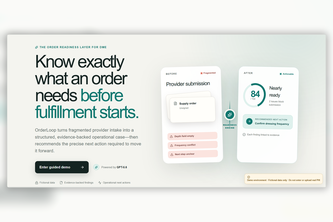
OrderLoop, as described by the author, is a software demonstration product designed to improve order readiness for durable medical equipment (DME) providers. It uses GPT-5.6 and structured intake workflows to identify missing or conflicting information in orders, score them for readiness, and guide providers through corrections before submission.
What changed
The project evolved from an internal, validated workflow at Galaxy Medical Supply into a productized demonstration during OpenAI Build Week. The author states that the original workflow received 111 provider submissions, indicating early validation of the concept.
Single most important open question — commercial due-diligence read
Is there evidence of real-world adoption or traction beyond the fictional demo and internal pilot? The description does not indicate any revenue, customers, or operational use outside of a hackathon submission.
What The Product Actually Is
The description states that OrderLoop is an order-readiness system for durable medical equipment (DME). It guides providers through structured intake, reviews orders against supporting documentation, identifies missing or conflicting information, and provides clear next actions before fulfillment delays occur.
It includes:
- Structured patient, provider, and order intake
- GPT-5.6 review with evidence-backed findings
- Readiness scoring (e.g., 70 to 97)
- Blocker identification and resolution guidance
- Provider signature confirmation
- Document generation (Letter of Medical Necessity, Prescription / DME Order, Wound Care Order Form)
- Handoff to a DME operations dashboard
The system is described as using deterministic rules for mechanical requirements and GPT-5.6 for clinical and operational review.
Inference The product appears to be a workflow automation tool aimed at reducing errors in DME order processing by integrating AI with structured data entry and document generation.
Positioning & Claim Evolution
The author positions OrderLoop as a solution to a common problem in DME: incomplete or conflicting prescriptions that delay fulfillment. It is described as turning “incomplete DME prescriptions into structured, review-ready orders.”
Claim evolution
- Initial idea: A guided intake workflow at Galaxy Medical Supply.
- Build Week version: Productized demonstration with AI integration and full operational flow.
- Future intent: Testing with more DME order categories and real feedback.
The author emphasizes that the system does not diagnose patients or guarantee insurance approval, but rather helps providers understand what is missing or wrong in an order and how to fix it.
Inference The positioning reflects a niche focus on improving DME order quality and operational efficiency through AI-assisted review and structured workflows.
Target Customer & ICP
The description states that OrderLoop targets DME providers, who send orders that often contain missing or conflicting information. These providers are likely part of the broader healthcare supply chain, working with durable medical equipment vendors like DME companies.
It also mentions that the system is designed to help both providers and DME teams by giving clear next actions and reducing delays caused by incomplete orders.
Inference The target customer is a DME provider or DME operations team. The ideal customer profile (ICP) likely includes organizations with high volumes of orders, regulatory compliance needs, and a need to reduce administrative friction in order processing.
Business Model & Pricing Evidence
There is no evidence of pricing, business model, or monetization strategy in the description.
The author states that this Build Week version uses fictional data only and does not accept real PHI, provide medical advice, or guarantee coverage or fulfillment. The product is described as a demonstration, not a commercial offering.
Inference No commercial structure or revenue model has been established or evidenced.
Technical & Delivery Signals
The author reports that the system was built using:
- Technology stack: codex, eslint, gpt-5.6, netlify, next.js, node.js, openai-api, react, typescript, vitest
- GPT integration: GPT-5.6 Terra compares structured orders with supporting evidence and provides explanations for issues
- Deterministic rules: Handle required fields and workflow states
- Testing: 24 workflow and unit tests plus 5 submission-safety tests
- Deployment: Application packaged for deployment
The system includes:
- Structured intake
- Evidence-based review
- Readiness scoring
- Document generation
- Dashboard handoff
Inference The technical architecture suggests a modern web application with AI integration, automated testing, and structured data handling. However, no evidence of production-grade infrastructure or scalability is provided.
Traction & Maturity Signals
The description states:
- A prior workflow at Galaxy Medical Supply received 111 provider submissions
- This version was built during OpenAI Build Week
- It uses fictional data only
- No real-world usage beyond the demo and internal pilot
There is no evidence of revenue, customer base, or operational use outside of the hackathon submission.
Inference The product has shown early validation in a limited context (111 submissions), but no traction or maturity beyond a demonstration version exists.
Competitive Context
The description does not mention any competitors or market positioning relative to others in the DME order processing space.
It is unclear whether similar tools exist for automating and validating medical orders, nor if OrderLoop addresses a unique gap in the market.
Inference No competitive landscape or differentiation strategy is evident from the description.
Open Questions & Risks
- No real-world adoption: The product has not been tested with real providers or DME operations.
- Fictional data only: The demo uses fictional examples, not actual patient or provider data.
- Unverified AI role: While GPT is used for review, there’s no evidence of how it performs in practice or whether it meets regulatory standards.
- No commercial model: No pricing, licensing, or monetization strategy is described.
- Limited scope: The demo covers only one DME order category (wound care) and a single use case.
Inference The project is at an early stage of development and lacks evidence of real-world utility or scalability.
Questions the description leaves open
- What specific feedback did you receive from the 111 provider submissions in your internal workflow?
- How does OrderLoop handle compliance with HIPAA and other healthcare data regulations?
- Are there any plans to integrate with existing DME systems or EHRs?
- What is the expected timeline for moving beyond the demo phase into a production-ready product?
- Have you identified any specific DME vendors or providers willing to pilot the system?
Overall Assessment
Assessment Not evidenced.
The description presents OrderLoop as a conceptual and demonstration-level solution, not a commercial product with traction, revenue, or real-world adoption. It is unclear whether this represents a viable business opportunity or just an idea in early development.
There is no evidence of:
- Revenue
- Customers
- Product-market fit beyond a single internal pilot
- Commercial viability or scalability
Inference This project is at a very early stage and lacks the commercial signals needed to assess investment or partnership potential. It may be a promising concept, but further due diligence would require evidence of real-world usage, product development, and market validation.
User Stories BotA demo video on every pull request
Get a demo video on every new feature
GitHub App that watches your pull requests and records a narrated, captioned demo.
Save time on demo prep and make informed decisions faster with a video walkthrough of every new feature.
Source
Submitted to the OpenAI 2026 hackathon on Devpost. Project home on Devpost. Back to the full gallery on Devpost.
This competitive analysis was produced by top-founders.com (opens in a new tab)
Generated by a language model from this project's public Devpost page — its tagline, the author's own write-up and any built-with tags listed there — as captured in August 2026. Short quotations are the author's words. It is an opinion on the idea as a business, not on the people behind it, and it reflects the description as published then. If the project has moved on, request a correction below. The analysis is not independent research and contains no verified traction, revenue or customer data.
An independent guide by KFG International LLC — not affiliated with, endorsed by, or connected to Devpost or OpenAI.