

Archive position — measured, not model output
0 likes on Devpost
2,263 of the 7,850 archived projects have more likes, and 5,587 share exactly 0 — so this project's #5,744 place in the like-ranked listing is a tie-break inside that group, not a ranking.
Projects (log scale)
Likes on Devpost. ▲ marks this project's group.
Show the figures
| Likes | Projects | Share of archive |
|---|---|---|
| 0 | 5,587 | 71.2% |
| 1 | 1,758 | 22.4% |
| 2 | 284 | 3.6% |
| 3–4 | 132 | 1.7% |
| 5–9 | 75 | 1.0% |
| 10+ | 14 | 0.2% |
 User Stories BotA demo video on every pull request
Get a demo video on every new feature
GitHub App that watches your pull requests and records a narrated, captioned demo.
Save time on demo prep and make informed decisions faster with a video walkthrough of every new feature.
Executive Summary
What the company appears to be
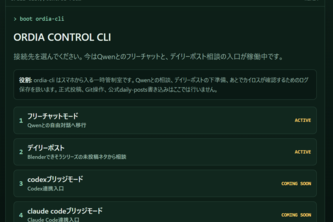
Ordia CLI 5.6 is a self-reported local-first command-line interface tool designed for educational use, particularly for children and learners. It aims to lower communication barriers in learning environments by generating small drafts or questions based on learner input, while preserving the final choice of authorship with the user.
What changed
The project was submitted as part of the OpenAI 2026 hackathon. The author describes it as a working prototype built during a "Build Week" experience, focused on education mode and local model use.
Single most important open question — the commercial due-diligence read
Is there any evidence of traction, revenue, or adoption beyond the self-reported developer workflow? The description does not indicate any customers, users, or monetization efforts.
What The Product Actually Is
The description states that Ordia CLI 5.6 is a local-first command-line interface tool for education. It includes:
- A set of four experiences in Education Mode:
- Diary Rescue (140-character prompt)
- Search & Question Rescue
- Filtered Local Chat
- Play Seed Lab
- A core loop involving:
- Learner input
- Input guardrails
- Small local model draft (Qwen3, Qwen2.5 Coder, Gemma)
- Hermes fixed audit layer
- Limited regeneration
- Final human choice
- The system is designed to not auto-submit or publish, and to preserve learner agency.
Evidence
- The author describes the tool as a “local-first” CLI.
- It uses local models (Qwen3, Qwen2.5 Coder, Gemma) via LM Studio.
- Hermes is used for deterministic audit checks.
- Outputs are not auto-saved or published.
- The system includes guardrails and fail-closed behavior.
Inference The tool is built as a prototype for educational use, likely in a developer context, with no evidence of commercial deployment or user-facing product.
Positioning & Claim Evolution
The author positions Ordia CLI 5.6 as a tool that lowers communication barriers in learning, especially for children who struggle to articulate problems or express experiences.
Key claims:
- It helps learners avoid the “something is wrong” problem by turning it into a useful question.
- It avoids replacing the learner’s own words, preserving authorship.
- It uses local models and deterministic auditing to maintain safety and control.
Evidence
- The tagline: “Local-first reflection and question-building: small Qwen drafts, Hermes checks, and the learner makes the final choice.”
- The write-up emphasizes that AI does not replace the child’s voice or words.
- The tool is described as a “diary rescue” and “question-building” system.
Inference The positioning is rooted in educational empathy and control over AI-generated content. It is not positioned for commercial use but rather as an experimental or prototype tool.
Target Customer & ICP
The description states that Ordia CLI 5.6 is built for learners, especially children, who struggle to articulate problems or express experiences.
It also mentions:
- A focus on diary writing and programming problem-solving
- Use in educational settings
- A “small Qwen drafts” approach that avoids overwhelming the learner
Evidence
- The tool is described as being for learners, especially children.
- It includes a Diary Rescue experience designed to help with writing.
- It supports programming problem-solving through question-building.
Inference The ICP appears to be young learners or students, particularly in educational contexts. No evidence of commercial customers or enterprise use.
Business Model & Pricing Evidence
There is no evidence of any business model, pricing, or monetization strategy in the description.
Evidence
- The author states that the tool is a prototype built during a hackathon.
- There is no mention of revenue, pricing tiers, or customer acquisition.
- The public preview is isolated from publisher workflows and logs.
Inference No commercial business model is evident. The project appears to be experimental or personal development work.
Technical & Delivery Signals
The tool uses:
- Local models: Qwen3 (4B), Qwen2.5 Coder (7B), Gemma 4 E4B
- Hermes for deterministic audit checks
- LM Studio for local model execution
- Codex SDK and GPT-5.6 for development, review, and calibration
- Git-based workflow, with isolated worktrees and clean artifact handling
Evidence
- The system uses local models and avoids cloud AI use.
- Hermes is used as a fixed audit layer.
- Codex was used to implement features and maintain quality.
- The tool supports a developer workflow that separates public preview from private logs.
Inference The technical architecture is focused on local-first, deterministic, and safe AI use, with clear separation between development and public-facing workflows. No evidence of production deployment or scalability beyond the author’s own use.
Traction & Maturity Signals
There is no evidence of traction, adoption, or user feedback.
Evidence
- The project was submitted to a hackathon.
- It is described as a prototype built during a Build Week.
- No mention of users, customers, or usage metrics.
- No data on retention, engagement, or product-market fit.
Inference No traction or maturity signals are evident. The tool is in early development and not yet deployed for public use.
Competitive Context
The description does not provide any information about competitors or the broader market landscape.
Evidence
- No mention of existing tools or platforms in this space.
- No comparison to similar educational AI tools or CLI-based learning systems.
Inference No competitive context is provided. The tool appears to be a novel, personal project with no known direct competitors.
Open Questions & Risks
Key risks and open questions:
- No commercial traction or adoption: The tool is described as a prototype.
- No evidence of scalability or production use: It’s built for local execution and developer workflows.
- No monetization strategy: No indication of how the product would be sold or funded.
- Self-reported only: All information is unverified and based on the author's own account.
Evidence
- The tool is described as a hackathon submission.
- There is no evidence of customer data, revenue, or user feedback.
- The public preview is isolated from developer workflows.
Inference The project lacks commercial viability or traction. It is not positioned for market entry or growth.
Questions the description leaves open
- What is the intended path to market for Ordia CLI 5.6?
- Are there any users or pilot programs beyond personal use?
- How does the author plan to monetize or scale this tool?
- What are the technical limitations of the local-first approach in educational settings?
- Is there a roadmap for expanding beyond the current prototype?
Overall Assessment
Not evidenced.
The project is described as a personal prototype built during a hackathon, with no evidence of traction, revenue, or commercial use.
Confidence Low This analysis is based entirely on self-reported information and lacks any independent verification or data on adoption, customers, or financials. The tool appears to be in early development and not yet ready for investment or partnership consideration.
User Stories BotA demo video on every pull request
Get a demo video on every new feature
GitHub App that watches your pull requests and records a narrated, captioned demo.
Save time on demo prep and make informed decisions faster with a video walkthrough of every new feature.
Source
Submitted to the OpenAI 2026 hackathon on Devpost. Project home on Devpost. Back to the full gallery on Devpost.
This competitive analysis was produced by top-founders.com (opens in a new tab)
Generated by a language model from this project's public Devpost page — its tagline, the author's own write-up and any built-with tags listed there — as captured in August 2026. Short quotations are the author's words. It is an opinion on the idea as a business, not on the people behind it, and it reflects the description as published then. If the project has moved on, request a correction below. The analysis is not independent research and contains no verified traction, revenue or customer data.
An independent guide by KFG International LLC — not affiliated with, endorsed by, or connected to Devpost or OpenAI.