

Archive position — measured, not model output
0 likes on Devpost
2,263 of the 7,850 archived projects have more likes, and 5,587 share exactly 0 — so this project's #5,746 place in the like-ranked listing is a tie-break inside that group, not a ranking.
Projects (log scale)
Likes on Devpost. ▲ marks this project's group.
Show the figures
| Likes | Projects | Share of archive |
|---|---|---|
| 0 | 5,587 | 71.2% |
| 1 | 1,758 | 22.4% |
| 2 | 284 | 3.6% |
| 3–4 | 132 | 1.7% |
| 5–9 | 75 | 1.0% |
| 10+ | 14 | 0.2% |
 User Stories BotA demo video on every pull request
Get a demo video on every new feature
GitHub App that watches your pull requests and records a narrated, captioned demo.
Save time on demo prep and make informed decisions faster with a video walkthrough of every new feature.
Executive Summary
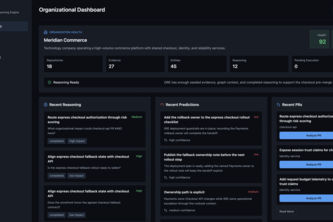
ORE - The Organizational Reasoning Engine is described by its author as a system that uses GPT-5.6 as an organizational reasoning engine to evaluate engineering changes before they are merged. It builds a knowledge graph from organizational evidence, then reasons over that structured model to predict consequences and generate explainable impact reports and actionable recommendations.
The project appears to be a single-person hackathon effort with no demonstrated traction or commercial activity. The author states the system is built using AI agents, developer tools, Docker, FastAPI, Neo4j, PostgreSQL, Next.js, React, TypeScript, and OpenAI APIs — but provides no evidence of revenue, customers, or usage.
The most important open question is whether this concept can be scaled into a viable product that delivers real value to engineering teams beyond the author's own vision. The description makes no claims about actual deployment, adoption, or business outcomes.
What The Product Actually Is
The description states that ORE is an Organizational Reasoning Engine that uses GPT-5.6 as its core reasoning engine. It builds a knowledge graph from organizational evidence and then reasons over that structured model to predict consequences of engineering changes.
According to the author, ORE:
- Gathers organizational evidence
- Expands relationships through a knowledge graph (Neo4j)
- Identifies organizational signals
- Constructs a structured representation of how the organization works
- Uses GPT-5.6 to evaluate competing hypotheses, identify dependencies, challenge assumptions, and predict downstream consequences
- Generates explainable Impact Reports with affected teams, services, repositories, documentation, deployment workflows, operational risks, confidence levels, and supporting evidence
- Produces practical engineering recommendations such as rollout strategies, migration checklists, reviewer suggestions, documentation updates, communication drafts, and operational tasks
The system is described as having a reasoning pipeline: Evidence → Relationships → Signals → Assumptions → Reasoning → Impact → Actions → Safe Execution.
Positioning & Claim Evolution
The author states that ORE was built on the realization that modern organizations don't have an information problem—they have an understanding problem. The product positions itself as moving beyond retrieval to reasoning about organizations.
Key claims:
- "Today's AI assistants are remarkably good at retrieving information and answering questions. But retrieval is not reasoning."
- "Instead of asking: 'What does this document say?' ORE asks a fundamentally different question: 'Given everything this organization knows today, what is most likely to happen if this change is merged?'"
- "AI shouldn't reason over documents. It should reason over organizations."
- "GPT-5.6 doesn't have to be another AI assistant. It can become the reasoning engine that helps an organization understand itself before making its next engineering decision."
The positioning evolved from a general understanding problem to a specific solution using GPT-5.6 as the organizational reasoning engine, with explainability and human control as core design principles.
Target Customer & ICP
The description states that ORE is designed for engineering teams who produce thousands of pieces of knowledge including pull requests, architecture documents, RFCs, incident reports, runbooks, deployment logs, ownership files, design discussions, and technical conversations.
The target audience appears to be:
- Software engineers working in organizations with complex engineering workflows
- Teams that make frequent changes to codebases and need to understand consequences before merging
- Organizations that struggle with scattered knowledge and undocumented institutional knowledge
However, there is no evidence provided about specific customer segments, personas, or use cases beyond the general description of engineering teams.
Business Model & Pricing Evidence
Not evidenced. The description does not contain any information about pricing models, revenue streams, monetization strategies, or business model assumptions.
Technical & Delivery Signals
The author states that ORE was built using:
- Next.js + React for user experience
- FastAPI for orchestration
- PostgreSQL for structured operational data
- Neo4j for the organizational knowledge graph
- GPT-5.6 as the organizational reasoning engine
- Codex for engineering execution after human approval
The system is described as having a reasoning pipeline: Evidence → Relationships → Signals → Assumptions → Reasoning → Impact → Actions → Safe Execution.
Key technical design decisions mentioned:
- Reasoning before prompting (GPT-5.6 doesn't receive raw documents)
- Explainability by design (every recommendation exposes evidence, assumptions, confidence, and reasoning)
- Separation of reasoning from execution (GPT-5.6 determines what should happen; Codex helps implement how it happens)
- Starting with product vision before features
The author notes that GPT-5.6 and Codex were used as design partners throughout development rather than just implementation tools.
Traction & Maturity Signals
Not evidenced. The description contains no information about:
- Revenue or financial performance
- Customer base or user adoption
- Product usage metrics
- Market traction or growth indicators
- Any form of commercial activity or business development
The project is described as a hackathon submission, and the author explicitly states that "no revenue, customer or traction data is available beyond what they state."
Competitive Context
Not evidenced. The description does not contain any information about:
- Competitors in the market
- Market size or competitive landscape
- Differentiation from existing tools
- Market positioning relative to other AI/developer tooling
The author makes no mention of similar products or services that might address the same problem space.
Open Questions & Risks
Several risks and open questions are evident from the description:
- Single-person development: The project is described as built by one person (Prakriti Rai) with no evidence of team expansion or commercial support structure.
- Unproven concept: The author states this is a hackathon effort, suggesting it's an experimental concept rather than a mature product with demonstrated value.
- No commercial evidence: There is no evidence of revenue, customers, or business traction beyond the author's own claims.
- High technical complexity without validation: The system requires sophisticated integration of multiple technologies (GPT-5.6, Neo4j, Codex, etc.) but there's no evidence that these components work together effectively in practice.
- Unverified assumptions: The entire premise relies on the assumption that organizations contain answers but lack connection between them, which is unproven.
- Limited scalability: The description suggests this is a foundational concept with "next goals" including expanding support for additional knowledge sources and deeper integration into workflows, implying the current version is incomplete.
- No clear path to monetization: The author makes no claims about how the product would generate revenue or be commercialized.
Questions the description leaves open
- What specific engineering problems are you trying to solve that existing tools don't address?
- How do you plan to validate that your reasoning engine actually produces better outcomes than current approaches?
- What evidence do you have that engineering teams would pay for this solution?
- How do you intend to scale from a single-person hackathon project to a product that can handle enterprise-level complexity?
- What are the technical challenges in building and maintaining the knowledge graph at scale?
- How do you plan to integrate with existing development workflows and tools?
- What is your roadmap for moving beyond the current hackathon version to a production-ready product?
- How will you ensure explainability remains practical as the system scales?
- What are the key metrics you would use to measure success of this product?
- How do you plan to address privacy and data security concerns when building organizational knowledge graphs?
Overall Assessment
Not evidenced. The description contains no information about:
- Financial performance or valuation
- Investment history or funding rounds
- Partnership opportunities or strategic value
- Commercial viability or market opportunity
- Any form of investment or partnership activity
The project is described as a hackathon submission with no commercial activity, revenue, customers, or traction data. The author explicitly states that "no revenue, customer or traction data is available beyond what they state." This makes any assessment of investment or partnership potential impossible based on the provided information alone.
The concept appears promising in theory but lacks demonstrated traction, market validation, or business model clarity. Any investment or partnership decision would require additional evidence of commercial viability, technical feasibility, and market demand beyond what is provided in this self-reported description.
User Stories BotA demo video on every pull request
Get a demo video on every new feature
GitHub App that watches your pull requests and records a narrated, captioned demo.
Save time on demo prep and make informed decisions faster with a video walkthrough of every new feature.
Source
Submitted to the OpenAI 2026 hackathon on Devpost. Project home on Devpost. Back to the full gallery on Devpost.
This competitive analysis was produced by top-founders.com (opens in a new tab)
Generated by a language model from this project's public Devpost page — its tagline, the author's own write-up and any built-with tags listed there — as captured in August 2026. Short quotations are the author's words. It is an opinion on the idea as a business, not on the people behind it, and it reflects the description as published then. If the project has moved on, request a correction below. The analysis is not independent research and contains no verified traction, revenue or customer data.
An independent guide by KFG International LLC — not affiliated with, endorsed by, or connected to Devpost or OpenAI.