

Archive position — measured, not model output
0 likes on Devpost
2,263 of the 7,850 archived projects have more likes, and 5,587 share exactly 0 — so this project's #5,748 place in the like-ranked listing is a tie-break inside that group, not a ranking.
Projects (log scale)
Likes on Devpost. ▲ marks this project's group.
Show the figures
| Likes | Projects | Share of archive |
|---|---|---|
| 0 | 5,587 | 71.2% |
| 1 | 1,758 | 22.4% |
| 2 | 284 | 3.6% |
| 3–4 | 132 | 1.7% |
| 5–9 | 75 | 1.0% |
| 10+ | 14 | 0.2% |
 User Stories BotA demo video on every pull request
Get a demo video on every new feature
GitHub App that watches your pull requests and records a narrated, captioned demo.
Save time on demo prep and make informed decisions faster with a video walkthrough of every new feature.
Executive Summary
What the company appears to be
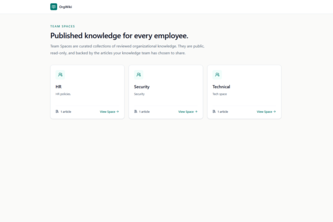
OrgWiki is an AI-powered organizational knowledge platform that converts fragmented documents into structured, trusted knowledge. The author states it uses GPT-5.6 for discovery and generation of knowledge articles, with a human review step before publication. It supports uploading ZIP files of documentation, and offers Team Spaces for organizing content.
What changed
The project is described as a self-contained hackathon submission built in one month by a single developer (Karthikeyan Srinivasan). The author claims to have explored an alternative approach to AI documentation tools — not just retrieval but transformation into trusted knowledge before search.
Single most important open question
Is there any evidence of traction, revenue, or customer adoption beyond the author's own description? The project is self-reported and unverified; no third-party data exists.
What The Product Actually Is
The description states that OrgWiki is an AI-powered organizational knowledge platform. It accepts ZIP files containing company documentation and processes them through a workflow involving:
- Upload
- AI Discovery (GPT-5.6)
- AI Generation (GPT-5.6)
- Human Review
- Publish
- Team Spaces
The system generates evidence-backed articles with citations, which can be organized into public-facing Team Spaces or downloaded as Markdown.
Inference The product is a document transformation tool that uses LLMs to structure unstructured organizational content and make it trustworthy via human review.
Positioning & Claim Evolution
The author states the inspiration was to move beyond AI tools focused on retrieving existing information, toward transforming fragmented documentation into curated knowledge. This positions OrgWiki as an AI-assisted knowledge management platform rather than a search engine or document repository.
Claim
OrgWiki aims to convert “fragmented organizational documents” into “structured, trusted knowledge.”
Inference It is positioned as a solution for organizations struggling with outdated, duplicated, or contradictory internal documentation.
Target Customer & ICP
The description does not name specific customers or personas. However, it implies use cases involving:
- Organizations with large volumes of unstructured documents
- Teams looking to improve knowledge sharing and trust in their internal resources
- Enterprises seeking to centralize and organize organizational knowledge
Inference The target is likely mid-to-large enterprises with complex documentation challenges, though no explicit segmentation or buyer personas are mentioned.
Business Model & Pricing Evidence
There is no evidence of pricing, monetization strategy, or business model in the description. The author only describes the technical workflow and product features.
Not evidenced.
Technical & Delivery Signals
The project was built using:
- Frontend: React
- Backend: ASP.NET Core (.NET 9)
- Database: PostgreSQL
- AI: GPT-5.6, Codex
- Other tech: JWT, REST APIs, Supabase, Tailwind, Vite, EF, Git
It follows a layered architecture with services for ingestion, AI orchestration, review workflows, publishing, and distribution.
Inference The technical stack suggests a modern, scalable backend with LLM integration and human-in-the-loop design. The use of Codex indicates rapid development, possibly through code generation tools.
Traction & Maturity Signals
There is no evidence of traction or adoption beyond the author's own account. No customers, revenue, usage metrics, or product-market fit indicators are provided.
Not evidenced.
Competitive Context
The description does not mention competitors or market positioning relative to other knowledge platforms like Confluence, Notion, SharePoint, or specialized AI tools for documentation.
Not evidenced.
Open Questions & Risks
- Single Developer: The entire project was built by one person (Karthikeyan Srinivasan), raising questions about scalability and long-term maintenance.
- Unverified Claims: All claims are self-reported, with no external validation or data to support traction, adoption, or performance.
- No Revenue Model: No indication of how the product will be monetized or whether it has a viable business model.
- AI Dependency Risk: Heavy reliance on GPT-5.6 and LLMs may pose risks related to cost, availability, and accuracy without clear controls.
Questions the description leaves open
- What specific problems are you solving for your target customers?
- How do you plan to validate that the AI-generated content is accurate and trustworthy?
- Are there any early adopters or pilot users who have tested this tool?
- What is your go-to-market strategy, and how will you scale beyond a single developer?
- How do you intend to monetize this platform?
- What are the risks associated with relying on GPT-5.6 for core functionality?
Overall Assessment
The description presents a self-contained hackathon project built by one individual, without any evidence of traction, revenue, or customer validation. While the idea has potential in the AI-powered knowledge management space, there is no basis to assess commercial viability or scalability.
Confidence Level Low
Assessment Not ready for investment or partnership consideration based on available information.
User Stories BotA demo video on every pull request
Get a demo video on every new feature
GitHub App that watches your pull requests and records a narrated, captioned demo.
Save time on demo prep and make informed decisions faster with a video walkthrough of every new feature.
Source
Submitted to the OpenAI 2026 hackathon on Devpost. Project home on Devpost. Back to the full gallery on Devpost.
This competitive analysis was produced by top-founders.com (opens in a new tab)
Generated by a language model from this project's public Devpost page — its tagline, the author's own write-up and any built-with tags listed there — as captured in August 2026. Short quotations are the author's words. It is an opinion on the idea as a business, not on the people behind it, and it reflects the description as published then. If the project has moved on, request a correction below. The analysis is not independent research and contains no verified traction, revenue or customer data.
An independent guide by KFG International LLC — not affiliated with, endorsed by, or connected to Devpost or OpenAI.