

Archive position — measured, not model output
0 likes on Devpost
2,263 of the 7,850 archived projects have more likes, and 5,587 share exactly 0 — so this project's #7,711 place in the like-ranked listing is a tie-break inside that group, not a ranking.
Projects (log scale)
Likes on Devpost. ▲ marks this project's group.
Show the figures
| Likes | Projects | Share of archive |
|---|---|---|
| 0 | 5,587 | 71.2% |
| 1 | 1,758 | 22.4% |
| 2 | 284 | 3.6% |
| 3–4 | 132 | 1.7% |
| 5–9 | 75 | 1.0% |
| 10+ | 14 | 0.2% |
 User Stories BotA demo video on every pull request
Get a demo video on every new feature
GitHub App that watches your pull requests and records a narrated, captioned demo.
Save time on demo prep and make informed decisions faster with a video walkthrough of every new feature.
Executive Summary
What the company appears to be
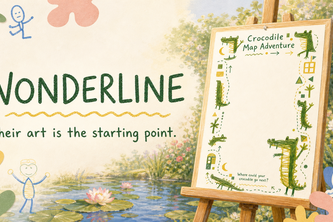
Wonderline is a self-reported creative companion for children that uses AI to transform a child’s original drawing into three personalized, printable art activities inspired by artistic languages.
What changed
The project was submitted as a hackathon prototype in 2026. It is not evidenced to have launched commercially or gained traction beyond its initial build.
Single most important open question
Is there evidence of any real-world usage, revenue, or customer feedback that would indicate whether the product works as intended in practice?
What The Product Actually Is
The description states that Wonderline:
- Takes a child’s drawing and turns it into three personalized, printable art activities.
- Uses AI to interpret the drawing and connect it with artistic languages from artists like Paul Klee, Henri Matisse, Joan Miró, etc.
- Generates three printable pages based on the child's own artwork.
- Preserves recognizable handmade elements from the original drawing.
- Does not replace or improve the child’s drawing but introduces new creative directions.
The product is described as a full-stack web experience built with Next.js, React, TypeScript, and OpenAI APIs.
Evidence
- The author states that Wonderline "transforms a child's original drawing into three personalized, printable art activities."
- It uses AI to analyze drawings and match them with artistic styles.
- It generates activity pages using GPT Image while preserving the original drawing’s elements.
- The interface allows uploading, previewing, and downloading results without requiring an account.
Inference This is a creative education tool for families or educators that leverages generative AI to support child-driven art exploration.
Positioning & Claim Evolution
The author claims Wonderline:
- Begins with what the child has already imagined.
- Does not replace creativity with AI-generated artwork.
- Introduces new ways of seeing and making while preserving the child’s original marks.
- Makes high-quality, personalized art education more accessible.
- Is designed to be warm, playful, and approachable for both children and parents.
Evidence
- The author states: “Wonderline uses AI to notice their lines, shapes, colors, and characters, then opens new directions for exploration.”
- It aims to make art education more accessible while ensuring the child remains the artist.
- The goal is to provide an experience that feels “warm, playful, and approachable.”
Inference The positioning centers on AI as a creative guide rather than a substitute, emphasizing personalization and preservation of child creativity.
Target Customer & ICP
The description states:
- Wonderline targets families and educators.
- It is designed for use by children and parents.
- The interface does not require an account or prior knowledge of art history or prompt engineering.
Evidence
- “Families do not need to understand art history or prompt engineering.”
- “Wonderline was inspired by the time I spent learning and making art with my son.”
Inference The primary user is a parent or educator who wants to support a child’s creative expression through personalized, AI-assisted activities.
Business Model & Pricing Evidence
There is no evidence in the description of any pricing model, monetization strategy, or business model. The project is described as a hackathon prototype.
Evidence
- No mention of subscriptions, freemium tiers, or paid features.
- No indication of how the product would be sold or distributed beyond its prototype form.
Inference The business model is not evident from this description. It may evolve post-hackathon.
Technical & Delivery Signals
The project was built with:
- Next.js, React, TypeScript
- OpenAI APIs (vision and structured outputs)
- GPT Image for generating printable pages
- A multimodal pipeline with specialized AI stages:
- Artwork Interpreter
- Art Language Matcher
- Creative Activity Planner
- Image Composer
Evidence
- “Wonderline is a full-stack web experience built with Next.js, React, TypeScript, and vinext.”
- “The creative pipeline uses multiple specialized AI stages: Artwork Interpreter, Art Language Matcher, Creative Activity Planner, Image Composer.”
- “We used the OpenAI Responses API with vision and Structured Outputs.”
Inference The technical architecture is modular and AI-driven, designed to support a consistent flow of interpretation → matching → planning → generation.
Traction & Maturity Signals
There is no evidence of any traction, revenue, or customer adoption beyond its hackathon prototype. The project is described as a demo with no indication of real-world usage.
Evidence
- “This project was submitted to the OpenAI 2026 hackathon.”
- “A private gallery is stored locally in the browser, so no account is required for the prototype.”
- No mention of users, downloads, or engagement metrics.
Inference No data supports commercial viability or product-market fit beyond its initial build.
Competitive Context
The description does not provide any information about competitors or market positioning. It does not reference existing tools in the creative education or AI art space.
Evidence
- No mention of competitors.
- No indication of how Wonderline differentiates from other educational or creative platforms.
Inference The competitive landscape is unknown, but the product appears to target a niche in personalized creative learning for children.
Open Questions & Risks
Key risks and open questions include:
- The project is described as a hackathon prototype with no evidence of real-world usage.
- No pricing or monetization strategy is evident.
- No indication of scalability, privacy controls, or long-term product development plans.
- The author states that the AI pipeline was refined to avoid correcting or beautifying drawings — but this may be difficult to maintain at scale.
Evidence
- “This project was submitted to the OpenAI 2026 hackathon.”
- “We spent time refining the prompts so that the generated pages would preserve the child's recognizable ideas and handmade qualities.”
Inference The lack of traction, monetization, or scalability planning raises concerns about whether this will become a viable product.
Questions the description leaves open
- What is the current status of the prototype? Is it being used by families or educators?
- How does Wonderline handle privacy and data storage for children's drawings?
- Are there any plans to monetize or scale the product beyond its current form?
- Has the AI pipeline been tested with real children, and what feedback was received?
- What are the technical limitations of the current system, especially in terms of API reliability and generation speed?
Overall Assessment
Not evidenced.
There is no evidence to support a commercial due-diligence read beyond the hackathon prototype. No revenue, customers, traction, or business model are described.
Confidence Low — based on self-reported description only, with no external validation or data points.
Conclusion
Wonderline appears to be an early-stage idea with strong conceptual framing around child creativity and AI as a guide. However, without evidence of usage, monetization, or product-market fit, it cannot be evaluated for investment or partnership potential at this stage.
User Stories BotA demo video on every pull request
Get a demo video on every new feature
GitHub App that watches your pull requests and records a narrated, captioned demo.
Save time on demo prep and make informed decisions faster with a video walkthrough of every new feature.
Source
Submitted to the OpenAI 2026 hackathon on Devpost. Project home on Devpost. Back to the full gallery on Devpost.
This competitive analysis was produced by top-founders.com (opens in a new tab)
Generated by a language model from this project's public Devpost page — its tagline, the author's own write-up and any built-with tags listed there — as captured in August 2026. Short quotations are the author's words. It is an opinion on the idea as a business, not on the people behind it, and it reflects the description as published then. If the project has moved on, request a correction below. The analysis is not independent research and contains no verified traction, revenue or customer data.
An independent guide by KFG International LLC — not affiliated with, endorsed by, or connected to Devpost or OpenAI.