

Archive position — measured, not model output
0 likes on Devpost
2,263 of the 7,850 archived projects have more likes, and 5,587 share exactly 0 — so this project's #7,712 place in the like-ranked listing is a tie-break inside that group, not a ranking.
Projects (log scale)
Likes on Devpost. ▲ marks this project's group.
Show the figures
| Likes | Projects | Share of archive |
|---|---|---|
| 0 | 5,587 | 71.2% |
| 1 | 1,758 | 22.4% |
| 2 | 284 | 3.6% |
| 3–4 | 132 | 1.7% |
| 5–9 | 75 | 1.0% |
| 10+ | 14 | 0.2% |
 User Stories BotA demo video on every pull request
Get a demo video on every new feature
GitHub App that watches your pull requests and records a narrated, captioned demo.
Save time on demo prep and make informed decisions faster with a video walkthrough of every new feature.
Executive Summary
What the company appears to be
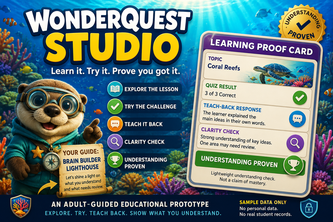
WonderQuest Studio is an adult-guided educational prototype for middle-school-level learning, built as a web application during OpenAI Build Week 2026. It is described as a demonstration of how AI can support learning beyond lesson delivery — focusing on teach-back, Clarity Check, and a final Learning Proof Card.
What changed
The project is presented as an experimental prototype with no revenue, customers, or traction data. It was built for a hackathon and does not claim to be a live autonomous tutoring system or production tool.
Single most important open question
Is there evidence of a viable path from this prototype to a product that supports real educational workflows with measurable learning outcomes?
What The Product Actually Is
The description states that WonderQuest Studio is an adult-guided education prototype for middle-school-level learning. It is described as a standalone web application built using HTML, CSS, and JavaScript.
It does not claim to be a live autonomous tutoring system or a production-grade tool. It uses GPT-5.6 for concept definition and Codex for building and debugging.
The prototype includes the following steps in its learning flow:
- Topic → Age Level → Wonder Map → Mini Lesson → Explore Cards → Try-It Challenge → Teach Back → Clarity Check → Understanding Proven → Learning Proof Card
The final output is a Learning Proof Card, which captures what was taught, tried, explained, understood, and needs review.
Evidence
- The author states it is a prototype.
- It uses HTML, CSS, JavaScript, GPT-5.6, and Codex.
- It includes a defined learning journey with teach-back and Clarity Check.
- No mention of real users, data collection, or live functionality.
Inference The product is not a commercial tool but an experimental demonstration.
Positioning & Claim Evolution
The author states that WonderQuest Studio explores a different question than most AI education tools: can the learner explain the idea in their own words?
It positions itself as:
- Not replacing parents, teachers, or human encouragement.
- A way to make learning evidence more visible through exploration, practice, teach-back, reflection, and a final Learning Proof Card.
The core claim is that learning should not end with content generation but should include teach-back, Clarity Check, and proof of understanding.
It also emphasizes:
- Age-appropriate framing.
- Privacy safety.
- Transparency about the role of adults in learning.
Evidence
- The author explicitly states this positioning.
- It is described as a demonstration for OpenAI Build Week 2026.
- No mention of commercial positioning or market traction.
Inference The project is positioned as an experimental, educational innovation — not a product for sale.
Target Customer & ICP
The author describes the target audience as:
- Middle-school learners
- Adults who guide learning (parents, teachers)
It is not described as targeting:
- Students directly.
- Institutions or schools.
- Any specific demographic beyond age and adult guidance.
Evidence
- The demo mission is for a 12-year-old.
- It is described as an “adult-guided education prototype.”
- No mention of institutional use, student data, or school adoption.
Inference The ICP is likely a parent or teacher using the tool to support learning, not a learner using it independently.
Business Model & Pricing Evidence
There is no evidence in the description of:
- A business model.
- Pricing structure.
- Revenue streams.
- Monetization strategy.
The project is described as a v1 prototype, built for a hackathon, and does not claim to be a live product or service.
Evidence
- The author states it is a demo.
- No mention of pricing, subscriptions, or sales.
- No indication of monetization.
Inference No business model or pricing can be inferred from the description.
Technical & Delivery Signals
The prototype was built using:
- HTML, CSS, JavaScript
- GPT-5.6 for concept definition and rubric design
- Codex for building, testing, and debugging
It includes:
- Deterministic demo content
- A simple keyword-based Clarity Check
- Responsive styling
- Documentation and release checks
The author states it is not a live autonomous tutoring system, does not collect child data, and does not grade real children.
Evidence
- The tech stack is listed.
- It uses AI tools for concept design and development.
- It is described as a v1 prototype with no live functionality or data collection.
Inference The technical approach is basic but functional for demonstration. No evidence of scalability or production-grade infrastructure.
Traction & Maturity Signals
There is no evidence of:
- Customers
- Revenue
- Usage metrics
- Product adoption
- Live users or feedback
It is described as a v1 prototype, built for a hackathon, and not intended to be a live product.
Evidence
- The author states it is a demo.
- No mention of real-world usage or traction.
- No data on user engagement or retention.
Inference The project is in early experimental phase with no maturity or traction signals.
Competitive Context
There is no evidence of:
- Competitors
- Market analysis
- Product differentiation from existing tools
- Industry positioning
The author does not reference other AI education tools, platforms, or learning systems.
Evidence
- No mention of competitors.
- No comparison to existing solutions.
- No indication of market research or competitive landscape.
Inference No competitive context can be inferred from the description.
Open Questions & Risks
Key risks and open questions include:
- No commercial viability: The project is a prototype, not a product.
- No traction or revenue: No evidence of adoption or monetization.
- Limited scope: Designed for demo purposes only; no indication of scalability.
- No user data or feedback: No real-world testing or usage.
- Unproven learning outcomes: The system does not claim to prove mastery, but it is unclear how it would be validated in practice.
Evidence
- Prototype nature.
- No revenue or customer data.
- No indication of long-term viability.
Inference The project has no commercial or product development signals.
Questions the description leaves open
- What is the intended path from this prototype to a functional, scalable product?
- How would you validate learning outcomes in real-world use?
- Is there any plan to collect user data or feedback for iterative improvement?
- What are the key assumptions about adult guidance and learning effectiveness?
- Are there plans to expand beyond middle-school learners or age-appropriate content?
- How do you intend to ensure safety, privacy, and ethical use in a real product?
Overall Assessment
There is no evidence of:
- Revenue
- Customers
- Product-market fit
- Commercial traction
- Scalable business model
The project is described as a v1 prototype, built for a hackathon, with no indication of commercial intent or development beyond the demo.
Evidence
- It is a demo.
- No mention of monetization or product use.
- No evidence of real-world adoption or feedback.
Inference This is not a viable investment or partnership opportunity at this stage. It is an experimental idea, not a product in development.
User Stories BotA demo video on every pull request
Get a demo video on every new feature
GitHub App that watches your pull requests and records a narrated, captioned demo.
Save time on demo prep and make informed decisions faster with a video walkthrough of every new feature.
Source
Submitted to the OpenAI 2026 hackathon on Devpost. Project home on Devpost. Back to the full gallery on Devpost.
This competitive analysis was produced by top-founders.com (opens in a new tab)
Generated by a language model from this project's public Devpost page — its tagline, the author's own write-up and any built-with tags listed there — as captured in August 2026. Short quotations are the author's words. It is an opinion on the idea as a business, not on the people behind it, and it reflects the description as published then. If the project has moved on, request a correction below. The analysis is not independent research and contains no verified traction, revenue or customer data.
An independent guide by KFG International LLC — not affiliated with, endorsed by, or connected to Devpost or OpenAI.