

Archive position — measured, not model output
0 likes on Devpost
2,263 of the 7,850 archived projects have more likes, and 5,587 share exactly 0 — so this project's #7,709 place in the like-ranked listing is a tie-break inside that group, not a ranking.
Projects (log scale)
Likes on Devpost. ▲ marks this project's group.
Show the figures
| Likes | Projects | Share of archive |
|---|---|---|
| 0 | 5,587 | 71.2% |
| 1 | 1,758 | 22.4% |
| 2 | 284 | 3.6% |
| 3–4 | 132 | 1.7% |
| 5–9 | 75 | 1.0% |
| 10+ | 14 | 0.2% |
 User Stories BotA demo video on every pull request
Get a demo video on every new feature
GitHub App that watches your pull requests and records a narrated, captioned demo.
Save time on demo prep and make informed decisions faster with a video walkthrough of every new feature.
Executive Summary
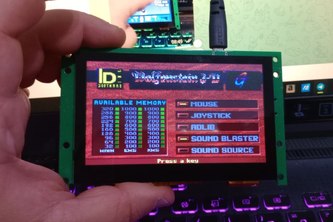
What the company appears to be: A solo developer project that ports legacy PC games (specifically Wolfenstein 3D) to low-power embedded touchscreen devices using SDL and C, with an emphasis on AI-assisted development workflows.
What changed: The author states this is a practical experiment and case study for "RetroPort AI", a workflow exploring how AI can assist in porting legacy software. It's not described as a commercial product or service but rather as an educational and technical demonstration.
Single most important open question: Is there any evidence of traction, revenue, customers or adoption beyond the author's own development work?
Note: This analysis is based entirely on the self-reported, unverified account provided by the author. No independent verification or additional data sources are available. All claims in this report are labeled as "the description states" and should be treated as such.
What The Product Actually Is
The description states that WOLF3D – AI-Assisted Retro Porting Lab is:
- An AI-assisted port of Wolfenstein 3D to low-power touch devices
- Focused on SDL optimization, performance tuning, and a clear human-AI development workflow
- A practical experiment to adapt a classic PC game for an ARM-based embedded Linux device with touchscreen input
The project includes:
- SDL rendering and performance optimizations
- Touchscreen input and coordinate calibration
- Platform-specific compatibility fixes
- Adaptation to a constrained embedded Linux environment
- Documentation of the human-AI development workflow
- Reproducible build, deployment, and testing notes
Inference: The product is an open-source technical demonstration, not a commercial offering. It's described as a "case study" for AI-assisted porting workflows.
Positioning & Claim Evolution
The description states that:
- This started as a "practical experiment"
- It evolved into a real-world case study for RetroPort AI
- The goal is to document engineering processes required to make legacy software work on unusual and resource-constrained hardware
- AI was used as an engineering support tool, not a replacement for engineering work
Inference: The positioning has shifted from a simple technical experiment to a demonstration of AI-assisted development workflows in legacy software porting. However, there is no evidence of commercial positioning or market traction.
Target Customer & ICP
The description states:
- No explicit target customer or ICP defined
- The project is focused on educational and technical demonstration purposes
- It's described as a "laboratory for learning" and a "real-world case study"
- The author mentions using it to learn about C programming, SDL rendering, embedded Linux, etc.
Not evidenced: No specific customer segments or ideal customer profiles are identified. There is no indication of who would use this beyond the developer or educational context.
Business Model & Pricing Evidence
The description states:
- No commercial business model is described
- The project does not distribute proprietary Wolfenstein 3D game data
- Users must provide their own legally obtained game files
- The repository contains only source code, patches, build tools, and documentation required for the port
Inference: There is no evidence of any pricing structure or revenue-generating mechanism. This appears to be a technical demonstration with no commercial intent.
Technical & Delivery Signals
The description states:
- Built with C, SDL, embedded Linux, ARM architecture
- Uses cross-compilation, makefiles, git, GitHub
- Focuses on performance tuning, optimization, and debugging
- Includes documentation of build, deployment, and testing processes
- Employs an iterative workflow: modify → compile → deploy → test → analyze → refine
Inference: The technical approach is clearly defined and shows a structured engineering process. However, there's no evidence of scalability or production delivery beyond this single project.
Traction & Maturity Signals
The description states:
- Accomplishments include running Wolfenstein 3D on a low-power embedded touchscreen device
- Improving SDL rendering performance
- Implementing usable touchscreen controls
- Fixing platform-specific compatibility issues
- Creating a repeatable legacy-porting workflow
- Documenting the interaction between AI assistance and hardware validation
Not evidenced: No evidence of user adoption, customer base, revenue, or market traction beyond the author's own work.
Competitive Context
The description states:
- No direct competitors are mentioned
- The project is framed as a technical case study for AI-assisted porting workflows
- It focuses on legacy software porting to embedded devices
Inference: There is no evidence of competitive landscape or market positioning beyond the author's own claims. No indication of similar projects or offerings in the market.
Open Questions & Risks
The description states:
- The project is a solo effort (1 person team)
- AI was used as an engineering support tool, not replacement for work
- Many ideas had to be measured, rejected, or modified after testing
- The real hardware remained the source of truth
- AI can accelerate investigation but cannot replace technical validation
Open questions:
- No evidence of commercial traction or adoption
- Solo developer effort may limit scalability
- Lack of clear monetization strategy
- No indication of broader market demand or interest
Questions the description leaves open
- What is the intended path from this experimental project to any kind of commercial offering?
- Are there any plans to expand beyond Wolfenstein 3D or target other legacy applications?
- How does the AI-assisted workflow scale beyond a single developer's capacity?
- Has there been any external interest or feedback on the RetroPort AI methodology?
- What are the specific technical limitations that prevent this from being a general-purpose tool?
Overall Assessment
The description states:
- This is an educational and experimental project
- No commercial product or service is described
- The author emphasizes learning and demonstrating workflows rather than building a business
Not evidenced: No evidence of investment potential, partnership opportunities, or commercial viability. The project appears to be a technical demonstration with no indication of traction, revenue, or market demand.
Inference: This does not appear to be a viable investment or partnership opportunity at this stage. It is a solo developer experiment without evidence of commercialization or market adoption.
User Stories BotA demo video on every pull request
Get a demo video on every new feature
GitHub App that watches your pull requests and records a narrated, captioned demo.
Save time on demo prep and make informed decisions faster with a video walkthrough of every new feature.
Source
Submitted to the OpenAI 2026 hackathon on Devpost. Project home on Devpost. Back to the full gallery on Devpost.
This competitive analysis was produced by top-founders.com (opens in a new tab)
Generated by a language model from this project's public Devpost page — its tagline, the author's own write-up and any built-with tags listed there — as captured in August 2026. Short quotations are the author's words. It is an opinion on the idea as a business, not on the people behind it, and it reflects the description as published then. If the project has moved on, request a correction below. The analysis is not independent research and contains no verified traction, revenue or customer data.
An independent guide by KFG International LLC — not affiliated with, endorsed by, or connected to Devpost or OpenAI.