

Archive position — measured, not model output
1 like on Devpost
505 of the 7,850 archived projects have more likes, and 1,758 share exactly 1 — so this project's #1,816 place in the like-ranked listing is a tie-break inside that group, not a ranking.
Projects (log scale)
Likes on Devpost. ▲ marks this project's group.
Show the figures
| Likes | Projects | Share of archive |
|---|---|---|
| 0 | 5,587 | 71.2% |
| 1 | 1,758 | 22.4% |
| 2 | 284 | 3.6% |
| 3–4 | 132 | 1.7% |
| 5–9 | 75 | 1.0% |
| 10+ | 14 | 0.2% |
 User Stories BotA demo video on every pull request
Get a demo video on every new feature
GitHub App that watches your pull requests and records a narrated, captioned demo.
Save time on demo prep and make informed decisions faster with a video walkthrough of every new feature.
Executive Summary
What the company appears to be
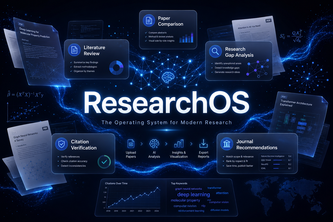
ResearchOS is a self-reported tool that aims to function as an "operating system for modern research", integrating literature review, citation analysis, gap discovery, journal matching, and AI-powered insights into one workspace.
What changed
The project was submitted to the OpenAI 2026 hackathon on Devpost. No evidence of prior development or traction is provided.
Single most important open question
Is there any evidence that ResearchOS has moved beyond a hackathon prototype, or whether it has begun to attract users or generate revenue?
What The Product Actually Is
The description states: "ResearchOS is the operating system for modern research, bringing literature review, citation analysis, gap discovery, journal matching, and AI-powered insights into one workspace."
- Claimed functionality: Literature review, citation analysis, gap discovery, journal matching, AI-powered insights.
- Not evidenced Specific features, UI/UX, integrations, or how these functions are implemented.
Inference Based on the technology stack (e.g., Next.js, React, Python, OpenAI, GPT-5), it appears to be a web-based application that leverages AI and LLMs for research tasks. However, this is an inference from the tech stack — not stated in the description.
Positioning & Claim Evolution
The author states: "ResearchOS is the operating system for modern research."
- Positioning: Positioned as a comprehensive platform for research workflows.
- Claim evolution: The tagline suggests a shift from fragmented tools to an integrated workspace, but no evidence of prior positioning or evolution is provided.
Not evidenced No indication of how this compares to existing tools (e.g., Zotero, Mendeley, Google Scholar), nor whether the product has evolved from an initial concept.
Target Customer & ICP
The description states: "ResearchOS is the operating system for modern research."
- Target customer: Researchers, likely academic or scientific professionals.
- ICP (Ideal Customer Profile): Not evidenced. No indication of specific user segments, roles, or use cases beyond general research.
Business Model & Pricing Evidence
The description does not state anything about pricing, monetization, or business model.
- Not evidenced No information on how the product will be sold, whether it's freemium, subscription-based, or otherwise.
Technical & Delivery Signals
The author-declared tech stack includes:
- AI/LLM tools: GPT-5, OpenAI
- Frontend: React, Next.js, Tailwind, TypeScript
- Backend: Node.js, Python, Prisma, SQLite
- Data sources: OpenAlex
- Other: GitHub, Codex, Graph, API, Knowledge
- Signals: The use of modern web frameworks and AI tools suggests a technical approach that could support a scalable product.
- Not evidenced No evidence of delivery timeline, MVP status, or actual product demo.
Traction & Maturity Signals
The description states:
- Submitted to the OpenAI 2026 hackathon on Devpost.
- Team size: 1 (Kaustubh Chaturvedi)
- Not evidenced No evidence of traction, users, revenue, or adoption. No mention of product usage, feedback, or growth metrics.
Competitive Context
The description does not provide any information about competitors.
- Not evidenced No comparison to existing research tools (e.g., Mendeley, Zotero, Semantic Scholar, Roam Research).
Open Questions & Risks
- Risk 1: The project is a hackathon submission with only one team member. This raises questions about scalability and long-term development.
- Risk 2: No evidence of product traction or user feedback. The lack of any real-world validation is an open question.
- Risk 3: The description is thin, self-reported, and lacks detail on functionality or business model.
Questions the description leaves open
- What specific research workflows does ResearchOS address that existing tools do not?
- Has the product been tested with actual researchers? If so, what feedback have you received?
- How is the product being developed beyond this hackathon submission?
- What is your plan for monetization and user acquisition?
- Are there any partnerships or integrations in place?
Overall Assessment
Not evidenced No information on valuation, funding rounds, or investment readiness.
- Confidence level: Low — the description is minimal and self-reported.
- Assessment: The project appears to be an early-stage hackathon prototype with no demonstrated traction or commercial viability. It lacks evidence of product-market fit, user adoption, or a clear path to monetization.
User Stories BotA demo video on every pull request
Get a demo video on every new feature
GitHub App that watches your pull requests and records a narrated, captioned demo.
Save time on demo prep and make informed decisions faster with a video walkthrough of every new feature.
Source
Submitted to the OpenAI 2026 hackathon on Devpost. Project home on Devpost. Back to the full gallery on Devpost.
This competitive analysis was produced by top-founders.com (opens in a new tab)
Generated by a language model from this project's public Devpost page — its tagline and any built-with tags listed there, since the author published no write-up — as captured in August 2026. Short quotations are the author's words. It is an opinion on the idea as a business, not on the people behind it, and it reflects the description as published then. If the project has moved on, request a correction below. The analysis is not independent research and contains no verified traction, revenue or customer data.
An independent guide by KFG International LLC — not affiliated with, endorsed by, or connected to Devpost or OpenAI.