

Archive position — measured, not model output
0 likes on Devpost
2,263 of the 7,850 archived projects have more likes, and 5,587 share exactly 0 — so this project's #5,742 place in the like-ranked listing is a tie-break inside that group, not a ranking.
Projects (log scale)
Likes on Devpost. ▲ marks this project's group.
Show the figures
| Likes | Projects | Share of archive |
|---|---|---|
| 0 | 5,587 | 71.2% |
| 1 | 1,758 | 22.4% |
| 2 | 284 | 3.6% |
| 3–4 | 132 | 1.7% |
| 5–9 | 75 | 1.0% |
| 10+ | 14 | 0.2% |
 User Stories BotA demo video on every pull request
Get a demo video on every new feature
GitHub App that watches your pull requests and records a narrated, captioned demo.
Save time on demo prep and make informed decisions faster with a video walkthrough of every new feature.
Executive Summary
The company appears to be a solo developer project named "Orcs! Orcs! Orcs!", submitted as part of the OpenAI 2026 hackathon. The author states that it is a tower defense game built using AI tools like Codex and ChatGPT5.6, with no prior experience in Godot or Blender. The project was developed over less than a week, and the author describes it as a proof-of-concept for how non-technical users might use AI-assisted development.
What changed: This is a self-reported demonstration of an experimental approach to game development using AI tools, not a commercial product with traction or customers.
The single most important open question: Is this project intended to evolve into a commercial product, and if so, what is the path to monetization and customer acquisition?
What The Product Actually Is
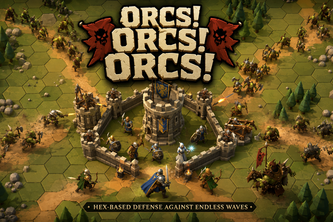
- The description states that "Orcs! Orcs! Orcs!" is a tower defense game.
- Players place buildings and combat units to defend their keep from waves of orcs.
- There is an intermission phase between levels where players can build, place units, or perform actions.
- The game uses Godot as the game engine, and Blender for unit models and animations.
- It includes unit animations, which were generated with help from Codex by referencing medical journals on anatomy.
Inference: The product is a playable prototype built in less than a week using AI tools, not a commercial offering.
Positioning & Claim Evolution
- The author states that the project was inspired by wanting to test how far GPT5.6 has come and simulate how a non-technical user might use Codex.
- It is framed as an experiment in accessible game development for younger or less experienced developers.
- The author claims that the project was built without prior experience in Godot or Blender, and with minimal planning.
Inference: The positioning is experimental, not commercial. It's a demonstration of AI-assisted development rather than a product with a defined market or value proposition.
Target Customer & ICP
- Not evidenced.
- The description does not state who the intended users are beyond the author’s own experience as a younger developer.
- No mention of target demographics, user personas, or customer segments.
Finding: No evidence of target customer or ideal customer profile (ICP).
Business Model & Pricing Evidence
- Not evidenced.
- There is no mention of pricing, monetization strategy, or business model.
- The project is described as a hackathon submission and prototype, not a commercial product.
Finding: No evidence of business model or pricing.
Technical & Delivery Signals
- Built with:
- Godot (game engine)
- Blender (models and animations)
- Codex and ChatGPT5.6 (AI assistance)
- Git (mentioned as a tool that was not used initially, causing issues)
- The author reports using natural language prompts to Codex.
- The project includes unit animations, which were improved by having Codex research anatomy from medical journals.
- Challenges included:
- Lack of Git usage
- Token limitations in Codex
- Difficulty with Blender mesh and model creation
Inference: The technical approach is experimental, relying heavily on AI tools. No evidence of scalability or production-grade delivery.
Traction & Maturity Signals
- Not evidenced.
- No data on users, customers, revenue, or adoption.
- The project was completed in less than a week and submitted to a hackathon.
- No mention of any distribution, marketing, or user engagement.
Finding: No evidence of traction or maturity.
Competitive Context
- Not evidenced.
- No mention of competitors or market context.
- The project is described as a prototype, not a product in a competitive landscape.
Finding: No evidence of competitive positioning or market analysis.
Open Questions & Risks
- Unproven commercial viability: The project is a hackathon submission and prototype, not a scalable or monetizable product.
- No customer or revenue data: There is no evidence of any users, customers, or income.
- Dependency on AI tools: Reliance on Codex and ChatGPT5.6 may be unstable or non-reproducible in the long term.
- Lack of version control: Git was not used initially, which could indicate poor development practices.
- No clear path to monetization: The author mentions future ideation and campaigns but no concrete plan.
Inference: This is a proof-of-concept, not a commercial product with a defined market or monetization strategy.
Questions the description leaves open
- Is this project intended to evolve into a commercial product?
- What is the path from prototype to monetization?
- Are there any plans for distribution (e.g., Steam)?
- How does the author plan to address token limitations and AI dependency?
- Has the author considered how to scale beyond a single-person development effort?
Overall Assessment
- Not evidenced.
- No evidence of revenue, traction, or commercial readiness.
- The project is described as a hackathon submission and prototype with no indication of market fit or scalability.
Finding: No basis for investment or partnership consideration at this stage. This is an experimental prototype, not a product with commercial potential.
User Stories BotA demo video on every pull request
Get a demo video on every new feature
GitHub App that watches your pull requests and records a narrated, captioned demo.
Save time on demo prep and make informed decisions faster with a video walkthrough of every new feature.
Source
Submitted to the OpenAI 2026 hackathon on Devpost. Project home on Devpost. Back to the full gallery on Devpost.
This competitive analysis was produced by top-founders.com (opens in a new tab)
Generated by a language model from this project's public Devpost page — its tagline, the author's own write-up and any built-with tags listed there — as captured in August 2026. Short quotations are the author's words. It is an opinion on the idea as a business, not on the people behind it, and it reflects the description as published then. If the project has moved on, request a correction below. The analysis is not independent research and contains no verified traction, revenue or customer data.
An independent guide by KFG International LLC — not affiliated with, endorsed by, or connected to Devpost or OpenAI.