

Archive position — measured, not model output
1 like on Devpost
505 of the 7,850 archived projects have more likes, and 1,758 share exactly 1 — so this project's #1,801 place in the like-ranked listing is a tie-break inside that group, not a ranking.
Projects (log scale)
Likes on Devpost. ▲ marks this project's group.
Show the figures
| Likes | Projects | Share of archive |
|---|---|---|
| 0 | 5,587 | 71.2% |
| 1 | 1,758 | 22.4% |
| 2 | 284 | 3.6% |
| 3–4 | 132 | 1.7% |
| 5–9 | 75 | 1.0% |
| 10+ | 14 | 0.2% |
 User Stories BotA demo video on every pull request
Get a demo video on every new feature
GitHub App that watches your pull requests and records a narrated, captioned demo.
Save time on demo prep and make informed decisions faster with a video walkthrough of every new feature.
Executive Summary
What the company appears to be
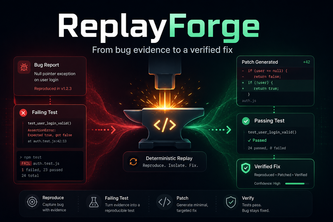
ReplayForge is a developer tool designed to make bug reproduction, fix review, and verification more observable and auditable. The author states it helps developers reproduce bugs, review suggested fixes, and verify that problems are actually solved.
What changed
This project was built as part of the OpenAI 2026 hackathon. It represents an early-stage prototype or proof-of-concept tool focused on local-first development workflows with deterministic testing and human approval gates.
Single most important open question
Does ReplayForge have any evidence of real-world usage, traction, or adoption beyond its hackathon submission?
What The Product Actually Is
The description states that ReplayForge:
- Accepts a concrete bug description and optional evidence
- Pins the source repository to a known commit
- Creates a disposable Git worktree
- Asks Codex for a deterministic Playwright reproduction plan
- Has two explicit human approval boundaries:
- Approval before writing the generated reproduction test
- Approval before applying the proposed application patch
- Preserves failing test output, root-cause analysis, proposed patch, applied diff, approval records, passing verification output, regression results, screenshots, videos, traces, and a hashed artifact manifest
The system is described as a local-first TypeScript monorepo using Next.js, React, Node.js, Playwright, FFmpeg, SQLite with Drizzle ORM, and OpenAI Codex.
Evidence Self-reported by the author. No independent verification or demonstration of functionality beyond the project submission.
Positioning & Claim Evolution
The author claims that ReplayForge was built to make the engineering loop "observable, auditable, and replayable." It is positioned as a tool for improving bug reporting and fixing workflows by ensuring:
- Reproduction can be verified
- Fixes are reviewed before application
- All steps in the process are preserved for auditability
The project evolved from addressing the challenge of turning fragmented bug reports into trustworthy repairs. The author notes that the real difficulty was not generating patches but preventing AI workflows from claiming success without verifiable evidence.
Evidence Self-reported claims about intent and positioning, not proof of traction or adoption.
Target Customer & ICP
The description states that ReplayForge is intended for developers who want to reproduce bugs, review suggested fixes, and verify solutions. It targets users working with frontend repositories and local development environments.
It appears to be aimed at teams or individuals involved in software engineering processes where bug reproduction and fix verification are critical.
Evidence Self-reported customer intent; no evidence of actual customers or usage beyond the hackathon submission.
Business Model & Pricing Evidence
No information is provided about pricing, monetization strategy, or business model. The project description does not mention any revenue streams, subscriptions, licensing, or commercial use cases.
Evidence Not evidenced.
Technical & Delivery Signals
The system is described as:
- A local-first TypeScript monorepo
- Built with Next.js and React for the web interface
- Uses Node.js, Playwright, FFmpeg, SQLite with Drizzle ORM
- Integrates with OpenAI Codex via ChatGPT-managed authentication
- Employs Git worktrees to isolate changes from original branches
- Validates repository paths and preserves raw command output
- Records artifact hashes and disables network access by default
It includes features like:
- Deterministic browser bug reproduction using Playwright
- Two human approval gates bound to exact payload hashes
- Artifact manifest for auditability
- Support for before-and-after screenshots, videos, traces, and diffs
Evidence Self-reported technical architecture and implementation details; no evidence of production deployment or performance data.
Traction & Maturity Signals
There is no evidence of traction, revenue, customer adoption, or market validation beyond the hackathon submission. The project was built as part of a competition and has no stated users or business metrics.
Evidence Not evidenced.
Competitive Context
No mention of competitors or competitive landscape in the description. The author does not reference existing tools for bug reproduction, fix review, or verification workflows.
Evidence Not evidenced.
Open Questions & Risks
- Unproven market demand: No evidence of real-world usage or customer feedback.
- Limited scope: Built as a hackathon project with no indication of scalability or broader functionality.
- Dependency on proprietary APIs: Relies on OpenAI Codex and ChatGPT-managed authentication, which may limit accessibility or introduce dependency risks.
- No commercial viability: No pricing, monetization, or business model described.
- Local-first approach: May not scale well for enterprise or distributed teams without clear integration paths.
Evidence Self-reported claims; no external validation or data to support these concerns.
Questions the description leaves open
- What specific bugs or use cases does ReplayForge currently support?
- How does the tool handle edge cases in repository management or file system boundaries (especially on Windows)?
- Has there been any internal testing or feedback from developers using this tool?
- Are there plans to integrate with CI/CD pipelines or existing issue trackers like GitHub Issues?
- What are the long-term goals for ReplayForge beyond the hackathon prototype?
- How does the approval process work in practice, and what happens if a patch fails verification?
- Is there any plan to support other types of repositories or frameworks beyond frontend ones?
Inference These questions aim to uncover whether the tool has moved beyond concept stage into practical application.
Overall Assessment
There is no evidence of revenue, customers, traction, or commercial viability. The project is described as a hackathon submission with no indication of ongoing development or market validation.
Confidence Level Low — based entirely on self-reported information without external corroboration.
Assessment Summary
ReplayForge appears to be an early-stage prototype built during a hackathon. While it describes a clear problem and proposes a structured solution involving deterministic testing, human approvals, and auditability, there is no evidence of real-world usage or business traction. It lacks any indication of commercialization plans or product-market fit beyond its initial concept.
Next Steps
If pursuing further diligence, seek evidence of actual user feedback, prototype deployment, or early adopter engagement. The tool’s potential value lies in addressing a real pain point for developers, but current evidence suggests it remains unproven in practice.
User Stories BotA demo video on every pull request
Get a demo video on every new feature
GitHub App that watches your pull requests and records a narrated, captioned demo.
Save time on demo prep and make informed decisions faster with a video walkthrough of every new feature.
Source
Submitted to the OpenAI 2026 hackathon on Devpost. Project home on Devpost. Back to the full gallery on Devpost.
This competitive analysis was produced by top-founders.com (opens in a new tab)
Generated by a language model from this project's public Devpost page — its tagline, the author's own write-up and any built-with tags listed there — as captured in August 2026. Short quotations are the author's words. It is an opinion on the idea as a business, not on the people behind it, and it reflects the description as published then. If the project has moved on, request a correction below. The analysis is not independent research and contains no verified traction, revenue or customer data.
An independent guide by KFG International LLC — not affiliated with, endorsed by, or connected to Devpost or OpenAI.