

Archive position — measured, not model output
1 like on Devpost
505 of the 7,850 archived projects have more likes, and 1,758 share exactly 1 — so this project's #1,803 place in the like-ranked listing is a tie-break inside that group, not a ranking.
Projects (log scale)
Likes on Devpost. ▲ marks this project's group.
Show the figures
| Likes | Projects | Share of archive |
|---|---|---|
| 0 | 5,587 | 71.2% |
| 1 | 1,758 | 22.4% |
| 2 | 284 | 3.6% |
| 3–4 | 132 | 1.7% |
| 5–9 | 75 | 1.0% |
| 10+ | 14 | 0.2% |
 User Stories BotA demo video on every pull request
Get a demo video on every new feature
GitHub App that watches your pull requests and records a narrated, captioned demo.
Save time on demo prep and make informed decisions faster with a video walkthrough of every new feature.
Executive Summary
What the company appears to be
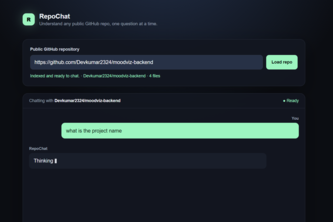
Repo Chat is a developer tool that allows users to chat with public GitHub repositories using natural language. The tool indexes source files from a given repo and uses AI to answer questions based on those files, showing which files were used in each response.
What changed
The project was submitted as part of the OpenAI 2026 hackathon. It is described as a proof-of-concept built with minimal infrastructure (no database, no auth), using shallow cloning and keyword-based retrieval to surface relevant code for chat queries.
Single most important open question
Is there any evidence of user adoption or commercial traction beyond the hackathon submission? The description does not indicate any revenue, customers, or usage metrics beyond its own self-reported development and demonstration.
What The Product Actually Is
The description states that Repo Chat lets developers paste a public GitHub repo URL and then chat with it using natural language. It indexes readable text files from the repo (excluding binaries, images, lockfiles, etc.), builds a context-aware prompt, and streams back answers via OpenAI’s API.
- Evidenced The tool uses shallow cloning, filters out irrelevant files, and retrieves top 5 most relevant files based on keyword matching.
- Inferred It is a single-page app built with Next.js, TypeScript, and React; it shows source attribution for every answer.
- Not evidenced No mention of pricing, monetization, or commercial deployment.
Positioning & Claim Evolution
The author claims Repo Chat helps developers quickly understand unfamiliar codebases by simulating a conversation with an expert teammate. It emphasizes transparency in how answers are generated — showing exactly which files were used to produce each response.
- Evidenced The tool is positioned as a way to “talk” to code, grounded in real source instead of guesswork.
- Inferred The goal is to reduce time spent navigating unfamiliar codebases and increase developer productivity.
- Not evidenced No claims about market positioning, competitive differentiation, or strategic intent beyond the hackathon.
Target Customer & ICP
The description states that Repo Chat targets developers who need to understand new or open-source projects — such as during job transitions, open-source contributions, or candidate assessments.
- Evidenced The target audience includes developers working with unfamiliar codebases.
- Inferred The tool is aimed at developers seeking faster onboarding into projects.
- Not evidenced No data on customer segments, personas, or specific use cases beyond the stated inspiration.
Business Model & Pricing Evidence
There is no evidence in the description of a business model or pricing strategy. The project is described as a hackathon submission with no authentication, database, or monetization layer.
- Not evidenced No mention of revenue streams, pricing tiers, subscriptions, or paid features.
- Inferred If commercialized, it might be offered as a SaaS tool or integrated into developer platforms.
- Not evidenced No indication of how the product would generate value for paying customers.
Technical & Delivery Signals
The project was built using Next.js 15 (App Router), TypeScript, React, and Node.js. It uses simple-git for shallow cloning, in-memory indexing, keyword-based retrieval, and OpenAI’s chat completions API.
- Evidenced The tech stack includes Next.js, React, Node.js, OpenAI API, and simple-git.
- Inferred The system is designed to be lightweight and deployable as a single app.
- Not evidenced No mention of scalability, infrastructure, or production-grade deployment practices.
Traction & Maturity Signals
The project was submitted to the OpenAI 2026 hackathon. It is described as an end-to-end working prototype with no authentication or database.
- Evidenced The tool works end-to-end from URL input to chat output.
- Inferred It has been tested in a hackathon environment and deployed as a single-page app.
- Not evidenced No data on usage, retention, or user feedback beyond the author’s own account.
Competitive Context
The description does not reference any existing tools or competitors. However, it implies a space where developers seek to understand codebases more efficiently — a category that includes tools like GitHub Copilot, Sourcegraph, and various AI-powered code exploration platforms.
- Inferred Repo Chat operates in the broader developer experience or AI-assisted code understanding space.
- Not evidenced No mention of competitors, market size, or competitive advantages.
Open Questions & Risks
- The tool is described as a hackathon prototype with no database, authentication, or persistent sessions.
- It uses shallow cloning and in-memory indexing — not scalable for large repos or production use.
- There is no evidence of commercial viability, monetization, or traction beyond the project’s own submission.
- Inferred Lack of persistence, scalability, and user management raises concerns about long-term utility.
- Not evidenced No indication of how the tool would evolve into a product suitable for enterprise or widespread adoption.
Questions the description leaves open
- What is your plan to scale beyond shallow cloning and in-memory indexing?
- How do you intend to support private repositories or persistent sessions?
- Have you considered embedding-based search or vector databases for better retrieval accuracy?
- Is there any interest from developers or organizations in using this tool beyond the hackathon?
- What are your thoughts on monetization — would you offer it as a SaaS product, API, or integration?
Overall Assessment
The project is described as a hackathon submission with no commercial traction, revenue, or customer data. It demonstrates technical capability but lacks evidence of market demand or scalability.
- Inferred The tool shows promise for developer productivity but requires significant development to become viable.
- Not evidenced No indication of investor interest, partnerships, or product-market fit beyond the author’s own claims.
- Confidence level: Low — based entirely on self-reported information with no external validation.
User Stories BotA demo video on every pull request
Get a demo video on every new feature
GitHub App that watches your pull requests and records a narrated, captioned demo.
Save time on demo prep and make informed decisions faster with a video walkthrough of every new feature.
Source
Submitted to the OpenAI 2026 hackathon on Devpost. Project home on Devpost. Back to the full gallery on Devpost.
This competitive analysis was produced by top-founders.com (opens in a new tab)
Generated by a language model from this project's public Devpost page — its tagline, the author's own write-up and any built-with tags listed there — as captured in August 2026. Short quotations are the author's words. It is an opinion on the idea as a business, not on the people behind it, and it reflects the description as published then. If the project has moved on, request a correction below. The analysis is not independent research and contains no verified traction, revenue or customer data.
An independent guide by KFG International LLC — not affiliated with, endorsed by, or connected to Devpost or OpenAI.