

Archive position — measured, not model output
0 likes on Devpost
2,263 of the 7,850 archived projects have more likes, and 5,587 share exactly 0 — so this project's #5,729 place in the like-ranked listing is a tie-break inside that group, not a ranking.
Projects (log scale)
Likes on Devpost. ▲ marks this project's group.
Show the figures
| Likes | Projects | Share of archive |
|---|---|---|
| 0 | 5,587 | 71.2% |
| 1 | 1,758 | 22.4% |
| 2 | 284 | 3.6% |
| 3–4 | 132 | 1.7% |
| 5–9 | 75 | 1.0% |
| 10+ | 14 | 0.2% |
 User Stories BotA demo video on every pull request
Get a demo video on every new feature
GitHub App that watches your pull requests and records a narrated, captioned demo.
Save time on demo prep and make informed decisions faster with a video walkthrough of every new feature.
Executive Summary
What the company appears to be
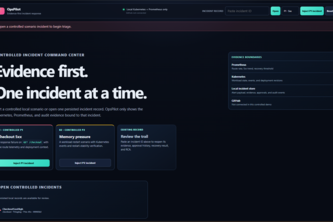
OpsPilot is a self-reported conversational AI copilot for on-call and SRE teams, designed to automate incident response in Kubernetes environments. It integrates logs, metrics, and deployment history to find root cause, propose fixes, and draft postmortems — all while maintaining human approval gates and audit trails.
What changed
The project is a proof-of-concept demonstration built during an OpenAI hackathon. It shows an end-to-end workflow in a controlled Kubernetes test environment, using GPT-5.6 as the reasoning engine and Codex for development assistance.
Single most important open question
Is there evidence of real-world adoption or traction beyond this demo? The description states no revenue, customers, or usage data exist outside of the controlled test environment.
What The Product Actually Is
The description states that OpsPilot is a conversational incident-response copilot for SREs and on-call engineers. It operates within a Kubernetes cluster and connects to tools like Prometheus, logs, deployment history, and alerts. The system investigates incidents by gathering evidence from these sources, presenting root-cause conclusions with cited evidence, and offering human-approved remediation actions.
It includes:
- Automated investigation triggered by alerts
- Evidence-based root cause analysis using GPT-5.6
- Dry-run previews of proposed changes
- Human approval required for any action
- Audit trail recording all steps
- Postmortem drafting from the audit trail
The system is demonstrated in a local Kubernetes test environment (kind cluster) and uses:
- FastAPI backend
- React/TypeScript frontend
- Prometheus metrics
- SQLite for storage
- OpenAI Responses API with GPT-5.6
Inference The product is not yet deployed in production, but rather a prototype built as part of a hackathon project.
Positioning & Claim Evolution
The author positions OpsPilot as an AI-powered assistant that reduces time spent on incident response by consolidating scattered data into actionable insights. It claims to:
- Reduce alert fatigue
- Improve consistency in triage
- Make root cause analysis more accessible through conversational interface
- Ensure safety via human approval and audit trails
The description also notes that the system avoids inventing data or making assumptions — it only answers based on what is present in the environment.
Inference The positioning reflects a desire to solve a common SRE pain point (tool switching, manual investigation) with AI. However, the claim of solving these issues is limited to the demo context and lacks external validation.
Target Customer & ICP
The description states that OpsPilot targets:
- On-call engineers
- SREs
- DevOps architects
It aims to reduce time spent switching between tools during production incidents.
Inference The target customer segment appears to be enterprise-level teams managing Kubernetes infrastructure, but there is no evidence of actual customers or market fit beyond the author’s personal experience.
Business Model & Pricing Evidence
There is no mention of pricing, monetization strategy, or business model in the description. The project is presented as a hackathon submission with no indication of commercial intent or revenue generation.
Not evidenced
Technical & Delivery Signals
The system uses:
- GPT-5.6 via OpenAI Responses API
- Kubernetes (kind) for simulation
- Prometheus for metrics
- React/TypeScript frontend
- FastAPI backend
- SQLite for audit logging
- Codex for development assistance
It includes:
- Evidence gathering from logs, metrics, events
- Structured reasoning with cited evidence
- Dry-run previews of changes
- Allowlisted remediation actions
- Independent verification of recovery
- Audit trail and postmortem generation
Inference The architecture is modular and designed around safety and traceability. However, the system has not been tested in a live production environment.
Traction & Maturity Signals
The project is described as a hackathon submission (OpenAI 2026). It includes:
- A working end-to-end demo
- 59 passing tests
- A claim-verification ledger
- Integration-ready with Alertmanager, PagerDuty, Datadog
There is no evidence of:
- Revenue
- Customers
- Product-market fit
- Live usage
- Production deployment
Not evidenced
Competitive Context
The description does not name competitors or reference existing solutions in the SRE/DevOps incident response space. It implies that current tools require engineers to manually switch between platforms and lack AI-driven automation.
Inference The competitive landscape likely includes traditional monitoring and alerting tools (e.g., Prometheus, Grafana, PagerDuty), but no direct comparison or differentiation is made in the description.
Open Questions & Risks
- Demo-only scope: The system works only in a controlled Kubernetes test environment.
- No real-world usage: No evidence of adoption or feedback from actual users.
- Limited tooling: Relies heavily on GPT-5.6 and Codex, which may not scale or be production-ready.
- Unproven trustworthiness: While safety mechanisms are described, their effectiveness in practice is unverified.
- No commercialization plan: No mention of monetization, pricing, or go-to-market strategy.
Questions the description leaves open
- What specific problems in your own SRE workflow did you observe that led to building this?
- How would the system behave if it encountered missing data or incomplete logs?
- Can you walk us through a scenario where the AI incorrectly identified root cause or proposed an unsafe fix?
- Have you tested this with any real-world teams or in actual production environments?
- What are your plans for integrating with existing alerting and incident management systems beyond Alertmanager?
- How do you plan to scale this beyond a single cluster or demo environment?
Overall Assessment
The description presents OpsPilot as an early-stage prototype built during a hackathon, demonstrating technical feasibility in a controlled environment. It shows strong alignment with current SRE pain points and a clear understanding of safety requirements.
However, there is no evidence of traction, revenue, or real-world adoption. The project remains unproven in production settings and lacks commercialization strategy or market validation.
Confidence: Low
This is a self-reported, unverified account of a demo-level product with no external corroboration. It does not yet demonstrate viability for investment or partnership.
User Stories BotA demo video on every pull request
Get a demo video on every new feature
GitHub App that watches your pull requests and records a narrated, captioned demo.
Save time on demo prep and make informed decisions faster with a video walkthrough of every new feature.
Source
Submitted to the OpenAI 2026 hackathon on Devpost. Project home on Devpost. Back to the full gallery on Devpost.
This competitive analysis was produced by top-founders.com (opens in a new tab)
Generated by a language model from this project's public Devpost page — its tagline, the author's own write-up and any built-with tags listed there — as captured in August 2026. Short quotations are the author's words. It is an opinion on the idea as a business, not on the people behind it, and it reflects the description as published then. If the project has moved on, request a correction below. The analysis is not independent research and contains no verified traction, revenue or customer data.
An independent guide by KFG International LLC — not affiliated with, endorsed by, or connected to Devpost or OpenAI.